

The Limitations of Gravity Disc Separators
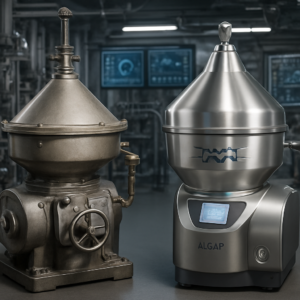 For decades, gravity disc separators were the workhorse of fuel purification—reliable, if not exactly elegant. Their design is rooted in a simple principle: centrifugal force flings heavier contaminants outward while lighter, purified fuel stays closer to the center. The gravity disc, a seemingly unremarkable metal ring, sits at the heart of this process, acting as a barrier to control the interface—the critical boundary where fuel and water meet inside the separator bowl. But here’s the catch: that disc isn’t one-size-fits-all. Its diameter must be precisely matched to the density and viscosity of the fuel being processed. Too large, and water slips through with the fuel; too small, and fuel gets lost with the waste. This isn’t just a minor inconvenience—it’s a fundamental limitation that turns fuel purification into a high-stakes guessing game.
Why the Right Disc Matters—and Why It’s Never Simple
The science behind gravity disc selection is straightforward in theory. The disc’s diameter determines the position of the interface, which in turn dictates how effectively the separator can split fuel from water and solids. The problem? Fuel isn’t a static substance. Its density fluctuates based on refining processes, blending practices, and even regional supply variations. A batch of heavy fuel oil (HFO) from Singapore might have a density of 991 kg/m³, while the same grade from Rotterdam could clock in at 1010 kg/m³. For a gravity disc separator, that difference isn’t trivial—it means the disc that worked perfectly yesterday might be completely wrong today.
Operators rely on nomograms—complex charts that plot fuel density against disc size—to make their selection. But these charts are only as good as the data fed into them. If the fuel’s actual density deviates even slightly from the assumed value (and it often does), the separator’s efficiency plummets. In practice, this means:
- Manual recalibration is non-negotiable. Every time the fuel density changes, the separator must be stopped, cooled, disassembled, and fitted with a new disc. In a marine setting, where fuel switches between HFO and distillates are common, this can happen multiple times per voyage.
- Human error is a constant risk. Selecting the wrong disc isn’t just a matter of reduced efficiency—it can lead to water carryover (where water contaminates the purified fuel) or fuel loss (where usable fuel is discarded with the sludge). Both scenarios are costly, but the latter is particularly insidious: in large engines, even a 1% loss of fuel can translate to thousands of dollars in wasted bunker over a single trip.
- The system is blind to real-time changes. Gravity disc separators have no way of detecting shifts in fuel quality mid-operation. If a fuel batch contains unexpected contaminants—like cat fines (aluminosilicate particles from catalytic cracking) or excessive water—the separator will keep running, oblivious, until the damage becomes visible in the engine.
More information on Life at Sea: The Harsh Reality of Food on Ships
Operational Nightmares: When the System Fights Back
The limitations of gravity disc separators aren’t just theoretical—they play out in real-world scenarios with frustrating regularity. Take, for example, a Panamax container ship running on a mix of HFO and low-sulfur marine gas oil (MGO). The switch from HFO to MGO isn’t just a matter of flipping a valve; it requires a full separator shutdown. The crew must:
- Stop the separator and let it cool (a process that can take 30–60 minutes).
- Drain the bowl, disassemble it, and swap the gravity disc for one sized for MGO’s lower density.
- Reassemble the unit, restart it, and wait for it to reach operational speed—another 20–30 minutes of lost time.
In an industry where downtime is measured in tens of thousands of dollars per hour, these interruptions add up fast. But the problems don’t end there. Even when the right disc is installed, the separator’s performance is fragile. A sudden spike in fuel viscosity—caused by temperature fluctuations or poor blending—can disrupt the interface, leading to:
- Incomplete water removal: Water in fuel doesn’t just reduce efficiency; it promotes microbial growth (which clogs filters) and accelerates corrosion in fuel pumps and injectors. In one documented case, a bulk carrier experienced repeated injector failures due to water carryover, costing over $200,000 in repairs and lost charter time.
- Poor cat fine separation: Cat fines are the silent killers of marine engines. These microscopic, abrasive particles embed themselves in cylinder liners and piston rings, causing scuffing, scoring, and catastrophic wear. Gravity disc separators are notoriously bad at removing them—studies show they capture only 30–50% of cat fines in fuel, compared to 80–90% for modern automated systems. The result? Engines that should last 20 years are scrapped after 10.
- Sludge buildup and clogging: Without precise interface control, sludge (a mix of water, fuel residues, and solids) accumulates unevenly in the separator bowl. Over time, this leads to reduced throughput, increased backpressure, and eventual system failure. In industrial power plants, where separators run 24/7, this can mean unplanned outages—a disaster for facilities that rely on continuous operation.
The Hidden Costs: More Than Just Downtime
The financial impact of gravity disc separators extends far beyond the time spent swapping discs. Consider the following:
- Maintenance overload: The constant disassembly and reassembly of separators take a toll on components. Gaskets wear out, bolts loosen, and bowls develop fatigue cracks. In a survey of 50 commercial vessels, operators reported spending an average of 8–12 hours per month on separator maintenance—time that could be spent on other critical tasks.
- Fuel waste: As mentioned earlier, even a 1% loss of fuel adds up. For a VLCC (Very Large Crude Carrier) consuming 80 tons of fuel per day, that’s 292 tons per year—worth roughly $150,000 at current HFO prices. Multiply that by a fleet of 20 ships, and the numbers become staggering.
- Engine damage: The ultimate cost of gravity disc limitations is the wear and tear on the engine itself. Water and cat fines don’t just reduce efficiency—they destroy components. A single episode of severe cat fine damage can require piston ring replacement, liner honing, or even a full engine overhaul. For a medium-speed marine engine, that’s a $500,000–$1 million repair bill.
- Regulatory risks: With IMO 2020 and other emissions regulations tightening, fuel quality is under more scrutiny than ever. Gravity disc separators, with their inconsistent performance, struggle to meet the ISO 8217 standards for purified fuel. Non-compliance can lead to fines, detentions, or even blacklisting by port authorities.
Perhaps the most frustrating part? These limitations aren’t just inconveniences—they’re built into the system. Gravity disc separators were designed for an era when fuel was simpler, engines were less sensitive, and downtime was an accepted part of operations. Today, with ultra-low-sulfur fuels, biofuel blends, and variable-quality bunkers flooding the market, that era is long gone. The question isn’t whether gravity disc separators can keep up—it’s how much longer industries can afford to rely on them.