
Extraction and Initial Separation
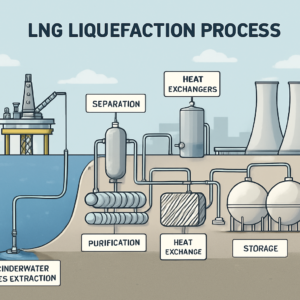 The journey of liquefied natural gas (LNG) begins long before it reaches the cryogenic temperatures that turn it into a liquid. It starts deep beneath the Earth’s surface—or even deeper, under the crushing weight of the ocean—where vast reservoirs of natural gas lie trapped in porous rock formations. Extracting this gas is a feat of engineering that balances brute force with precision, raw power with delicate control. And the first critical step? Getting it out of the ground—or the seabed—without letting the chaos of the underground world sabotage the entire operation.
The Drill: Breaking Into the Reservoir
Whether onshore or offshore, the extraction process begins with a well—a narrow, meticulously engineered tunnel that acts as a lifeline between the surface and the gas reservoir. On land, drilling rigs tower over the landscape, their rotary tables spinning drill bits deep into the Earth, chewing through layers of rock with relentless force. Offshore, the stakes are even higher. Here, rigs stand on massive platforms or float on the open sea, tethered to the ocean floor by risers that must withstand storms, currents, and the immense pressure of the deep.
Offshore drilling is a high-wire act. The deeper the water, the more extreme the conditions. In ultra-deepwater fields, like those in the Gulf of Mexico or off the coast of West Africa, wells can plunge more than 10,000 feet below the seabed, where pressures exceed 15,000 psi—enough to crush most materials like paper. To prevent blowouts—catastrophic releases of gas and oil—drillers use blowout preventers (BOPs), massive stacks of valves and rams that can seal off a well in seconds. These systems are the last line of defense against disasters like the Deepwater Horizon spill, and their reliability is non-negotiable.
Once the well is drilled, it’s lined with steel casing and cemented in place to prevent collapse and isolate the gas from surrounding formations. Then, the real work begins: coaxing the gas to the surface. Unlike oil, which can sometimes flow under its own pressure, natural gas often needs a helping hand. In some cases, artificial lift systems, like gas lift or electric submersible pumps, are used to reduce the density of the fluid column and encourage flow. In others, the reservoir’s natural pressure is enough—but even then, the gas doesn’t come up alone.
More information on Life at Sea: The Harsh Reality of Food on Ships
The First Filter: Separating the Chaos
When natural gas first emerges from a well, it’s far from the clean, pipeline-ready product the industry needs. Instead, it’s a messy cocktail of hydrocarbons, water, sand, and other impurities—all rushing to the surface at high pressure and temperature. This raw, unprocessed stream is called wellstream, and if it were sent straight to processing facilities, it would wreak havoc on equipment, clogging pipelines, corroding metal, and gumming up the works.
That’s where initial separation units come in. These are the first line of defense in the LNG production chain, designed to strip away the most problematic components before the gas moves further downstream. The process typically happens in stages, often right at the wellhead or on a nearby platform, and it’s all about physics: density, pressure, and temperature.
- Three-Phase Separators: The workhorse of initial separation, these large, cylindrical vessels use gravity to split the wellstream into its three main components:
- Gas: The lightest fraction, which rises to the top and is drawn off for further processing.
- Oil/Condensate: Heavier hydrocarbons that liquefy under pressure and collect in the middle layer. These are often valuable in their own right and are sent to storage or refining.
- Water and Solids: The heaviest components, which sink to the bottom. This includes produced water (a byproduct of extraction), sand, and other particulates.
- Heater-Treaters: In some cases, especially in colder climates or with waxy crude, the wellstream is heated to break emulsions—stable mixtures of oil and water that resist separation. By raising the temperature, these units help the water and oil separate more cleanly.
- Scrubbers and Filters: Even after the three-phase separation, the gas may still carry fine droplets of liquid or solid particles. Scrubbers use mist eliminators or cyclonic action to knock out these remaining impurities, while filters trap sand and other abrasive materials that could damage downstream equipment.
The goal here isn’t perfection—it’s damage control. Removing the bulk of the water, sand, and heavier hydrocarbons early prevents a cascade of problems later. For example, water can form hydrates—ice-like solids that clog pipelines—when the gas is cooled. Sand and other particulates act like sandpaper, eroding valves and compressors. And heavier hydrocarbons, if left in the gas, can condense in pipelines or processing equipment, leading to blockages and inefficiencies.
The Offshore Challenge: Pressure, Corrosion, and the Sea’s Wrath
While the principles of initial separation are the same onshore and offshore, the latter presents a unique set of challenges. The ocean doesn’t forgive mistakes. Equipment must be designed to withstand not just the pressure of the deep, but also the relentless corrosion of saltwater, the motion of waves, and the sheer remoteness of the operation.
- Pressure Management: Offshore reservoirs are often under immense pressure, and managing that pressure is critical. If the pressure drops too quickly, it can cause the well to collapse or allow water to invade the reservoir. If it’s too high, it risks damaging equipment or causing a blowout. Chokes—adjustable valves at the wellhead—are used to control the flow rate and maintain stable pressure as the gas moves to the surface.
- Corrosion and Material Selection: Saltwater is a brutal adversary. Offshore platforms and pipelines are constantly battling corrosion, which can weaken structures and lead to leaks. Materials like corrosion-resistant alloys (CRAs) and coatings are used to protect critical components, while cathodic protection systems—essentially, sacrificial metal anodes—help divert corrosion away from vital equipment.
- Motion and Stability: Floating production systems, like FPSOs (Floating Production, Storage, and Offloading vessels), are subject to the whims of the ocean. Waves, wind, and currents can cause the vessel to pitch and roll, which complicates separation. To counter this, separators are often equipped with motion-compensating internals, like baffles or weirs, that help maintain efficient separation even when the platform is moving.
- Environmental Safeguards: Offshore operations are under intense scrutiny for their environmental impact. Spills, leaks, or even routine discharges of produced water must be minimized. Modern platforms use closed-loop systems to handle produced water, treating and reinjecting it into the reservoir rather than dumping it into the sea. Meanwhile, subsea separation systems—where separation happens on the seabed rather than on a platform—are gaining traction as a way to reduce the footprint of offshore operations.
One of the most critical decisions in offshore extraction is whether to process the gas at the wellhead or transport it to shore first. Subsea processing, where separation and even compression happen on the ocean floor, is an emerging trend that promises to reduce costs and environmental risks. But it’s not without its challenges. Subsea equipment must operate for years without maintenance, in conditions where even a minor failure can mean a costly and dangerous intervention.
The Condensate Conundrum
Among the impurities removed during initial separation, condensates—a mix of heavier hydrocarbons like pentane, hexane, and heptane—deserve special attention. These liquids form when the gas cools slightly as it rises from the reservoir, and they’re often more valuable than the gas itself. But if they’re not removed early, they can cause serious problems.
Condensates are notorious for dropping out in pipelines. As the gas travels, changes in temperature and pressure can cause these heavier hydrocarbons to liquefy, pooling in low points and restricting flow. This phenomenon, known as condensate banking, can reduce pipeline capacity by up to 50% and require expensive pigging (cleaning) operations to remove the buildup. By stripping condensates out early, operators ensure smoother, more efficient transport of the gas to processing facilities.
But condensates aren’t just a nuisance—they’re also a commodity. Often referred to as natural gasoline, they’re used as feedstocks for petrochemical plants or blended into fuels. In some cases, the value of the condensates can make or break the economics of a gas field. This dual nature—both a problem and a product—makes their separation one of the most critical steps in the entire LNG chain.
The Unseen Battle: Keeping the Gas Flowing
Initial separation might seem like a straightforward process: let gravity do its work, skim off the layers, and move on. But in reality, it’s a constant battle against the unpredictable nature of the reservoir. Wells don’t produce at a steady rate. Pressures fluctuate. Temperatures change. And the composition of the wellstream can vary dramatically over time, with some fields producing more water or condensate as they age.
To keep up, operators rely on a mix of real-time monitoring and adaptive technology. Multiphase flow meters measure the composition of the wellstream as it leaves the well, allowing engineers to adjust separation parameters on the fly. Automated control systems tweak the settings of separators, chokes, and valves to optimize performance. And in some cases, machine learning algorithms are being deployed to predict changes in well behavior before they happen, giving operators a head start on adjusting their processes.
This is the reality of extraction: it’s not just about brute force, but also about finesse. The gas doesn’t give itself up easily. It fights back with pressure, corrosion, and chaos. And the first step in taming it—separating the useful from the destructive—sets the stage for everything that comes next. Because if you get this part wrong, the rest of the LNG process is already doomed before it begins.