

The Birth of Cryogenic Shipping: A Historical Perspective
 It all began in a cluttered laboratory in London, where a man with wild hair and a relentless curiosity tinkered with glass tubes and open flames. In 1823, Michael Faraday, then just 31 years old, was already making waves in the scientific community with his work on electromagnetism. But it was his experiments with chlorine that would accidentally plant the first seed for an industry that would one day move entire economies across oceans. Faraday managed to liquefy chlorine by cooling it under pressure—a seemingly small feat, but one that cracked open a door no one had even realized was there. If chlorine could be turned into a liquid, why not other gases? The question lingered, but the world wasn’t ready to answer it. Not yet.
For decades, the idea of liquefying gases remained a scientific curiosity, a parlor trick for chemists. That changed in the late 19th century, when a German engineer named Carl von Linde turned theory into industry. Linde wasn’t just a scientist; he was a problem-solver with a sharp eye for practicality. In 1895, he patented the first industrial-scale gas liquefaction process, using a method called Joule-Thomson expansion to cool air until it turned into a liquid. His breakthrough wasn’t just about temperature—it was about control. For the first time, humans could reliably produce and store liquefied gases, not in tiny lab flasks, but in quantities that mattered. Linde’s work laid the groundwork for everything from medical oxygen to, eventually, the global trade in liquefied natural gas (LNG).
More information on Life at Sea: Internet & Food Realities on LPG Ships
But between Faraday’s glass tubes and Linde’s industrial plants, there was a missing piece: how to move these cryogenic liquids across vast distances. The challenge wasn’t just keeping the gas cold—it was doing so on a ship, where waves, saltwater, and the sheer scale of the operation turned every variable into a potential disaster. The first real test came in the 1950s, when a group of engineers and dreamers looked at a retired World War II cargo ship and asked: What if?
The Methane Pioneer: A Gamble on the Atlantic
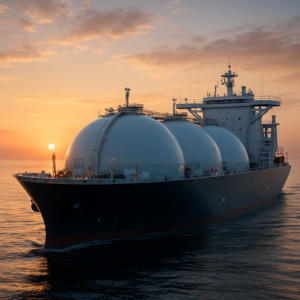
In 1959, the Methane Pioneer—a converted Liberty ship originally built to haul supplies across the Atlantic during the war—set sail from Louisiana to the UK with a revolutionary cargo: 5,000 cubic meters of liquefied natural gas. The ship was a Frankenstein’s monster of innovation and improvisation. Its tanks, lined with balsa wood and aluminum, were held together by a mix of hope and hastily calculated engineering. No one knew if the insulation would hold. No one knew if the ship would survive the journey. And no one knew if, upon arrival, the gas would still be a liquid—or if the whole experiment would end in a catastrophic, icy explosion.
The voyage was anything but smooth. The Atlantic, as always, had other plans. Storms battered the Methane Pioneer, testing the limits of its makeshift cryogenic system. Below deck, engineers monitored pressure gauges and temperature sensors with the intensity of bomb squad technicians. Every creak of the hull, every shudder of the tanks, sent a jolt of tension through the crew. One miscalculation, one weak weld, and the ship could have become a floating time bomb. But against the odds, the Methane Pioneer made it. When it docked in Canvey Island, England, in February 1959, it didn’t just deliver a shipment of LNG—it delivered proof. Proof that cryogenic shipping wasn’t just possible; it was viable.
The Human Factor: Ingenuity in the Face of the Unknown
The success of the Methane Pioneer wasn’t just a triumph of technology—it was a testament to human perseverance. The engineers who worked on that first voyage were flying blind in many ways. There were no manuals for building a cryogenic tanker. No safety protocols for handling -162°C liquids at sea. No playbook for what to do when a storm threatened to turn your carefully insulated tanks into a deathtrap. Instead, they relied on a mix of gut instinct, trial and error, and sheer stubbornness.
Take, for example, the problem of thermal contraction. When metal gets that cold, it shrinks—dramatically. The engineers on the Methane Pioneer had to design tanks that could flex without cracking, pipes that could bend without breaking. They experimented with materials, testing everything from rubber to exotic alloys, before settling on a combination of aluminum and balsa wood. The balsa wasn’t just for insulation; it acted as a buffer, absorbing the stress of the metal’s contraction and expansion. It was a hack, but it worked.
Then there was the issue of boil-off gas. Even with the best insulation, some of the LNG would inevitably warm up and turn back into a gas. Left unchecked, this could build up pressure and rupture the tanks. The solution? Vent it overboard. But that meant losing valuable cargo—and, in the early days, no one was entirely sure what would happen when a cloud of methane gas hit the open air. Would it ignite? Would it suffocate the crew? The first few voyages were a tense game of “what if,” with engineers holding their breath every time a valve hissed open.
From Experiment to Industry
The Methane Pioneer’s voyage was just the beginning. In the years that followed, the industry scrambled to turn that one successful experiment into a repeatable process. Shipbuilders in the U.S., UK, and Japan raced to design the first purpose-built LNG carriers, moving away from retrofitted war relics to vessels engineered from the keel up for cryogenic cargo. The challenges were immense:
- Material science: Finding metals and insulators that could withstand -162°C without becoming brittle or losing their structural integrity.
- Safety: Developing protocols for loading, unloading, and venting gas in a way that wouldn’t turn a tanker into a floating bomb.
- Economics: Proving that LNG shipping could be profitable enough to justify the astronomical costs of building and operating these specialized vessels.
By the 1960s, the pieces started falling into place. The first commercial LNG trade route was established between Algeria and the UK, followed by projects in Alaska and Indonesia. Each new voyage chipped away at the unknowns, turning cryogenic shipping from a high-stakes gamble into a cornerstone of the global energy trade. The engineers who had once held their breath over pressure gauges now had data, experience, and—most importantly—confidence.
Looking back, it’s easy to see the Methane Pioneer as a quaint relic, a footnote in the history of energy. But in 1959, it wasn’t just a ship. It was a leap of faith. A bet that humans could tame the cold, defy the elements, and turn a scientific curiosity into a revolution. And for all the high-tech tankers that followed, for all the billions of dollars invested in the industry today, that first voyage remains the moment when someone looked at the impossible and said: Let’s try.