

The Shale Revolution: The Foundation of America’s LNG Boom
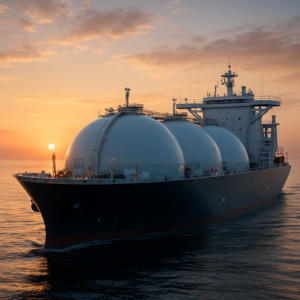 It wasn’t an overnight transformation. The story of how the United States went from a nation dependent on foreign energy to the world’s top exporter of liquefied natural gas (LNG) begins deep underground, in rock formations that geologists had long dismissed as unproductive. The shale revolution didn’t just change the game—it rewrote the rules entirely. And at the heart of that revolution were two technologies that turned skepticism into staggering abundance: hydraulic fracturing (fracking) and horizontal drilling.
For decades, natural gas production in the U.S. followed a predictable, if uninspiring, trajectory. Conventional wells tapped into porous rock formations where gas flowed freely, but these reserves were finite. By the early 2000s, domestic production was stagnating, and the country was preparing to build more import terminals to meet growing demand. Then, almost without warning, the script flipped. Engineers and wildcatters—many working in obscurity—began experimenting with techniques to extract gas from shale, a dense, impermeable rock that had previously been considered too difficult to exploit. What they unlocked would reshape global energy markets.
More information on Life at Sea: The Harsh Reality of Food on Ships
The Breakthrough: Fracking and Horizontal Drilling
Shale gas wasn’t a new discovery. Geologists had known about these vast reserves for over a century, but the rock’s low permeability made extraction economically unviable. That changed with the convergence of two critical innovations:
- Hydraulic fracturing: A process that involves injecting a high-pressure mixture of water, sand, and chemicals into shale formations to create fractures, allowing trapped gas to escape. While fracking had been used in vertical wells since the 1940s, its application in horizontal drilling was the real game-changer.
- Horizontal drilling: Instead of drilling straight down, operators began steering wells laterally through shale layers, exposing far more of the rock to the fracking process. A single horizontal well could now access the same amount of gas that once required multiple vertical wells.
Together, these technologies turned shale into a viable resource. The first major commercial success came in the Barnett Shale in Texas in the late 1990s, where companies like Mitchell Energy (later acquired by Devon Energy) proved that shale gas could be produced profitably. But the real explosion was yet to come.
The Marcellus and Permian: America’s New Energy Powerhouses
If the Barnett Shale was the proving ground, the Marcellus Shale in the Appalachian Basin became the crown jewel of the shale revolution. Stretching across Pennsylvania, West Virginia, Ohio, and New York, the Marcellus held an estimated 141 trillion cubic feet of recoverable gas—enough to supply the entire U.S. for nearly six years at 2020 consumption rates. By the mid-2010s, it had become the largest natural gas-producing region in the country, with output surging from just 2 billion cubic feet per day (Bcf/d) in 2010 to over 30 Bcf/d by 2020.
Meanwhile, halfway across the country, the Permian Basin in Texas and New Mexico was undergoing its own transformation. Traditionally known as an oil powerhouse, the Permian’s stacked layers of shale and tight rock formations also held massive quantities of associated gas—natural gas produced alongside oil. As fracking techniques improved, operators began targeting these gas-rich zones, turning the Permian into a dual-threat producer of both oil and gas. By 2023, the basin was supplying nearly 20 Bcf/d of natural gas, making it the second-largest gas-producing region in the U.S.
The impact of these two basins cannot be overstated. Together, the Marcellus and Permian accounted for nearly half of all U.S. natural gas production by the late 2010s. Their rise didn’t just boost output—it flipped the script on America’s energy trade balance. In 2005, the U.S. was importing nearly 16% of its natural gas, much of it from Canada. By 2017, thanks to shale, the country had become a net exporter for the first time in nearly six decades. The era of energy scarcity was over; the age of abundance had begun.
Key Milestones: From Skepticism to Surplus
The shale revolution didn’t happen in a straight line. It was a series of breakthroughs, setbacks, and hard-won lessons that gradually built momentum. Some of the most pivotal moments include:
- 1998: The Barnett Shale breakthrough – Mitchell Energy’s successful fracking of the Barnett Shale in Texas proved that shale gas could be produced at scale, though many in the industry remained skeptical.
- 2003: The rise of horizontal drilling – Devon Energy’s acquisition of Mitchell Energy and its subsequent shift to horizontal drilling in the Barnett marked the tipping point. Production soared, and other companies took notice.
- 2008: The Marcellus awakens – Range Resources drilled the first economically viable Marcellus well in Pennsylvania, setting off a land rush. Within a decade, the region would become the largest gas-producing basin in the U.S.
- 2011: The U.S. becomes a net gas exporter (temporarily) – For the first time since 1957, the U.S. exported more natural gas than it imported, thanks to rising shale production and declining demand during a mild winter. Though the country would briefly return to net importer status, the writing was on the wall.
- 2016: The first LNG export from the Lower 48 – Cheniere Energy’s Sabine Pass terminal in Louisiana shipped its first cargo of LNG, marking the official start of the U.S. as a major player in the global gas market. Within four years, the U.S. would become the world’s third-largest LNG exporter.
- 2019: The Permian’s gas surge – As oil production in the Permian Basin skyrocketed, so did associated gas output. Pipeline constraints initially led to flaring and price crashes, but infrastructure investments soon turned the region into a gas export hub.
Each of these milestones reinforced a simple but revolutionary idea: the U.S. was no longer constrained by its natural resources. Technology had unlocked reserves that were once thought unreachable, and the country was now producing more gas than it could consume.
The Road to Energy Independence—and Beyond
The shale revolution didn’t just reduce America’s reliance on foreign gas—it eliminated it. In 2005, the U.S. imported 4.3 trillion cubic feet of natural gas, primarily from Canada. By 2020, net imports had fallen to zero, and the country was exporting nearly 11 Bcf/d of LNG. The shift wasn’t just about volume; it was about control. For the first time in generations, the U.S. had the flexibility to shape its own energy destiny.
But the real legacy of the shale revolution lies in what it made possible: the LNG export industry. Before shale, the idea of the U.S. as a major LNG exporter was almost laughable. The country was building import terminals, not export facilities. Yet by 2020, the U.S. had become the world’s third-largest LNG exporter, behind only Qatar and Australia, with capacity expected to double by 2025. The surplus created by shale production didn’t just meet domestic demand—it created a new global commodity.
This transformation wasn’t just about energy; it was about geopolitics. Countries like Japan, South Korea, and China, which had long relied on Middle Eastern and Australian LNG, suddenly had a new supplier—one with vast reserves, flexible contracts, and a reputation for reliability. Europe, too, turned to U.S. LNG as a way to diversify away from Russian pipeline gas. The shale revolution didn’t just change America’s energy landscape; it redrew the map of global energy trade.
And it all started with a handful of engineers, a lot of trial and error, and the stubborn belief that the impossible was just a matter of time.