

The Evolution of LNG Carrier Designs
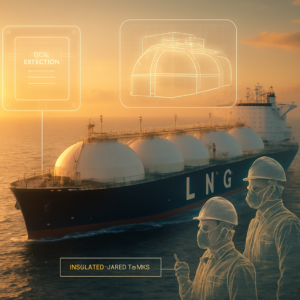 Few vessels in maritime history have demanded as much ingenuity—or faced as many existential challenges—as the LNG carrier. The story of these ships isn’t just one of steel and engineering; it’s a tale of human persistence, of engineers staring down temperatures colder than the vacuum of space, of shipbuilders wrestling with materials that had never before been pushed to such extremes. To understand how we arrived at today’s floating fortresses of cryogenic technology, we have to go back to an era when the very idea of transporting liquefied natural gas across oceans was considered borderline reckless.
The Birth of an Industry: The 1950s and the *Methane Pioneer*
It all began in 1959 with a converted World War II cargo ship named the *Methane Pioneer*. This was no purpose-built marvel—it was a 5,000-cubic-meter experiment, a proof of concept cobbled together by a consortium of American and British engineers who were essentially flying blind. The ship’s five aluminum tanks, insulated with balsa wood and plywood, were a far cry from today’s precision-engineered systems. Yet, when the *Methane Pioneer* set sail from Louisiana to the UK with its first cargo of LNG, it didn’t just cross the Atlantic—it crossed a threshold. For the first time, the world saw that liquefied gas could be transported safely over long distances.
More information on Life at Sea: Internet & Food Realities on LPG Ships
But the *Methane Pioneer* was far from perfect. The balsa wood insulation, while innovative for its time, was prone to moisture absorption, which compromised its effectiveness. The tanks themselves were rigidly fixed to the ship’s hull, meaning any flexing of the vessel under rough seas could stress the containment system. Worse, the ship had no secondary barrier—if a tank failed, the LNG would flood directly into the hull, risking catastrophic brittle fracture of the steel. These weren’t just technical hurdles; they were existential risks that could have sunk the entire LNG shipping industry before it even began.
The 1960s: The First Generation of Purpose-Built Ships
By the mid-1960s, the industry had moved beyond retrofitted war relics. The first purpose-built LNG carriers, like the *Methane Princess* and *Methane Progress*, entered service, boasting capacities of around 27,000 cubic meters. These ships introduced self-supporting prismatic tanks, a design where the containment system was structurally independent of the hull. This was a critical evolution—it meant the tanks could expand and contract with temperature changes without transferring stress to the ship’s structure.
Yet, the challenges were still immense. The biggest? Material selection. At -162°C, most metals become brittle, and even minor imperfections in welding could lead to catastrophic failures. Engineers turned to 9% nickel steel, a material that retained its toughness at cryogenic temperatures, but it was expensive and difficult to work with. Aluminum alloys were another option, but they had their own drawbacks—corrosion in saltwater environments and lower strength compared to steel.
Then there was the issue of boil-off gas. Even with insulation, some LNG would inevitably evaporate during transit. Early ships simply vented this gas into the atmosphere—a wasteful and environmentally questionable practice. It wasn’t until the late 1960s that engineers developed boil-off gas management systems, using the vapor as fuel for the ship’s engines. This wasn’t just a cost-saving measure; it was a necessity. Without it, the economics of LNG shipping would have collapsed under the weight of lost cargo.
The 1970s: The Moss Revolution
If the 1960s were about proving LNG shipping could work, the 1970s were about making it better. Enter the Moss system, named after the Norwegian company that developed it. This was a radical departure from earlier designs. Instead of prismatic tanks, Moss carriers featured massive spherical tanks that rose above the deck like the domes of futuristic cathedrals. Each sphere was a marvel of engineering: made from aluminum alloy, supported by a high-strength steel skirt, and wrapped in layers of polyurethane foam insulation.
The genius of the Moss system lay in its structural independence. The spheres weren’t part of the hull; they sat inside it, free to expand and contract without stressing the ship’s framework. This made them far more resilient to the flexing of the vessel in rough seas. The design also introduced a secondary barrier—a steel drip tray beneath each tank to catch any leaks, with the space between the tank and hull filled with inert nitrogen to prevent fires.
But the Moss system wasn’t without its critics. The spherical tanks wasted space—imagine trying to stack basketballs in a shoebox—and limited the ship’s overall capacity. Still, for its time, it was a triumph. The first Moss carrier, the *Norman Lady*, entered service in 1973, and the design quickly became the gold standard for LNG shipping. Even today, Moss carriers remain a common sight, their distinctive silhouettes instantly recognizable on the world’s trade routes.
The 1980s: The Rise of Membrane Technology
While the Moss system dominated the 1970s, a quiet revolution was brewing in France. Engineers at Gaz Transport & Technigaz (GTT) were developing a radically different approach: membrane tanks. Unlike Moss’s independent spheres, membrane tanks were fully integrated into the ship’s hull, their thin, flexible barriers conforming to the vessel’s inner shape. This meant they could utilize every inch of available space, dramatically increasing cargo capacity.
The membrane system relied on two key innovations:
- Primary and secondary barriers: The tanks featured two layers of corrugated stainless steel or invar (a nickel-iron alloy with almost no thermal expansion), separated by insulation. If the primary barrier failed, the secondary one would contain the leak.
- Insulation boxes: The space between the barriers was filled with plywood boxes packed with perlite, a volcanic glass that provided exceptional thermal insulation. This kept the LNG cold while minimizing boil-off.
The first membrane carrier, the *Gastor*, entered service in 1981, and the design quickly gained traction. By the late 1980s, membrane technology had overtaken Moss in popularity, thanks to its superior space efficiency and lower construction costs. Today, membrane carriers account for the vast majority of the global LNG fleet, with capacities exceeding 260,000 cubic meters—nearly ten times that of the *Methane Pioneer*.
The Regulatory Wildcard: How Safety Rules Reshaped Design
No discussion of LNG carrier evolution would be complete without acknowledging the role of regulation. The most seismic shift came in 1992, when the International Maritime Organization (IMO) mandated double-hull construction for all new tankers, including LNG carriers. This was a direct response to high-profile oil spills like the Exxon Valdez disaster, which exposed the vulnerabilities of single-hull designs.
For LNG carriers, the double-hull requirement was both a challenge and an opportunity. On one hand, it added complexity and cost—shipbuilders had to design vessels with an outer hull, an inner hull, and a network of ballast tanks in between. On the other hand, it forced innovation. The space between the hulls could be used for additional insulation, safety barriers, or even boil-off gas recovery systems. It also made ships more resilient to collisions and groundings, a critical consideration as LNG traffic grew in congested waterways.
Other regulations, like the IMO’s International Code for the Construction and Equipment of Ships Carrying Liquefied Gases in Bulk (IGC Code), set strict standards for everything from tank materials to emergency shutdown systems. These rules didn’t just shape design—they saved lives. Before the IGC Code, LNG carriers operated in a regulatory gray area, with each country setting its own standards. The code created a global framework, ensuring that no matter where a ship was built or operated, it met minimum safety requirements.
The Modern Era: Pushing the Boundaries
Today’s LNG carriers are a far cry from the *Methane Pioneer*. Ships like the *Q-Max* class, with capacities of 266,000 cubic meters, are the size of three football fields and can carry enough gas to power a small city for a year. Yet, the industry isn’t resting on its laurels. Engineers are constantly pushing the boundaries, exploring new materials like high-manganese steel (cheaper than nickel steel but just as tough at cryogenic temperatures) and composite materials for insulation.
One of the most exciting developments is the rise of floating LNG (FLNG) facilities. These aren’t just carriers—they’re entire liquefaction plants built on massive floating platforms, capable of producing, storing, and offloading LNG at sea. The first of these, Shell’s *Prelude FLNG*, is longer than four soccer fields and can produce 3.6 million tons of LNG per year. It’s a testament to how far the industry has come: from a converted wartime cargo ship to a floating industrial complex that can operate in the middle of the ocean.
But perhaps the most enduring lesson from the evolution of LNG carriers is this: innovation doesn’t happen in a vacuum. Every breakthrough—from the Moss sphere to membrane tanks, from double hulls to FLNG—was born from a combination of necessity, ingenuity, and sheer stubbornness. These ships didn’t just evolve; they were fought for, one failed experiment and one sleepless night at a time. And as the world’s hunger for clean energy grows, the next chapter in their story is already being written.