

Pressure Control: The Role of Mast Risers in Tanker Safety
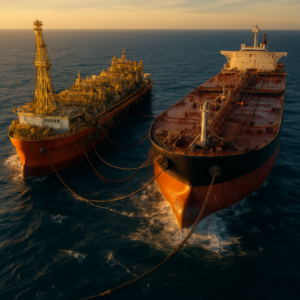 Picture this: a supertanker the length of three football fields, its belly swollen with hundreds of thousands of tons of crude oil, sitting at a terminal while pumps roar to life. In a matter of hours, millions of liters of liquid are either rushing into its tanks or being sucked out. What’s not immediately obvious—but absolutely critical—is the invisible battle happening inside those steel walls. Pressure, that silent and relentless force, is either building up or plummeting, and if left unchecked, it can turn a routine operation into a catastrophe.
This is where mast risers come in—not as the most glamorous piece of maritime engineering, but as one of the most vital. These towering structures, often rising 20 meters or more above the deck, act as the tanker’s pressure relief valves, a last line of defense against the violent forces that can tear a vessel apart from the inside out.
More information on Life at Sea: Internet & Food Realities on LPG Ships
The Physics of Pressure: Why Tankers Can’t Hold Their Breath
When a tanker loads or unloads cargo, it’s not just liquid that’s moving. Every barrel of oil that enters or leaves a tank displaces an equivalent volume of gas—usually a volatile mix of hydrocarbon vapors, inert gases like nitrogen, and air. During loading, as liquid fills the tank, the gas inside has nowhere to go but up. If it can’t escape, pressure climbs, pressing against the tank walls with thousands of kilopascals of force. Conversely, during unloading, the opposite happens: as liquid is pumped out, a vacuum can form, causing the tank to implode under the weight of the atmosphere outside.
To put this in perspective, consider that a typical crude oil tanker’s cargo tanks are designed to withstand a maximum overpressure of about 2.5 kPa (0.36 psi) and a vacuum of -0.7 kPa (-0.1 psi). Exceed those limits, even briefly, and the results can be devastating. In 1989, the Khark 5, a VLCC (Very Large Crude Carrier), suffered a catastrophic failure when a pressure surge during loading ruptured one of its tanks. The resulting explosion and fire killed three crew members and spilled over 70,000 tons of oil into the Atlantic—one of the worst environmental disasters of its time. Investigations later revealed that the mast riser system had been improperly maintained, allowing pressure to build unchecked.
Mast Risers: The Unsung Heroes of Pressure Relief
So how do mast risers prevent such disasters? At their core, they’re deceptively simple: a vertical pipe, usually made of corrosion-resistant steel, that connects the cargo tanks to the open air. But their design is anything but basic. Here’s how they work:
- Venting Excess Pressure: When pressure inside a tank rises above a preset threshold (typically around 2 kPa), a pressure/vacuum (P/V) valve at the base of the mast riser opens automatically, allowing gas to escape upward and out into the atmosphere. This prevents the tank from rupturing like an overinflated balloon.
- Preventing Vacuum Collapse: During unloading, if the pressure inside the tank drops too low, the same P/V valve allows air to rush in, equalizing the pressure and stopping the tank from buckling inward.
- Handling Volatile Vapors: On modern tankers, mast risers are often integrated with vapor recovery systems that capture escaping hydrocarbons and either burn them in an incinerator or return them to shore for processing. This isn’t just about safety—it’s about compliance with environmental regulations like MARPOL Annex VI, which limits the release of volatile organic compounds (VOCs).
The engineering behind these systems is a masterclass in balancing strength and precision. Mast risers must be tall enough to ensure that vented gases disperse safely above deck (to avoid igniting near potential sources of sparks), yet sturdy enough to withstand the corrosive effects of saltwater, wind, and the constant vibration of the ship. They’re typically equipped with:
- Flame Arrestors: Mesh-like devices that prevent any external flames from traveling back down the riser and igniting the cargo tanks.
- High-Level Alarms: Sensors that trigger if the liquid level in a tank rises too close to the venting point, warning the crew to stop loading before liquid (not just gas) starts escaping.
- Remote Monitoring: In the ship’s control room, officers can track pressure levels in real time, with alarms sounding if thresholds are breached.
When Pressure Control Fails: Lessons from the Past
History is littered with examples of what happens when pressure control systems fail—and the consequences are never pretty. Take the case of the Castillo de Bellver, a Spanish tanker that exploded off the coast of South Africa in 1983. A malfunction in the inert gas system (which is supposed to replace oxygen in the tanks with non-flammable gas) allowed a dangerous mix of hydrocarbon vapors and air to form. When a spark ignited the mixture during loading, the resulting explosion tore the ship in half. The mast risers, which should have vented the pressure, were later found to be clogged with residue, rendering them useless.
Or consider the Erika, which broke apart in the Bay of Biscay in 1999, spilling 20,000 tons of heavy fuel oil and devastating the French coastline. While the immediate cause was structural failure due to poor maintenance, investigators noted that the ship’s pressure control systems were outdated and poorly monitored. The disaster led to sweeping reforms in tanker safety, including stricter requirements for mast riser maintenance and the phase-out of single-hull tankers.
These incidents underscore a grim truth: pressure control systems don’t fail on their own—they fail because of human error, poor maintenance, or outdated technology. Modern tankers have learned from these tragedies, but the risks remain, especially on older vessels or those operating under lax regulatory oversight.
The Human Factor: Crew Responsibilities and Maintenance Protocols
No amount of engineering can replace vigilance. On a supertanker, the crew’s role in monitoring and maintaining pressure control systems is just as critical as the hardware itself. Here’s what that looks like in practice:
- Pre-Loading Checks:
- Before any cargo operation begins, the chief officer or designated cargo officer must verify that all mast risers are clear of obstructions. This includes checking for ice buildup in cold climates, salt deposits in tropical regions, or residue from previous cargoes.
- P/V valves are tested to ensure they open and close at the correct pressures. This is often done using a portable pressure gauge or by simulating pressure changes in a controlled environment.
- Flame arrestors are inspected for corrosion or blockages. A clogged arrestor can turn a mast riser into a pipe bomb if a backfire occurs.
- Real-Time Monitoring:
- During loading or unloading, the control room is staffed 24/7. Pressure levels in each tank are displayed on screens, with audible and visual alarms triggered if thresholds are breached.
- Crew members conduct regular deck rounds to listen for unusual noises (like hissing gas) and to check for leaks or malfunctions in the mast riser system.
- On some vessels, inert gas systems (which pump nitrogen or flue gas into the tanks to reduce oxygen levels) are used in tandem with mast risers to further mitigate explosion risks.
- Maintenance and Record-Keeping:
- Mast risers and P/V valves undergo scheduled maintenance every few months, with parts replaced as needed. This is documented in the ship’s Planned Maintenance System (PMS).
- After each cargo operation, the system is flushed with water or inert gas to remove any residual vapors or liquids that could corrode the pipes or valves.
- Crew members receive regular training on pressure control procedures, including emergency response drills for scenarios like a sudden pressure spike or a mast riser failure.
Perhaps the most critical responsibility falls on the cargo officer, who must make split-second decisions if something goes wrong. For example, if a P/V valve fails to open during loading, the officer must immediately order the pumps to stop and investigate the cause. Hesitation can mean the difference between a near-miss and a full-blown disaster.
The Future of Pressure Control: Smarter, Safer, More Reliable
While mast risers have been a staple of tanker design for decades, modern technology is making them smarter and more reliable. Some of the innovations now being adopted include:
- Automated Pressure Monitoring: Advanced sensors can now detect even minor pressure fluctuations and adjust venting automatically, reducing the risk of human error.
- Remote Diagnostics: On some vessels, pressure control systems can be monitored and even controlled from shore via satellite, allowing for real-time troubleshooting by experts.
- Self-Cleaning Systems: New designs incorporate mechanisms to prevent residue buildup in mast risers, reducing the need for manual cleaning and the risk of clogs.
- Integrated Safety Systems: Modern tankers often link pressure control systems with other safety features, such as emergency shutdown systems that automatically stop cargo operations if a critical failure is detected.
Yet, for all these advancements, the fundamental principle remains the same: a tanker’s safety depends on its ability to breathe. Mast risers may not be the most talked-about part of a supertanker, but they are, without question, one of the most important. In a world where a single mistake can lead to environmental ruin, financial ruin, or loss of life, these towering pipes stand as silent guardians—ready to vent the pressure before it vents itself in the most destructive way possible.