

The Physics of Boil-Off: Heat Transfer in Transit
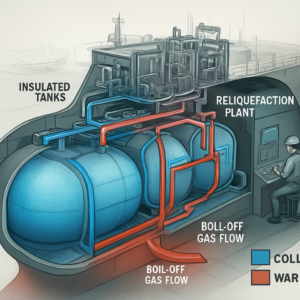 At its core, the formation of boil-off gas (BOG) is a relentless battle against the laws of thermodynamics—a silent tug-of-war between the cryogenic cargo and the world around it. Even the most advanced insulation systems can’t completely halt the march of heat into a liquefied gas tank. Instead, they slow it down, buying time for the cargo to reach its destination before too much of it slips away as vapor. To understand why boil-off happens—and how to manage it—we need to dissect the forces at play: the sources of heat, the mechanics of phase change, and the stubborn physics that make evaporation inevitable.
The Heat That Won’t Be Stopped: Sources of Thermal Influx
Every liquefied gas carrier is a floating thermos, but unlike your morning coffee, the contents inside are often colder than -100°C. This extreme temperature differential between the cargo and its surroundings creates a constant, one-way flow of heat into the tanks. The primary culprits?
- Ambient Air: Even in temperate climates, air at 20°C is a furnace compared to LNG at -162°C. Heat transfers through convection and conduction, sneaking in through tank walls, deck plating, and even the smallest gaps in insulation. On a still day, this might be a slow seep; on a windy one, convection currents accelerate the process, stripping away the cold like a persistent draft under a door.
- Solar Radiation: The sun doesn’t just warm the deck—it turns it into a radiant heater. A black-hulled LNG carrier in the Persian Gulf can absorb enough solar energy to raise deck temperatures above 60°C. This heat doesn’t stay on the surface; it migrates downward, worming its way through steel and insulation until it reaches the cargo. Studies have shown that solar radiation alone can account for 10-15% of total heat influx on exposed tank surfaces during peak daylight hours.
- Seawater: The ocean is a massive thermal reservoir, and at 10-30°C, it’s far warmer than any liquefied gas cargo. Heat transfer here is brutal and direct: through the hull, into the ballast tanks, and eventually into the cargo holds. In rough seas, the churning water increases convective heat transfer, while in calm conditions, stagnant layers near the hull can actually reduce heat influx—though never eliminate it. For membrane tanks, which sit closer to the hull, seawater is often the dominant heat source, contributing up to 50% of total thermal load in some cases.
These sources don’t act in isolation. They overlap, compound, and adapt to conditions. A ship sailing from Norway to Japan might start its journey battling Arctic air, then face the relentless sun of the tropics, and finally endure the warm embrace of the Kuroshio Current. Each leg of the voyage presents a new thermal challenge, and the boil-off rate adjusts accordingly.
More information on Life at Sea: The Harsh Reality of Food on Ships
The Phase Change Paradox: Why Liquids Refuse to Stay Liquid
Boil-off isn’t just about heat—it’s about what that heat does to the cargo. When heat enters a liquefied gas tank, it doesn’t uniformly raise the temperature of the liquid. Instead, it triggers a phase change: some of the liquid absorbs the energy and vaporizes, while the rest remains at its boiling point. This is the latent heat of vaporization in action—a thermodynamic safety valve that keeps the bulk cargo cold even as heat pours in.
Here’s how it works in practice:
- Heat Ingress: Thermal energy penetrates the tank walls, warming the outermost layer of liquid.
- Boiling Point Lock: The liquid at the surface can’t get hotter than its boiling point (e.g., -162°C for methane), so instead of rising in temperature, it changes state, turning into vapor.
- Energy Absorption: The phase change consumes the incoming heat. For LNG, vaporizing 1 kg of methane requires 510 kJ of energy—enough to cool 12 kg of water by 10°C. This is why boil-off is so effective at regulating temperature: it’s a self-correcting system.
- Pressure Dynamics: As vapor forms, it increases the tank’s internal pressure. If the pressure rises too high, relief valves vent the excess BOG to maintain safety. If it’s too low, more liquid evaporates to compensate. This delicate balance is why cargo tanks are never completely full—there’s always a ullage space to accommodate the expanding vapor.
The rate of boil-off depends on two key factors: the heat influx rate and the latent heat of vaporization of the cargo. Methane (LNG) has a relatively low latent heat (510 kJ/kg), meaning it vaporizes easily. Propane (LPG), with a latent heat of 425 kJ/kg, is even more volatile. Ethylene, at 480 kJ/kg, sits somewhere in between. This is why LPG carriers often see higher boil-off rates than LNG ships, despite similar insulation—propane simply requires less energy to turn into gas.
Boil-Off in the Wild: Real-World Rates and Cargo Quirks
Not all liquefied gases are created equal, and neither are their boil-off rates. The numbers below aren’t just theoretical—they’re the daily reality for crews and operators managing these cargoes:
| Cargo Type | Boiling Point (°C) | Typical Boil-Off Rate (% of cargo/day) | Key Influencing Factors |
|---|---|---|---|
| LNG (Methane) | -162 | 0.10% – 0.15% | Membrane tanks (higher heat influx), long voyages, tropical routes |
| LPG (Propane/Butane) | -42 (propane) / -0.5 (butane) | 0.15% – 0.30% | Higher latent heat sensitivity, smaller tanks, less insulation |
| Ethylene | -104 | 0.20% – 0.25% | Intermediate properties, often carried in semi-pressurized tanks |
These rates might seem small, but over a 20-day voyage, an LNG carrier could lose 2-3% of its cargo to boil-off—enough to power a small city for a day. For LPG, the losses can be even higher, especially on older ships with less efficient insulation. The numbers also fluctuate wildly based on external conditions. For example:
- An LNG carrier in the North Atlantic might see boil-off rates as low as 0.08%/day in winter, but 0.20%/day when crossing the equator.
- An ethylene carrier with a poorly maintained insulation system could lose 0.40%/day—double the expected rate—simply because of moisture ingress degrading the tank’s thermal performance.
- On a particularly sunny day, solar radiation alone can increase boil-off by 10-20%, a spike that operators must account for in their fuel and cargo planning.
The cargo’s properties play a starring role in these variations. Methane’s low boiling point means it’s always on the edge of vaporization, but its high specific heat capacity (2.2 kJ/kg·K) helps it resist temperature changes. Propane, by contrast, has a higher boiling point but a lower latent heat, making it more sensitive to small heat influxes. Ethylene’s intermediate properties make it a wildcard—stable enough for short voyages but prone to rapid boil-off if insulation fails.
Insulation: The Last Line of Defense
If heat influx is the enemy, insulation is the shield. But not all shields are created equal. The two dominant tank designs—membrane and spherical (Moss)—take radically different approaches to thermal protection, each with its own strengths and vulnerabilities.
Membrane Tanks: The Thin but Mighty Barrier
Membrane tanks, used in over 70% of modern LNG carriers, rely on a multi-layered insulation system sandwiched between the cargo and the ship’s hull. The typical setup includes:
- Primary Barrier: A thin (0.7-1.2 mm) corrugated stainless steel or invar membrane that contains the liquid. This layer is flexible, allowing it to expand and contract with temperature changes without cracking.
- Insulation Layers: Two or three layers of reinforced polyurethane foam (RPUF) or perlite-filled plywood boxes, each 200-300 mm thick. These layers are staggered to minimize thermal bridging—weak points where heat can bypass the insulation.
- Secondary Barrier: Another membrane layer, often made of triplex (aluminum foil + fiberglass), to contain any leaks from the primary barrier.
The advantage of membrane tanks is their space efficiency. By hugging the hull, they maximize cargo capacity, which is why they dominate the LNG fleet. But this proximity to the hull also makes them more vulnerable to heat influx from seawater. A well-maintained membrane system can limit heat transfer to 0.1-0.2 W/m²·K, but if moisture seeps into the insulation (a common issue in older ships), this can double or triple, sending boil-off rates soaring.
Real-world example: In 2018, an LNG carrier with a degraded membrane insulation system reported boil-off rates of 0.25%/day—nearly double the expected rate. The culprit? Water ingress into the perlite insulation, which reduced its thermal resistance by 40%. The fix required dry-docking the ship and replacing the compromised insulation at a cost of millions.
Spherical (Moss) Tanks: The Standalone Fortress
Moss tanks, named after the Norwegian company that pioneered them, are self-supporting spherical pressure vessels that sit entirely within the ship’s hull. Unlike membrane tanks, they don’t rely on the hull for structural support, which gives them a key advantage: minimal contact with the ship’s structure. This reduces heat transfer from the hull and seawater, but it comes at a cost—Moss tanks take up more space, limiting cargo capacity.
The insulation system in Moss tanks is simpler but no less critical:
- Tank Material: 9% nickel steel or aluminum, chosen for its strength and low-temperature performance. The tank itself is 50-70 mm thick, providing some insulation but not enough to stop heat influx on its own.
- Insulation Layer: A 200-300 mm thick layer of polyurethane foam or aerogel, applied to the outer surface of the sphere. This is often covered with a vapor barrier to prevent moisture ingress.
- Support Structure: The tank rests on a cradle system that minimizes contact with the hull, further reducing heat transfer.
Moss tanks typically achieve lower heat influx rates than membrane tanks—around 0.05-0.15 W/m²·K—thanks to their standalone design. However, their spherical shape means they have a larger surface area-to-volume ratio than membrane tanks, which can offset some of this advantage. In practice, Moss carriers often see boil-off rates 10-20% lower than comparable membrane ships, but they carry 10-15% less cargo for the same hull size.
Real-world example: The Mozah, a Q-Max LNG carrier with Moss tanks, reported an average boil-off rate of 0.11%/day during a 2019 voyage from Qatar to Japan. The ship’s advanced aerogel insulation and minimal hull contact kept heat influx low, even in tropical conditions. By comparison, a similar-sized membrane carrier on the same route averaged 0.14%/day.
The Cargo’s Role: Why Methane and Propane Behave Differently
Not all liquefied gases are equally cooperative when it comes to boil-off. Their behavior is dictated by a handful of key properties, each of which shapes how they respond to heat influx:
- Boiling Point: The lower the boiling point, the more sensitive the cargo is to heat. Methane (-162°C) is always on the verge of vaporizing, while butane (-0.5°C) can tolerate much warmer conditions before boil-off becomes an issue. This is why LPG carriers often use semi-pressurized tanks—they can afford to let the cargo warm up slightly without risking excessive vaporization.
- Latent Heat of Vaporization: As mentioned earlier, this is the energy required to turn a liquid into a gas. Methane’s high latent heat (510 kJ/kg) means it absorbs a lot of energy per kilogram vaporized, which helps stabilize the cargo. Propane’s lower latent heat (425 kJ/kg) makes it more volatile—small heat influxes lead to disproportionately high boil-off rates.
- Specific Heat Capacity: This determines how much energy is needed to raise the temperature of the liquid. Methane’s high specific heat (2.2 kJ/kg·K) means it resists temperature changes, while propane’s lower value (1.6 kJ/kg·K) makes it more responsive to heat influx. In practice, this means propane tanks warm up faster, leading to higher boil-off rates over time.
- Density: Lighter gases like methane (422 kg/m³) have lower thermal mass, meaning they’re more affected by heat influx than denser gases like butane (600 kg/m³). This is why ethylene (568 kg/m³), despite its intermediate boiling point, can sometimes exhibit boil-off behavior closer to LPG than LNG.
These properties interact in complex ways. For example, an LNG carrier with a high heat influx might see a lower boil-off rate than an LPG carrier with the same influx, simply because methane’s higher latent heat absorbs more energy per kilogram vaporized. Conversely, an LPG carrier with poor insulation might lose twice as much cargo as an LNG ship with the same insulation, because propane’s lower latent heat means it vaporizes more easily.
Real-world example: During a 2020 study, two sister ships—one carrying LNG, the other LPG—sailed the same route from the Middle East to India. The LNG carrier, with membrane tanks, averaged a boil-off rate of 0.13%/day. The LPG carrier, with similar insulation but semi-pressurized tanks, averaged 0.22%/day. The difference? Propane’s lower latent heat and higher sensitivity to heat influx, combined with the LPG ship’s smaller tank size (which increased the surface area-to-volume ratio).
The takeaway? Boil-off isn’t just a function of insulation or voyage conditions—it’s a cargo-specific phenomenon. Operators must tailor their strategies to the gas they’re carrying, whether that means adjusting voyage speeds to minimize heat influx, pre-cooling tanks before loading, or fine-tuning the balance between reliquefaction and fuel use.