

The Rise of Dual-Fuel: Why the Industry Is Switching
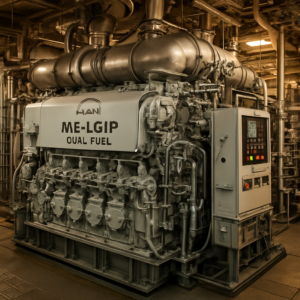 Let’s be honest—no one in shipping wakes up one morning and decides to overhaul their entire fleet just for fun. The shift to dual-fuel engines, particularly systems like MAN B&W’s ME-LGIP, isn’t a trend. It’s a survival strategy. And if you’re a marine engineer still betting on traditional heavy fuel oil (HFO), you might want to pay attention. The rules of the game have changed, and the industry is moving fast—whether you’re ready or not.
So, what’s really driving this push toward dual-fuel? It’s not just one thing. It’s a perfect storm of regulations, economics, and operational necessity. Let’s break it down.
The Regulatory Hammer: IMO 2030, 2050, and the Alphabet Soup of Compliance
If you’ve been in shipping long enough, you know the International Maritime Organization (IMO) doesn’t mess around. Their 2030 and 2050 greenhouse gas (GHG) reduction targets aren’t suggestions—they’re mandates. By 2030, the IMO wants a 40% reduction in carbon intensity compared to 2008 levels. By 2050, the goal is a 50% cut in absolute emissions. And if you think those numbers are ambitious, wait until you see the penalties for missing them.
Enter EEXI (Energy Efficiency Existing Ship Index) and CII (Carbon Intensity Indicator). These aren’t just acronyms to memorize for your next certification—they’re the new reality. EEXI measures a ship’s energy efficiency at design speed, while CII grades vessels annually on their carbon performance. Fail to meet the standards? Your ship gets a “D” or “E” rating, which means operational restrictions, higher port fees, or worse—being forced into early retirement. And no, scrubbers alone won’t save you anymore.
More information on Switching to LPG Tankers: A Starter’s Roadmap
Here’s the kicker: LNG (liquefied natural gas) and dual-fuel engines are the most straightforward path to compliance today. Why? Because they slash CO₂ emissions by 20-30% compared to HFO, and they virtually eliminate sulfur oxides (SOx) and particulate matter. For operators, that’s not just good PR—it’s the difference between staying in business and getting left behind.
Take DNV’s 2023 Maritime Forecast, which predicts that by 2030, over 60% of newbuilds will be LNG-ready or dual-fuel. That’s not a niche market—that’s the new baseline. And if you’re still running on HFO without a transition plan, you’re essentially driving a diesel truck in a Tesla world.
Fuel Cost Volatility: The LNG vs. HFO Rollercoaster
Let’s talk money. Because at the end of the day, shipping is a business, and no one survives long if they ignore the bottom line.
HFO has been the backbone of maritime fuel for decades, but its price is anything but stable. Remember 2022? When HFO prices spiked to $700+ per ton thanks to geopolitical chaos and supply chain disruptions? Meanwhile, LNG prices, while not immune to volatility, have shown longer-term stability and lower carbon costs. In fact, Clarksons Research found that in 2023, LNG was 20-30% cheaper than HFO on an energy-equivalent basis in key bunkering hubs like Rotterdam and Singapore.
But here’s the real game-changer: dual-fuel engines give operators options. If LNG prices spike, you can switch to HFO or even biofuels. If HFO becomes too expensive or restricted, you’ve got LNG as a backup. That kind of flexibility isn’t just nice to have—it’s a competitive edge in an industry where fuel can account for 50-60% of operating costs.
Consider Pacific Gas, one of the early adopters of MAN B&W’s ME-LGIP engines. Their fleet of LNG-powered gas carriers doesn’t just comply with IMO 2030—they’re saving millions in fuel costs annually. And when HFO prices surged in 2022, their dual-fuel vessels kept running smoothly while competitors scrambled to secure expensive low-sulfur alternatives.
Operational Flexibility: The Silent Killer of Single-Fuel Ships
Regulations and fuel costs are the big, obvious drivers, but there’s a third factor that’s just as critical: operational flexibility. And in today’s shipping world, flexibility isn’t a luxury—it’s a necessity.
Dual-fuel engines like the ME-LGIP aren’t just about switching between LNG and HFO. They’re about future-proofing. As the industry moves toward ammonia, methanol, and hydrogen, dual-fuel systems are the bridge to those next-gen fuels. Retrofitting a single-fuel engine for new fuels? That’s expensive, time-consuming, and often impractical. But if you’re already running dual-fuel? The transition becomes far less painful.
Take BSM (Bernhard Schulte Shipmanagement), which has been aggressively retrofitting its fleet with ME-LGIP systems. Their reasoning? “We don’t know what the fuel of 2035 will be, but we know it won’t be HFO. Dual-fuel gives us the agility to adapt.” That’s not just smart—it’s strategic survival.
And let’s not forget port restrictions. More and more, ports are banning HFO or imposing strict emissions controls. In the Baltic and North Seas, for example, HFO is already a no-go in many areas. If your ship can’t run on LNG or another compliant fuel, you’re locked out of key markets. Dual-fuel engines? They open doors.
Real-World Examples: Who’s Winning with Dual-Fuel?
Enough theory—let’s talk about who’s actually making this work.
- MOL (Mitsui O.S.K. Lines): One of the first to adopt ME-LGIP engines for their LNG carriers. Result? 25% lower fuel costs and full compliance with IMO 2030—years ahead of schedule. Their dual-fuel vessels also command higher charter rates because operators know they won’t get hit with unexpected compliance costs.
- Teekay LNG: Their ME-LGIP-powered fleet has reduced CO₂ emissions by 30% while maintaining the same operational efficiency as HFO. That’s not just good for the planet—it’s good for their P&L. In 2023, Teekay reported $12 million in annual fuel savings across their dual-fuel vessels.
- NYK Line: By retrofitting older vessels with dual-fuel systems, they’ve extended the lifespan of their fleet by 10-15 years. That’s millions in avoided newbuild costs—and a major advantage in a market where shipyards are booked solid for years.
These aren’t outliers. They’re the new standard. And the message is clear: if you’re not running dual-fuel, you’re falling behind.
The Bottom Line: Why This Matters for Engineers
So, why should you, as a marine engineer, care about any of this? Because the skills that got you here won’t get you there.
Companies like Pacific Gas and BSM aren’t just looking for engineers with “experience on gas carriers.” They want specialists who understand ME-LGIP systems, LNG fuel handling, and dual-fuel operations. And they’re willing to pay for it—20-30% higher salaries for engineers with proven dual-fuel expertise, according to Maritime HR Association data.
If you’re still running on HFO knowledge alone, you’re not just missing out on better pay—you’re limiting your career. The industry is moving toward dual-fuel, and the demand for skilled engineers is only going to grow. The question isn’t if you’ll need this experience—it’s when.
Author:Ch.Eng