

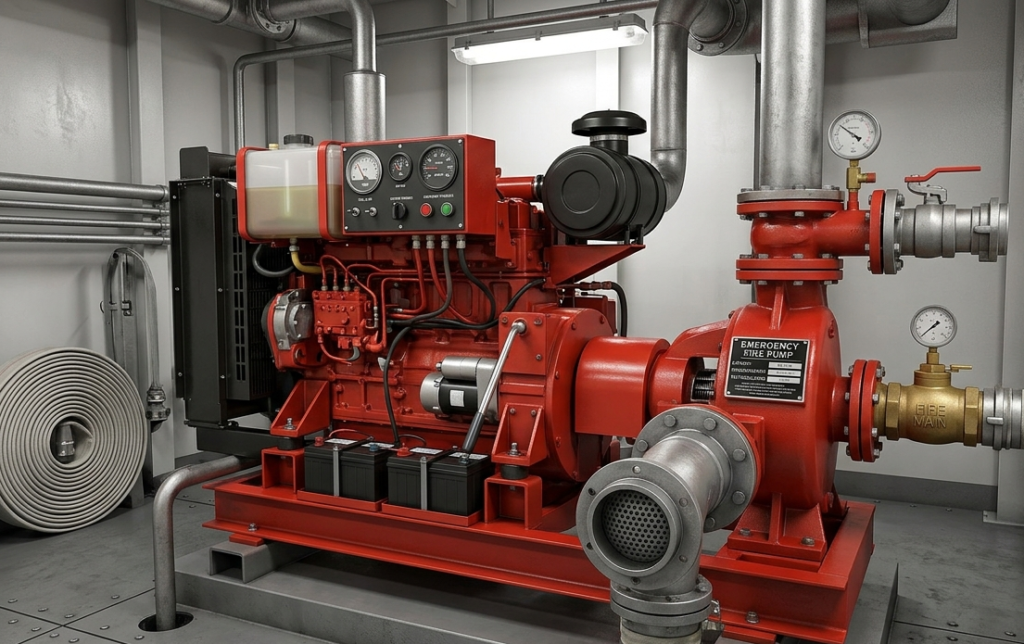
The Emergency Fire Pump is one of the most critical safety systems on any vessel. Its operability is the very first thing PSC, SIRE, and CDI inspectors check. However, in practice, many marine engineers face a situation where the pump simply refuses to deliver water at the most crucial moment.
Why does this happen, and how can one simple habit save the shipowner thousands of euros on diving services? Let’s break down the technical nuances and real engine room experience.
The Main Vulnerability — Its Autonomy
The specific design of the emergency fire pump dictates that it operates as a completely independent system. It has a separate suction line, its own non-return valve, and usually a dedicated seachest.
Ironically, this exact design feature, intended to ensure reliability during an engine room blackout, often becomes the main cause of its failure in daily operation.
If the pump is not tested under real load and allowed to run for at least 30–60 minutes every week, the water in its suction line stagnates. This creates perfect conditions for:
- Marine growth (mollusks and barnacles) clogging the seachest.
- Marine flora fouling the suction non-return valve.
More information on Handling Hazardous Cargo: VCM, Butadiene & Ammonia Risks
Bitter Experience: The Cost of Negligent Checks
Over the years, I have repeatedly encountered situations where the responsible officer approached the pump testing formally: cranked the starter for a couple of minutes, saw a pressure spike, and shut it down.
Such negligence inevitably led to critical seachest fouling. But the most insidious problem hides in the non-return valve. Due to barnacle buildup, the valve fails to close tightly. As a result, while the pump is on standby, the water from the suction line simply drains overboard, and the line becomes completely dry.
When there is a real need to start the system, the priming pump installed on the emergency fire pump physically cannot pull the air out of the empty pipe to prime the main pump properly. The result is a critical failure of a vital safety system.
Fixing this issue with the crew’s efforts is almost impossible. To clean the seachest and restore the valve, the company has to order expensive diving services right in the port, or in the worst-case scenario, postpone the repair until the next scheduled drydock.
Effective Practice: How to Prevent These Problems
The best way to combat this issue is not repairing it, but proper prevention. Back when I was a 2nd Engineer, and testing the emergency fire pump was my direct responsibility, I established a strict rule. Every week, instead of just a formal “click” of the starter, I ran the pump in actual operation for 30–60 minutes. This powerful flow of water naturally flushed the seachest, the suction line, and the non-return valve, giving marine growth no chance to settle.
A Professional Hack with Mooring Operations
Another excellent practice I always applied was using the emergency fire pump to supply cooling water for the mooring winches during mooring operations.
This method provides two huge advantages:
- Pre-port battle test: You guarantee the system is fully operational right before entering the port and facing a potential PSC inspection.
- Early diagnostics: Any deviations in the priming pump operation or pressure drops are detected in a working environment, giving you ample time to troubleshoot.
Thanks to this approach, I never had problems with the emergency fire pump during inspections or normal operations. Today, working for many years in the position of Chief Engineer, I continue to actively pass this practice on to my engineering colleagues. The regular running of machinery is the key to its longevity and your peaceful watch.