

The Basics: Why Gas Transport Differs from Liquids
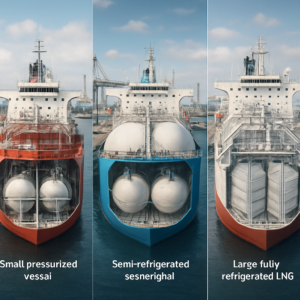 At first glance, moving gas from point A to point B might seem like a simpler task than transporting liquids. After all, gases don’t slosh, don’t spill in the same messy way, and don’t require the same level of structural reinforcement to keep them contained—or so the thinking goes. But here’s the catch: gases are far more finicky than liquids when it comes to storage and transport. Their behavior under pressure, temperature, and even minor environmental changes can turn a routine shipment into a high-stakes logistical puzzle. To understand why, we need to peel back the layers of what makes gases so uniquely challenging—and why the ships, tanks, and pipelines that carry them look nothing like those used for oil, water, or even liquid chemicals.
The Compressibility Conundrum: Why Volume Isn’t What It Seems
Let’s start with the most obvious difference: compressibility. Liquids, for the most part, are stubborn. Squeeze a barrel of crude oil, and you’ll barely change its volume—it might heat up slightly from the pressure, but it won’t shrink or expand in any meaningful way. Gases, on the other hand, are the ultimate shape-shifters. They’ll happily fill whatever container you put them in, expanding or contracting based on pressure and temperature like a living, breathing thing.
This isn’t just a quirk—it’s a logistical nightmare. Imagine trying to design a cargo hold for a gas that, at standard temperature and pressure, would occupy 600 times the space of the same mass in liquid form. That’s the reality for something like methane (the main component of natural gas). If you tried to ship it in its gaseous state without any special handling, you’d need a vessel the size of a small city to move even a modest amount. The solution? Compress it, cool it, or both—but each of those approaches comes with its own set of trade-offs.
Take propane, for example. At room temperature, it’s a gas, but apply enough pressure (around 8-10 bar), and it condenses into a liquid that takes up 1/270th of its original volume. That’s why you can fit weeks’ worth of fuel for a backyard grill into a tank the size of a small suitcase. But here’s the kicker: propane’s pressure isn’t static. Leave that same tank in the sun on a hot day, and the pressure inside can spike dangerously. That’s why propane tanks are built with safety margins, relief valves, and thick steel walls—because the alternative is a very loud, very fiery lesson in why compressibility matters.
More information on Life at Sea: The Harsh Reality of Food on Ships
Boiling Points and the Cryogenic Gamble
If compressibility is the first hurdle, boiling points are the second—and they’re where things get really interesting (and expensive). Every gas has a temperature at which it condenses into a liquid, and that temperature dictates how you transport it. Some gases, like propane or butane (the key components of LPG), have boiling points that are just below room temperature. That means you can liquefy them with moderate pressure alone, making them relatively easy to handle. Others, like methane (LNG) or ethylene, require extreme cold to stay liquid—we’re talking -162°C for methane and -104°C for ethylene. Transporting these isn’t just a matter of slapping them in a tank; it’s an exercise in cryogenic engineering.
Why does this matter? Because cold costs money. A lot of it. Cryogenic tanks need layers of insulation (often vacuum-sealed), specialized materials that won’t become brittle at low temperatures, and constant monitoring to prevent even the slightest heat leak. A single degree of warming can cause the liquid to boil off, turning back into gas and increasing pressure inside the tank. That’s why LNG carriers look like floating thermoses, with their characteristic moss-covered tanks (a type of insulation) and double-hulled designs to prevent heat transfer from the ocean. Compare that to an LPG tanker, which might use simpler, semi-refrigerated or fully pressurized tanks, and you start to see how boiling points shape the entire transport ecosystem.
Then there’s the boil-off problem. Even with the best insulation, some gas will inevitably vaporize during transit. For LNG, this boil-off is often used as fuel for the ship’s engines—a neat way to turn a problem into a solution. But for other gases, like ammonia, boil-off isn’t so easily repurposed. Ammonia’s boiling point (-33°C) is low enough that it requires refrigeration, but high enough that it’s not as straightforward as LNG. Left unchecked, the gas can corrode tanks, create toxic fumes, or even form explosive mixtures with air. That’s why ammonia carriers often use semi-refrigerated tanks, keeping the cargo just cold enough to minimize boil-off without the full cryogenic treatment.
Reactivity: The Invisible Wildcard
Not all gases play nice. Some are highly reactive, meaning they’ll happily bond with other substances—or even with the materials of the tank itself—if given the chance. This is where things get dangerously nuanced. Take chlorine, for example. It’s a gas at room temperature, but it’s also highly corrosive and toxic. Transporting it requires tanks lined with materials like nickel or specialized polymers to prevent reactions that could weaken the container or, worse, cause a leak. Then there’s ethylene oxide, a gas used in chemical manufacturing that’s not only flammable but also prone to explosive polymerization—a chain reaction that can turn a stable cargo into a ticking time bomb if not properly stabilized.
Compare that to something like nitrogen, which is inert, non-toxic, and happy to sit in a tank for years without causing trouble. The difference in handling requirements is night and day. Reactive gases demand specialized containment, often with inert gas padding (like nitrogen or argon) to prevent unwanted reactions, and rigorous monitoring for leaks or pressure changes. They might also require stabilizers or inhibitors—chemicals added to the cargo to keep it from misbehaving. Ammonia, for instance, is often shipped with a small amount of water to prevent it from corroding steel tanks. Without that buffer, the gas would slowly eat away at the metal, turning a routine shipment into a potential disaster.
Even within the same category of gases, reactivity can vary wildly. Propane and ammonia are both transported in pressurized or semi-refrigerated tanks, but their handling couldn’t be more different. Propane is relatively stable—it’s flammable, sure, but it won’t react with the tank or the environment unless there’s an ignition source. Ammonia, on the other hand, is toxic, corrosive, and water-soluble. A leak doesn’t just pose a fire risk; it can create a hazardous cloud that drifts with the wind, requiring emergency response teams to evacuate entire areas. That’s why ammonia carriers often have double-walled tanks and advanced leak detection systems, while propane tankers might get away with simpler designs.
Containment Systems: The Art of Keeping Gas Where It Belongs
All these factors—compressibility, boiling points, reactivity—converge on one critical question: How do you keep the gas contained safely and efficiently? The answer depends entirely on the gas in question, and the solutions range from brute-force pressure to high-tech refrigeration to chemical trickery. Let’s break down the three main approaches:
- Fully Pressurized Transport:The simplest method, but also the most limited. Here, the gas is compressed into a liquid and stored in thick-walled tanks designed to withstand high pressure. This works well for gases like propane, butane, or carbon dioxide, which can be liquefied at relatively low pressures (under 20 bar). The downside? Weight and volume. Pressurized tanks are heavy, which limits how much cargo a ship can carry. They’re also not practical for gases that require extreme pressures to liquefy, like methane. That’s why you’ll see fully pressurized tanks on small LPG carriers or road tankers, but not on large-scale LNG ships.
- Semi-Refrigerated/Semi-Pressurized Transport:The middle ground. Here, the gas is cooled to reduce its pressure requirements, but not to cryogenic levels. This is the sweet spot for gases like ethylene or ammonia, which have boiling points that are low but not extremely low. The tanks are still pressurized, but not to the same degree as fully pressurized systems, which saves weight and cost. The trade-off? You need refrigeration equipment on board, which adds complexity. Semi-refrigerated carriers are a common sight in the petrochemical trade, where they shuttle gases like propylene or vinyl chloride between refineries and manufacturing plants.
- Fully Refrigerated (Cryogenic) Transport:The heavyweight champion of gas transport. For gases like methane (LNG) or nitrogen, which have boiling points below -100°C, refrigeration is the only viable option. These ships use insulated, double-walled tanks to keep the cargo at ultra-low temperatures, often with a layer of vacuum or specialized insulation materials to minimize heat transfer. The engineering behind these vessels is staggering—some LNG carriers use membrane tanks, where the cargo is held in a thin, flexible liner supported by the ship’s hull, while others use self-supporting spherical tanks that look like giant golf balls welded into the deck. The cost? Millions of dollars in R&D, construction, and maintenance. But for the volumes of gas these ships carry, it’s the only game in town.
Each of these methods has its place, and the choice often comes down to a balancing act between cost, safety, and practicality. Fully pressurized transport is cheap and simple, but it’s only viable for small volumes of easily liquefied gases. Cryogenic transport can handle massive quantities, but it’s expensive and complex. Semi-refrigerated systems split the difference, offering a compromise for gases that don’t fit neatly into either category.
And then there are the edge cases. Gases like hydrogen or helium push the boundaries of what’s possible. Hydrogen, for example, has a boiling point of -253°C—so cold that it requires liquid nitrogen shielding to keep it from boiling off. Helium, meanwhile, is so light and non-reactive that it’s often transported as a gas in high-pressure cylinders, even though it’s more expensive to move that way. These gases remind us that there’s no one-size-fits-all solution in gas transport—just a series of calculated trade-offs, where every decision has consequences.