

The Fundamentals of Bunker Quantity Calculations
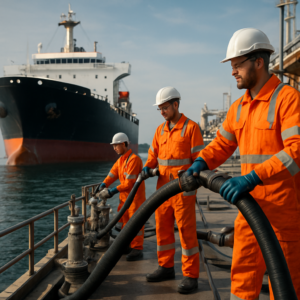 Calculating the right amount of bunker fuel isn’t just about filling the tanks and hoping for the best. It’s a precise science—one that balances vessel performance, regulatory compliance, and operational efficiency. Get it wrong, and you’re looking at costly delays, engine wear, or even non-compliance with environmental regulations. Here’s how the process breaks down, step by step, and why every detail matters.
The Step-by-Step Process: From Consumption to Confirmation
Bunker quantity calculations start long before the fuel hose is connected. The process typically follows this sequence:
- Determine the Voyage ProfileEvery calculation begins with the basics: where the vessel is going, how far it’s traveling, and what conditions it will face. Key inputs include:
- Distance: The total nautical miles between ports, accounting for planned route deviations (e.g., avoiding piracy zones or adverse weather).
- Speed: The vessel’s service speed, which directly impacts fuel consumption. A Panamax bulker cruising at 14 knots will burn significantly more fuel than one traveling at 12 knots.
- Duration: Total voyage time, including potential delays (e.g., port congestion, weather-related slowdowns).
- Establish Fuel Consumption RatesVessel operators rely on two primary sources for consumption data:
- Sea Trials and Performance Curves: Manufacturers provide baseline consumption rates under ideal conditions (e.g., calm seas, clean hull). For example, a modern VLCC might consume ~55 metric tons per day (MTPD) at 15 knots in still water.
- Historical Data: Real-world logs from previous voyages account for variables like hull fouling, engine efficiency degradation, and weather. A 10-year-old container ship might burn 10-15% more fuel than its sea trial figures suggest due to wear and tear.
Pro Tip: Always cross-reference sea trial data with recent voyage records. A vessel’s actual consumption can drift over time due to factors like propeller roughness or engine tuning.
- Factor in Auxiliary ConsumptionMain engines aren’t the only fuel consumers on board. Auxiliary systems—such as generators, boilers, and incinerators—can account for 5-15% of total fuel use, depending on the vessel type. For instance:
- A reefer container ship may require additional fuel for refrigeration units during a tropical voyage.
- A tanker in port might rely on auxiliary boilers to maintain cargo temperature, adding to consumption.
Ignoring these systems can lead to under-ordering fuel, forcing mid-voyage adjustments or costly emergency bunkering.
- Calculate Base Fuel RequirementThe core formula is straightforward:Total Fuel Required = (Daily Consumption × Voyage Days) + Safety Margin
For example, a Handymax bulker with a 20-day voyage and a daily consumption of 25 MTPD would need 500 metric tons of fuel—before adding any buffer. But this is where things get complicated.
- Apply Corrections for Fuel Density and TemperatureFuel isn’t a static commodity. Its volume expands and contracts with temperature, and its density varies by type (e.g., HFO vs. VLSFO). Here’s how to adjust for these variables:
- Density Correction:Fuel is typically ordered by mass (metric tons), but suppliers measure it by volume (cubic meters). The conversion relies on density, which is temperature-dependent. The formula:Mass (MT) = Volume (m³) × Density (kg/m³) ÷ 1,000
For example, 1,000 m³ of VLSFO with a density of 940 kg/m³ at 15°C equals 940 metric tons. But if the fuel is delivered at 40°C, its density drops, and the actual mass received will be less—unless corrected.
- Temperature Correction (ASTM Table 54B):The industry standard for adjusting fuel volume to a reference temperature (usually 15°C). A 1°C increase in temperature can expand fuel volume by ~0.06-0.08%. For a 1,000 m³ delivery, that’s a difference of 6-8 m³—enough to cause a shortfall if unaccounted for.Real-World Example: In 2019, a Capesize bulker ordered 2,000 MT of HFO for a transatlantic voyage. The fuel was delivered at 35°C, but the crew failed to apply temperature corrections. The actual mass received was 1,920 MT—a 4% shortfall. The vessel ran low on fuel mid-voyage, forcing a diversion to a high-priced port for emergency bunkering, costing the operator $120,000 in delays and premium fuel costs.
- Density Correction:Fuel is typically ordered by mass (metric tons), but suppliers measure it by volume (cubic meters). The conversion relies on density, which is temperature-dependent. The formula:Mass (MT) = Volume (m³) × Density (kg/m³) ÷ 1,000
- Add Safety Margins and ContingenciesNo calculation is complete without a buffer. Industry best practices recommend:
- 5-10% for routine voyages: Covers minor delays, weather, or consumption variations.
- 15-20% for high-risk routes: Includes areas with piracy, icebergs, or unreliable bunker suppliers (e.g., West Africa, Arctic passages).
- Additional 5% for new fuel types: Post-IMO 2020, VLSFO and biofuels can have unpredictable consumption rates due to varying energy content. A vessel switching from HFO to VLSFO might see a 3-5% increase in consumption for the same power output.
Case Study: In 2021, a product tanker loaded with VLSFO for a voyage from Rotterdam to Singapore. The operator used HFO consumption rates for calculations, assuming similar efficiency. However, the VLSFO’s lower energy density (40.5 MJ/kg vs. 42 MJ/kg for HFO) increased consumption by 8%. The vessel arrived with only 2% fuel remaining, narrowly avoiding a costly emergency stop.
- Verify Tank Capacity and StabilityEven the most precise calculation is useless if the vessel’s tanks can’t hold the required fuel. Key considerations:
- Tank Ullage: The space left in a tank to allow for fuel expansion. Overfilling can lead to spills or structural damage. For example, a tank with 95% capacity at 15°C might reach 100% at 40°C, risking overflow.
- Stability and Trim: Fuel distribution affects the vessel’s center of gravity. Loading too much fuel in one tank can cause list or reduce maneuverability. Software like NAPA Stability or Maxsurf helps model these effects.
- Segregation Requirements: Post-IMO 2020, vessels often carry multiple fuel types (e.g., VLSFO and HSFO for scrubber-equipped ships). Each requires dedicated tanks, complicating capacity planning.
- Finalize and Communicate the OrderOnce calculations are complete, the bunker order is sent to the supplier, specifying:
- Fuel type (e.g., VLSFO 0.5% sulfur, MGO 0.1%).
- Quantity in metric tons (with density and temperature references).
- Delivery location and time window.
- Any special requirements (e.g., compatibility testing for blended fuels).
Critical Note: Always confirm the order in writing. Verbal agreements or vague emails can lead to disputes over quantity or quality. In 2020, a dispute between a shipowner and supplier over a 50 MT shortfall in a 1,500 MT delivery resulted in a three-day port delay while the matter was resolved—costing $60,000 in demurrage fees.
More information on Life at Sea: The Harsh Reality of Food on Ships
Tools of the Trade: Software and Hardware for Accurate Calculations
Gone are the days of manual calculations and paper logs. Today’s industry relies on a mix of software and hardware to ensure precision:
- Bunker Planning Software:
- DNV’s BunkerManager: Integrates voyage planning, consumption data, and stability calculations. Used by 30% of the global fleet.
- StormGeo’s BunkerPlanner: Combines weather routing with fuel optimization, reducing consumption by 2-5% on average.
- Lloyd’s Register’s Fuel Oil Bunker Analysis (FOBAS):strong> Provides real-time fuel quality data to adjust consumption models.
- Onboard Monitoring Systems:
- Flow Meters: Installed in fuel lines to measure real-time consumption. Accuracy varies; high-end models (e.g., Krohne Optimass) claim ±0.1% precision.
- Tank Gauging Systems: Radar or ultrasonic sensors (e.g., Enraf, Saab) track fuel levels with millimeter accuracy, accounting for vessel motion.
- Density and Temperature Measurement:
- Portable Density Meters: Handheld devices (e.g., Anton Paar DMA 35) measure density at the point of delivery, allowing immediate corrections.
- Automated Sampling Units: Systems like Marine Fuel Tech’s MFT-3000 take representative samples during bunkering for lab analysis, ensuring the delivered fuel matches the ordered specifications.
Common Pitfalls and How to Avoid Them
Even experienced operators can stumble over these recurring issues:
- Ignoring Fuel Density VariationsDensity isn’t constant. VLSFO, for example, can range from 890 to 980 kg/m³. A 2022 study by Marine Benchmark found that 12% of bunker disputes were due to density mismatches between ordered and delivered fuel. Solution: Always specify density in the bunker order and verify it upon delivery using a certified density meter.
- Overlooking Temperature EffectsFuel expands when heated. A 1,000 m³ delivery at 40°C will occupy less mass than the same volume at 15°C. Solution: Use ASTM Table 54B to correct volume to the standard 15°C reference temperature. Most bunker planning software includes this feature.
- Underestimating Auxiliary ConsumptionGenerators, boilers, and other systems can add 5-15% to fuel use. Solution: Log auxiliary consumption separately during voyages and factor it into future calculations.
- Failing to Account for Fuel SwitchingVessels with scrubbers may switch between HSFO and VLSFO, each with different consumption rates. Solution: Model consumption for each fuel type and plan tank segregation accordingly.
- Skipping Stability ChecksLoading too much fuel in one tank can affect trim or stability. Solution: Use stability software to simulate fuel distribution before bunkering.
IMO 2020: The New Complexity in Bunker Calculations
The IMO’s 2020 sulfur cap didn’t just change fuel types—it introduced a host of new variables into bunker quantity calculations:
- Wider Density RangesVLSFO densities vary more than HFO, from 860 to 1,010 kg/m³. This affects volume-to-mass conversions and tank capacity planning. For example, a 5,000 m³ tank can hold 4,300 MT of low-density VLSFO (860 kg/m³) but 5,050 MT of high-density VLSFO (1,010 kg/m³).
- Energy Content VariabilityVLSFO’s energy content (measured in MJ/kg) can differ by 10% or more between suppliers. A vessel burning 30 MTPD of VLSFO with 40 MJ/kg will consume 7.5% more fuel than one burning VLSFO with 43 MJ/kg for the same power output. Solution: Request energy content data from suppliers and adjust consumption models accordingly.
- Compatibility RisksBlended VLSFOs can be incompatible, leading to sludge formation in tanks. This reduces usable fuel volume and can clog filters. Solution: Test fuel compatibility before bunkering and avoid mixing fuels from different suppliers.
- Higher Safety MarginsThe unpredictability of VLSFO’s performance (e.g., cold flow properties, stability) means operators often add larger safety margins—up to 20% for some routes. This increases costs but reduces the risk of non-compliance or engine issues.
Real-World Impact: In 2020, a Capesize bulker loaded with VLSFO for a voyage from Singapore to Brazil. The operator used HFO consumption rates for calculations, assuming similar efficiency. However, the VLSFO’s lower energy content (40.2 MJ/kg vs. 42 MJ/kg for HFO) increased consumption by 9%. The vessel arrived with only 3% fuel remaining, forcing a diversion to Cape Town for emergency bunkering. The total cost of the miscalculation? $250,000 in fuel, delays, and port fees.
Lessons from the Field: When Calculations Go Wrong
Miscalculations aren’t just theoretical—they happen, and the consequences can be severe. Here are three real-world examples:
- The Overfilled Tank Incident (2018)A VLCC took on 3,500 MT of HFO in Rotterdam, filling its tanks to 98% capacity. The crew failed to account for fuel expansion due to a 15°C temperature increase during the voyage. By the time the vessel reached the Suez Canal, the fuel had expanded, causing a 20 m³ spill into the engine room. The cleanup and repairs cost $1.2 million, and the vessel was detained for three days.Lesson: Always leave ullage (typically 2-3% of tank capacity) to accommodate thermal expansion.
- The Density Dispute (2021)A container ship ordered 1,200 MT of VLSFO in Houston, specifying a density of 920 kg/m³. The supplier delivered fuel with a density of 950 kg/m³, resulting in only 1,160 MT of fuel by mass. The crew didn’t verify the density upon delivery, and the vessel ran low on fuel mid-Atlantic. The operator had to purchase 200 MT of MGO at a premium price in the Azores, costing an extra $150,000.Lesson: Always measure density at the point of delivery using a certified device.
- The VLSFO Energy Gap (2020)A Panamax bulker switched from HFO to VLSFO for a voyage from Shanghai to Los Angeles. The operator assumed the same consumption rate but didn’t account for the VLSFO’s lower energy content (39.5 MJ/kg vs. 42 MJ/kg for HFO). The vessel consumed 12% more fuel than planned, arriving with only 1% remaining. The delay and emergency bunkering added $80,000 to the voyage cost.Lesson: Adjust consumption models for the energy content of new fuel types.
Bunker quantity calculations are more than just numbers on a spreadsheet. They’re a critical part of vessel operations, where precision can mean the difference between a smooth voyage and a costly disaster. With the added complexity of IMO 2020 and the variability of modern fuels, the margin for error has never been smaller. The tools and best practices exist to get it right—it’s up to operators to use them.