
The Anatomy of a Game-Changer: VSP Design and Mechanics
 At first glance, the Voith Schneider Propeller (VSP) looks like something plucked from the pages of a steampunk novel—less a propeller and more a mesmerizing dance of metal and motion. But beneath its unconventional exterior lies a masterclass in marine engineering, a system that redefines what propulsion can—and should—be in the most demanding environments. Unlike traditional screw propellers, which rely on brute force and fixed angles, the VSP is a study in precision, adaptability, and mechanical elegance. To understand why it’s a game-changer, we need to dissect its anatomy, piece by intricate piece.
The Vertical Revolution: A Disk That Defies Convention
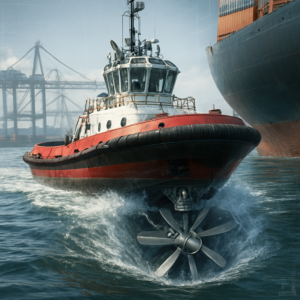
The most immediate difference between a VSP and a conventional propeller is its orientation. Where traditional propellers spin horizontally, mounted at the stern like a fan pushing water backward, the VSP flips the script entirely. Its defining feature is a vertically mounted, rotating disk—typically ranging from 1.5 to 3.5 meters in diameter—housing a series of adjustable blades (usually four to six) that protrude downward into the water. This disk doesn’t just spin; it becomes the heart of a dynamic, shape-shifting force, capable of redirecting thrust in any direction almost instantaneously.
But why vertical? The answer lies in omnidirectional control. A horizontal propeller can only push water in one general direction at a time, requiring complex rudder systems or azimuth pods to change course. The VSP, by contrast, generates thrust in any direction within its plane of rotation. Imagine a helicopter’s rotor, but underwater—where the disk’s rotation creates lift (or, in this case, thrust), and the angle of each blade determines the direction of that force. This is the core of the VSP’s magic: it merges propulsion and steering into a single, seamless mechanism.
More information on Handling Hazardous Cargo: VCM, Butadiene & Ammonia Risks
The Kinematic Ballet: How Blades Dance to Create Thrust
The real genius of the VSP isn’t just in its vertical disk—it’s in how that disk’s blades move. Each blade is attached to the rotating disk via a control rod, a slender but robust arm that connects to a central kinematic mechanism hidden within the disk’s hub. This mechanism is the system’s brain, translating the captain’s commands into the precise, ever-shifting angles of the blades as they spin.
Here’s how it works:
- The Control Rods: These rods act as the blades’ puppeteers. As the disk rotates, each rod is pushed or pulled by the central kinematic system, adjusting the blade’s pitch angle (the angle at which it “bites” into the water) in real time. The rods are typically made from high-strength stainless steel or titanium alloys, chosen for their ability to withstand the relentless cyclic loading of marine operations without fatiguing.
- The Kinematic Mechanism: At the heart of the VSP is a cam or eccentric gear system (depending on the model) that orchestrates the blades’ movements. This mechanism is connected to a control lever on the bridge, allowing the operator to dictate the direction and magnitude of thrust. When the lever is centered, the blades align in such a way that their forces cancel out—resulting in zero net thrust, even as the disk continues to spin. Push the lever forward, and the blades adjust to create forward thrust; pull it to the side, and the thrust vector shifts accordingly, all without changing the disk’s rotation speed or direction.
- The Hydraulic Muscle: The kinematic mechanism doesn’t move on its own. It’s driven by hydraulic cylinders, which provide the muscle to adjust the blade angles under load. These cylinders are fed by a closed-loop hydraulic system, pressurized by pumps that draw power from the main engine. The hydraulics are designed to be fail-safe—if power is lost, the system locks the blades in their last position, preventing uncontrolled thrust. The hydraulic fluid itself is a synthetic, biodegradable blend, chosen to minimize environmental impact in case of leaks while still providing the necessary lubricity and corrosion resistance.
The result is a system that can go from full ahead to full astern in under a second, or pivot a 30,000-ton tanker with the delicacy of a surgeon’s scalpel. For comparison, a conventional azimuth thruster—while powerful—requires the entire propulsion unit to physically rotate to change thrust direction, a process that’s both slower and mechanically complex. The VSP, by contrast, achieves the same result with no moving parts outside the disk itself, reducing wear, maintenance, and the risk of mechanical failure.
Built to Endure: Materials That Defy the Sea
The marine environment is a brutal one. Saltwater corrodes, waves pound, and the constant motion of a vessel subjects every component to relentless stress. The VSP’s materials are chosen not just for strength, but for longevity in the face of these challenges. Here’s what goes into making a system that can last decades in the harshest conditions:
- Blades: The blades are the most exposed part of the system, bearing the brunt of hydrodynamic forces. They’re typically cast from duplex stainless steel (a mix of austenitic and ferritic microstructures) or super duplex alloys, which offer an exceptional balance of strength, corrosion resistance, and toughness. Some high-performance models even use titanium, which is lighter and even more resistant to corrosion but comes at a higher cost. The leading edges of the blades are often reinforced with hard-facing coatings (like tungsten carbide) to resist erosion from sand, silt, and other abrasives.
- Disk and Hub: The rotating disk and its central hub are usually machined from high-grade carbon steel or cast steel, then coated with epoxy or ceramic-based anti-corrosion layers. The hub, in particular, is a critical component, housing the kinematic mechanism and bearing the full torque of the system. It’s designed with oversized bearings and sealed lubrication systems to prevent water ingress and ensure smooth operation.
- Control Rods and Linkages: These components are often made from precipitation-hardened stainless steel (like 17-4 PH), which combines high strength with excellent resistance to pitting and crevice corrosion. The rods are polished to a mirror finish to reduce drag and prevent fouling, and their connections to the blades are sealed with elastomeric bearings that absorb vibration and prevent galvanic corrosion.
- Hydraulic Components: The hydraulic cylinders and valves are typically made from bronze or nickel-aluminum bronze, materials that resist corrosion in seawater while maintaining the tight tolerances needed for precise control. The hydraulic lines themselves are double-walled stainless steel, with sacrificial anodes installed to protect against galvanic corrosion.
This meticulous attention to material science isn’t just about durability—it’s about predictability. In a system where a single blade failure could mean the difference between a smooth docking and a multi-million-dollar collision, every component is designed to perform flawlessly, even after years of abuse. For operators, this translates to lower maintenance costs, fewer unplanned dry-dockings, and the confidence to push the system to its limits when it matters most.
VSP vs. Azimuth Thrusters: Why Simplicity Wins
To truly appreciate the VSP’s design, it’s worth comparing it to its closest competitor: the azimuth thruster. Both systems offer omnidirectional thrust, but their approaches couldn’t be more different—and the VSP’s simplicity is its greatest strength.
| Feature | Voith Schneider Propeller (VSP) | Azimuth Thruster |
|---|---|---|
| Mechanical Complexity | Single rotating disk with adjustable blades; no external moving parts for thrust vectoring. | Entire propulsion unit (propeller + gearbox + motor) rotates 360 degrees; requires complex sealing and bearing systems. |
| Response Time | Instantaneous thrust vector changes; blades adjust in real time without changing disk rotation. | Slower response; entire unit must physically rotate to change thrust direction, often taking 5-10 seconds for full 180-degree turns. |
| Maintenance | Fewer moving parts; primary maintenance involves blade inspections and hydraulic fluid changes. | Higher maintenance due to rotating seals, bearings, and gearboxes; more points of failure in the azimuth mechanism. |
| Efficiency at Low Speeds | Excels in low-speed, high-precision maneuvers; blades optimize thrust even at minimal rotation speeds. | Less efficient at low speeds; fixed-pitch propellers struggle to generate thrust without significant rotation. |
| Durability in Harsh Conditions | Blades and disk are designed to withstand impact and abrasion; fewer external components exposed to damage. | Rotating unit is more vulnerable to debris, ice, and impact; seals and bearings are high-wear items. |
| Power Transmission | Direct drive from engine to disk via a simple bevel gear; no need for complex shafting or clutches. | Requires a right-angle gearbox to transmit power from the horizontal engine to the vertical propeller shaft. |
The azimuth thruster isn’t without its merits—it’s a proven technology, often more efficient at higher speeds, and can be easier to retrofit onto existing vessels. But when it comes to precision, responsiveness, and mechanical robustness, the VSP stands alone. Its design eliminates the need for a rudder, a separate steering system, or even a traditional propeller shaft. Instead, it consolidates all those functions into a single, elegant unit that’s as at home in the icy waters of the Arctic as it is in the congested ports of Shanghai or Rotterdam.
Perhaps the most telling advantage is how the VSP feels to operate. Captains who’ve worked with both systems often describe the VSP as an extension of their own hands—a tool that responds to the slightest input with immediate, predictable force. In the high-stakes world of port operations, where a misjudged maneuver can mean disaster, that level of control isn’t just an advantage. It’s a necessity.