

The Rise and Fall of America’s LNG Shipping Legacy
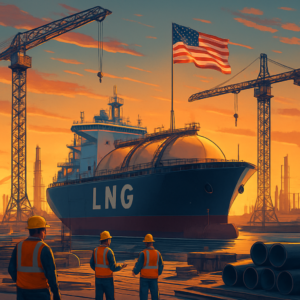 There was a time when the United States didn’t just dominate the global energy market—it defined how the world moved liquefied natural gas across oceans. The 1970s were the golden age of American LNG shipping, a decade when U.S. shipyards didn’t just build tankers; they built the future. These weren’t just vessels; they were floating fortresses of innovation, designed to carry one of the most volatile cargoes on earth at temperatures colder than the surface of Mars. And for a brief, shining moment, no one did it better than America.
The story begins not in the halls of Congress or the boardrooms of oil majors, but in the salt-stained shipyards of Newport News, Virginia, and Quincy, Massachusetts, where the first generation of American LNG tankers took shape. The early 1970s were a period of bold experimentation, driven by a simple but urgent reality: the U.S. needed to secure its energy future, and LNG was the key. The country had just emerged from the oil shocks of the previous decade, and the idea of importing natural gas from places like Algeria and Indonesia—cooled to -260°F and shipped in massive, pressurized tanks—wasn’t just ambitious. It was revolutionary.
More information on Toxic Voyages: The Hidden Dangers of VCM and Butadiene
The Pioneers: El Paso Natural Gas and the Birth of an Industry
At the heart of this revolution was El Paso Natural Gas, a company that didn’t just dip its toes into LNG shipping—it dove in headfirst. In 1972, El Paso placed an order for nine LNG tankers, a fleet that would become the backbone of America’s early LNG trade. These weren’t off-the-shelf vessels; they were custom-built marvels, designed to specifications that pushed the boundaries of maritime engineering. The first of these, the SS El Paso Columbia, rolled out of the Newport News Shipbuilding yard in 1975, a 936-foot behemoth with a cargo capacity of 125,000 cubic meters. To put that in perspective, that’s roughly the equivalent of 55 Olympic-sized swimming pools of liquefied gas, suspended in tanks so cold they could freeze steel on contact.
What made these ships so groundbreaking wasn’t just their size—it was their technology. The El Paso fleet introduced the world to the membrane containment system, a design that used thin, corrugated stainless steel membranes to hold the LNG, surrounded by layers of insulation and a secondary barrier. This was a radical departure from the older, spherical “Moss” tanks used by European and Japanese builders, which were effective but bulky. The membrane system was lighter, more space-efficient, and—crucially—cheaper to build. It was a game-changer, and for a while, it made American shipyards the envy of the world.
But El Paso wasn’t alone. Other U.S. companies were also betting big on LNG. Distrigas Corporation, a subsidiary of Cabot Corporation, commissioned the SS Methane Princess and SS Methane Progress, two of the first LNG carriers built in the U.S. These ships, constructed at General Dynamics’ Quincy Shipbuilding Division, were smaller than the El Paso fleet but no less innovative. They featured self-supporting prismatic tanks, a design that balanced structural integrity with cargo efficiency. The Methane Princess, in particular, became a workhorse of the early LNG trade, shuttling gas between Algeria and the U.S. East Coast for nearly two decades.
The Golden Age: When American Shipyards Ruled the Waves
For a brief period in the mid-1970s, it seemed like the U.S. was unstoppable. American shipyards were churning out LNG tankers at a pace that left competitors scrambling. The Jones Act, which required that ships transporting goods between U.S. ports be built in American shipyards and crewed by American sailors, gave domestic builders a near-monopoly on the burgeoning LNG trade. The logic was simple: if the U.S. was going to rely on imported LNG, it should at least control the ships that carried it.
But the real advantage wasn’t just regulatory—it was technological. American engineers were pushing the limits of what was possible. Take, for example, the SS LNG Aquarius, built in 1977 at Avondale Shipyards in Louisiana. This ship wasn’t just another tanker; it was a floating laboratory. It featured an early version of boil-off gas management, a system that captured the natural evaporation of LNG (which occurs even in the most insulated tanks) and used it to power the ship’s engines. This wasn’t just efficient—it was a glimpse into the future of LNG shipping, where waste was minimized and every drop of cargo was maximized.
By the late 1970s, the U.S. had built or had on order nearly 20 LNG tankers, a fleet that represented more than half of the world’s LNG shipping capacity at the time. American shipyards were the undisputed leaders in the field, and the country’s energy security seemed assured. But beneath the surface, cracks were beginning to form.
The Decline: How America Lost Its Edge
So what went wrong? How did a country that once led the world in LNG shipping end up with zero operational LNG tankers under its flag today? The answers are as complex as the ships themselves, but they boil down to three key factors: cost, competition, and complacency.
1. The Cost Crisis: When American Labor Became a Liability
Building an LNG tanker in the U.S. in the 1970s was expensive. Not just a little expensive—prohibitively expensive. American shipyards were unionized, and labor costs were sky-high compared to international competitors. According to maritime historian Dr. Salvatore Mercogliano, a professor at Campbell University and former merchant mariner, the cost of building an LNG tanker in the U.S. could be two to three times higher than in Japan or South Korea. “The Jones Act was supposed to protect American shipbuilding,” Mercogliano says, “but it also made it nearly impossible for U.S. yards to compete on price. When the global LNG market started to take off in the 1980s, foreign shipyards could undercut American builders by a mile.”
Take the case of the SS LNG Taurus, one of the last LNG tankers built in the U.S. in the early 1980s. Constructed at National Steel and Shipbuilding Company (NASSCO) in San Diego, the Taurus was a technological triumph—but it was also a financial albatross. The ship cost $250 million to build, a staggering sum at the time. By comparison, South Korean shipyards were delivering similar vessels for less than half that price. The math was simple: if you were an energy company looking to build a fleet, where would you go?
2. The Rise of the East: How South Korea and Japan Ate America’s Lunch
While American shipyards were struggling with high costs, South Korea and Japan were busy perfecting the art of mass-producing LNG tankers. The shift began in the late 1970s, when Japanese shipbuilders like Mitsubishi Heavy Industries and Kawasaki Heavy Industries began investing heavily in LNG technology. They took the membrane containment system pioneered by the U.S. and refined it, making it more efficient and—critically—cheaper to produce.
But the real game-changer came in the 1980s, when South Korea entered the fray. Companies like Daewoo Shipbuilding & Marine Engineering (DSME) and Hyundai Heavy Industries didn’t just build LNG tankers—they perfected them. They introduced modular construction techniques, where entire sections of a ship were built simultaneously and then assembled like a giant puzzle. This slashed build times and costs, and by the 1990s, South Korea had become the undisputed leader in LNG shipping, a title it holds to this day.
Industry veteran Captain John Konrad, a former LNG tanker master and founder of the maritime news site gCaptain, recalls the shift firsthand. “I sailed on American-built LNG tankers in the 1980s, and they were incredible ships—well-built, reliable, state-of-the-art,” he says. “But by the 1990s, it was clear that the Koreans had taken over. Their ships were just as good, if not better, and they could deliver them in half the time for a fraction of the cost. The writing was on the wall.”
3. Complacency: The Fatal Flaw of American Shipbuilding
But cost and competition alone don’t tell the whole story. The third—and perhaps most damning—factor in America’s decline was complacency. While South Korea and Japan were investing billions in R&D, modernizing their shipyards, and training the next generation of maritime engineers, the U.S. was resting on its laurels. American shipbuilders assumed that the Jones Act would protect them forever, that foreign competition would never catch up. They were wrong.
“The U.S. had a head start, but we didn’t keep innovating,” says Dr. Mercogliano. “We built a few great ships, and then we stopped. Meanwhile, the Koreans and Japanese were constantly improving their designs, their construction techniques, their efficiency. By the time we realized what was happening, it was too late.”
A perfect example of this complacency is the fate of the El Paso fleet. By the late 1980s, the ships that had once been the pride of American LNG shipping were being sold off or scrapped. The SS El Paso Columbia, the first of the fleet, was laid up in 1985 after just a decade of service. It wasn’t that the ships were obsolete—they were still among the best in the world. But they were too expensive to operate under the Jones Act, and their owners couldn’t justify the cost when cheaper, foreign-built alternatives were available.
The Aftermath: A Legacy Frozen in Time
By the early 1990s, the U.S. LNG shipping industry was effectively dead. The last American-built LNG tanker, the SS LNG Leo, was delivered in 1981, and no new orders followed. The shipyards that had once been the heart of the industry pivoted to other types of vessels—military contracts, commercial ships, anything but LNG. The expertise that had taken decades to build began to fade, and with it, America’s ability to control its own energy destiny.
Today, the remnants of that golden age are scattered across the globe. Some of the old American LNG tankers were sold to foreign operators and reflagged under other nations. The SS Methane Progress, for example, spent its final years sailing under the Liberian flag before being scrapped in 2009. Others, like the SS LNG Aquarius, were converted for other uses or left to rust in layup yards. The last operational American-flagged LNG tanker, the SS Clean Energy, was retired in 2015, marking the end of an era.
For maritime historians and industry veterans, the decline of America’s LNG shipping legacy is a cautionary tale—one of missed opportunities, short-sighted policies, and the dangers of assuming that past success guarantees future dominance. “We had the technology, we had the know-how, we had the market,” says Captain Konrad. “But we lost it because we got complacent. And now, if we want to rebuild, we’re going to have to start from scratch.”
The question now is whether the U.S. can—or even should—try to reclaim its place in the LNG shipping world. The challenges are daunting: the cost of rebuilding shipyards, the lack of a skilled workforce, the dominance of foreign competitors. But the stakes are higher than ever. With LNG now a cornerstone of global energy security, the country that once led the world in LNG shipping is now a bystander, watching as others control the seas.