
The Arrival: Guiding a 330-Meter Giant to Dock
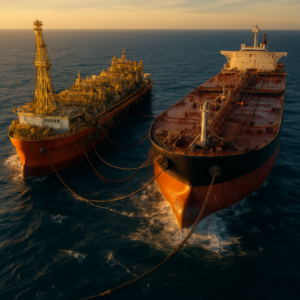 Picture this: a floating skyscraper, longer than the Eiffel Tower laid on its side, inching toward an offshore oil platform with the delicacy of a surgeon’s scalpel. That’s a Very Large Crude Carrier (VLCC) in the final stretch of its journey—a 330-meter behemoth carrying enough crude oil to fuel a small country. But before a single barrel can be pumped aboard, this steel leviathan must perform one of the most nerve-wracking ballets in the maritime world: docking alongside an FPSO (Floating Production Storage and Offloading unit) in the middle of the open ocean. There are no docks here, no calm harbors—just the relentless motion of the sea, the whisper of wind, and the ever-present risk of catastrophe if even a single calculation is off.
The moment a VLCC appears on the horizon, a carefully choreographed operation swings into action. Unlike container ships or passenger vessels, these tankers don’t just “pull up” to a terminal. They require an entire ecosystem of expertise, technology, and raw seamanship to bring them safely alongside. And at the heart of it all? The maritime pilot—a specialist who steps aboard with nothing but a duffel bag, a lifetime of experience, and the weight of billions of dollars in cargo resting on their decisions.
The Pilot’s Gambit: When Local Knowledge Saves the Day
No one knows the waters around an offshore oil field better than the pilots who work them day in and day out. These aren’t just any captains—they’re elite navigators who’ve spent years studying the quirks of a specific stretch of ocean: where the currents shift with the tides, how the wind funnels between platforms, and which underwater hazards could turn a routine docking into a disaster. When a VLCC is still 20 nautical miles out, the pilot is already on a helicopter, racing toward the ship at 150 knots, their mind running through checklists, weather reports, and the unique personality of the vessel they’re about to board.
“Every tanker has its own soul,” says Captain Elena Vasquez, a veteran pilot with over 2,000 VLCC dockings under her belt. “Some handle like a dream—responsive, predictable. Others? They’ve got a mind of their own. You can feel the sluggishness in the rudder, the way the bow resists turning. And in 30-meter swells, that’s when you earn your paycheck.”
The handover from the ship’s captain to the pilot is a ritual steeped in trust. The pilot climbs the Jacob’s ladder—a rope-and-wood contraption dangling 15 meters above the churning water—while the tanker is still moving at 5 knots. One misstep, one rogue wave, and they’re in the drink. But there’s no time for hesitation. The moment they step onto the bridge, the clock starts ticking. The VLCC is now theirs to command.
More information on Handling Hazardous Cargo: VCM, Butadiene & Ammonia Risks
Tugboats: The Unsung Heroes of the Deep
No VLCC docks alone. Even with its massive engines, a 300,000-ton tanker is at the mercy of the elements. That’s where tugboats come in—small but mighty vessels that act as the tanker’s external muscles, nudging, pulling, and sometimes forcing the giant into position. These aren’t your average harbor tugs; offshore operations require ocean-going tugs with bollard pulls of 100 tons or more, capable of wrestling a VLCC in 6-meter seas.
The dance begins with the tugs taking up position—one at the bow, one at the stern, and sometimes a third acting as a stabilizer. Their captains communicate via VHF radio, their voices calm but urgent, as they adjust thrusters in real time. “It’s like trying to park a bus with three remote-controlled cars,” jokes Tug Master Raj Patel, who’s spent 15 years guiding tankers in the North Sea. “Except the bus is the size of three football fields, the cars are the size of a house, and if you mess up, you’ve got an environmental disaster on your hands.”
The tugs don’t just push—they brace. In heavy weather, they’ll hold the VLCC in place while the pilot fine-tunes the approach, their engines roaring against the current. If the wind shifts suddenly, the tugs must react instantly, their propellers biting into the water to counteract the drift. It’s a high-stakes game of tug-of-war, and the ocean always has the home-field advantage.
The Invisible Battle: Wind, Current, and the Ghosts of Past Disasters
Maneuvering a VLCC isn’t just about power—it’s about outsmarting the ocean. Wind and current are the silent adversaries, capable of turning a textbook docking into a white-knuckle ordeal in seconds. A 20-knot crosswind can push a tanker sideways like a leaf in a storm, while a strong current can make the stern swing unpredictably, threatening to slam the vessel into the FPSO’s hull. And then there’s squat—the hydrodynamic effect that causes a ship to sink slightly in the water as it moves, reducing under-keel clearance and making shallow areas even more treacherous.
“You’ve got to think three steps ahead,” explains Captain Vasquez. “If the wind’s coming from the northeast, you don’t just aim for the FPSO—you aim where the wind will push you. And if the current’s running against you? You’ve got to give yourself room to drift. There’s no ‘undo’ button out here.”
Visibility—or the lack of it—adds another layer of complexity. In fog, rain, or the dead of night, pilots rely on radar, AIS (Automatic Identification System), and dynamic positioning (DP) systems to paint a picture of their surroundings. But technology can fail. In 2018, a VLCC in the Persian Gulf lost its DP system mid-docking due to a software glitch. The pilot had to rely on raw instinct and the tugs’ muscle to avoid a collision. “That night, I aged ten years,” the pilot later admitted. “You realize very quickly that no matter how many screens you have, the ocean doesn’t care about your gadgets.”
Dynamic Positioning: The Digital Safety Net
Modern VLCCs and FPSOs are equipped with dynamic positioning systems—a network of GPS, gyroscopes, and thrusters that automatically adjust the ship’s position to counteract wind, waves, and current. These systems are so precise they can hold a tanker within 3 meters of a target position in moderate seas. But DP isn’t foolproof. It requires constant power, flawless sensor data, and a backup plan for when things go wrong.
The system works by taking real-time data from wind sensors, motion reference units, and GPS, then calculating the exact thrust needed to keep the ship steady. If the wind gusts, the DP system fires up the thrusters to compensate. If the current shifts, it adjusts the rudder and engines. But in extreme conditions—say, a sudden 40-knot squall—the system can be overwhelmed. That’s when the pilot’s experience kicks in. “DP is a tool, not a crutch,” says Captain Vasquez. “You’ve got to know when to trust it and when to take manual control. Because if the system fails, you’ve got about 30 seconds before that 300,000-ton ship starts drifting toward a billion-dollar platform.”
The Final Approach: A Matter of Inches
As the VLCC closes in on the FPSO, the tension on the bridge becomes palpable. The pilot’s voice drops to a low murmur as they issue commands to the helmsman, their eyes flicking between the radar, the wind gauge, and the looming shadow of the platform. The tugs strain against their lines, their engines growling in protest. The FPSO’s crew watches from the deck, their own lives now in the hands of the pilot and the sea.
The last 50 meters are the most critical. At this range, even a slight miscalculation can mean disaster. The VLCC’s bow must align perfectly with the FPSO’s mooring hawser—a thick steel cable that will eventually secure the two vessels together. If the angle is off, the hawser could snap under tension. If the speed is too high, the impact could damage the tanker’s hull or the platform’s fenders. And if the wind suddenly gusts? The VLCC could pivot like a weather vane, its stern swinging dangerously close to the FPSO’s vulnerable equipment.
“You’re not just docking a ship—you’re threading a needle in a hurricane,” says Raj Patel. “And the needle is made of dynamite.”
When the bow finally kisses the FPSO’s fenders with a deep, resonant thud, the bridge erupts in quiet relief. The pilot exhales, the tug masters wipe sweat from their brows, and the FPSO’s crew springs into action, ready to secure the mooring lines. But the job isn’t over yet. The VLCC is still a floating bomb, its cargo worth hundreds of millions. One wrong move during the mooring process, and the entire operation could unravel.
For now, though, the giant is home. The real work—the transfer of oil, the dance of pumps and hoses, the journey to refineries halfway across the world—can begin. But none of it would be possible without the hours of precision, the split-second decisions, and the sheer nerve it took to guide a 330-meter colossus to its berth in the middle of the ocean.