

The Challenge of Inertia: Why Big Ships Can’t Stop on a Dime
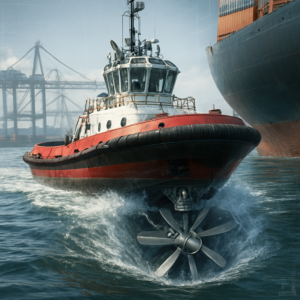 Picture this: a 220,000-ton container ship slicing through the ocean at 23 knots—roughly 26 miles per hour. To the untrained eye, it might look like a floating skyscraper, serene and unshakable. But beneath that calm exterior lies a physics problem so stubborn it could fill a textbook. That problem is inertia, the unyielding force that keeps objects in motion unless acted upon by an external force. And when that object is a vessel the size of a small city, inertia doesn’t just whisper—it roars.
Inertia isn’t just about weight; it’s about momentum, the product of mass and velocity. A Triple E-class ship, the behemoth of modern maritime trade, carries enough momentum at cruising speed to make stopping feel like trying to halt a runaway freight train with a feather. Even with engines in full reverse, the laws of physics demand their due. From the moment the captain orders “all stop,” that ship will glide forward for up to three miles before finally surrendering to stillness. To put that into perspective, imagine stacking five Eiffel Towers end-to-end along the Champs-Élysées. That’s the distance this steel leviathan needs to come to a complete halt. In the open ocean, this is merely an inconvenience—a delay, a calculation, a footnote in a voyage. But in the tight confines of a port or canal? It’s a disaster waiting to happen.
More information on Life at Sea: Internet & Food Realities on LPG Ships
The Physics of a Floating Mountain
Let’s break it down. A Triple E-class ship displaces 220,000 metric tons of water—that’s the equivalent of 200,000 family sedans, or roughly the weight of two Empire State Buildings. When that mass is moving at 23 knots, it generates momentum on a scale that defies human intuition. The ship’s engines, even at full astern, can only counteract a fraction of that force. The rest? It’s up to friction—water resistance, air resistance, and the sheer stubbornness of physics—to bleed off that energy over time and distance.
Here’s the kicker: water is slippery. Unlike a car’s tires gripping asphalt, a ship’s hull has no traction. There’s no sudden jolt, no screeching halt—just a slow, inevitable drift. The ship’s propellers can churn the water in reverse, but they’re fighting against a force so vast it might as well be invisible. It’s like trying to stop a boulder rolling downhill with a garden hose. The water pushes back, but the boulder keeps coming.
Why Ports Become Death Traps
Now, imagine trying to thread that same boulder through a needle’s eye. That’s essentially what happens when a 400-meter-long ship attempts to navigate a port or canal. The Suez Canal, for instance, is 205 meters wide at its narrowest point. A Triple E-class ship? 59 meters wide. On paper, that sounds manageable—until you factor in inertia. Even at reduced speeds, the ship’s momentum means it can’t pivot, swerve, or stop on command. It’s not just about the width of the channel; it’s about the time and space required to change direction or come to a halt.
In a confined space, inertia transforms from a minor inconvenience into a ticking time bomb. Consider the following risks:
- Collision: A ship moving at even 5 knots in a port has enough momentum to crush docks, pier structures, or smaller vessels like a sledgehammer through a cardboard box. The force of impact isn’t just destructive—it’s catastrophic, capable of sinking ships, rupturing fuel tanks, and causing environmental disasters.
- Grounding: Shallow waters and narrow channels leave no room for error. A ship that can’t stop in time will run aground, its hull scraping against the seabed like a knife against stone. The damage can be severe enough to breach the hull, leading to flooding, cargo loss, or even the total loss of the vessel.
- Loss of Control: Inertia doesn’t just affect stopping—it affects turning. A ship’s rudder, which relies on water flow to steer, becomes nearly useless at low speeds. Without assistance, the ship becomes a floating battering ram, drifting helplessly with the current or wind.
This is why ports don’t just prefer assistance—they require it. A ship attempting to dock alone is like a blindfolded giant trying to thread a needle while running. The risks aren’t just financial; they’re existential. A single miscalculation can result in millions of dollars in damages, weeks of delays, and, in the worst cases, loss of life.
The Illusion of Control
It’s tempting to think that modern technology—GPS, thrusters, advanced propulsion systems—has tamed the beast of inertia. But technology can only mitigate, not eliminate, the fundamental laws of physics. A ship’s captain can plot the perfect course, adjust for wind and current, and still find themselves at the mercy of momentum. The ocean doesn’t care about precision; it cares about mass and velocity.
This is why the ballet of port operations exists in the first place. It’s not just about guiding a ship into a berth; it’s about outsmarting inertia. Every tugboat, every line thrown, every calculated burst of engine power is a chess move against physics itself. The ship may be a marvel of engineering, but in the end, it’s still a 220,000-ton reminder that some forces can’t be rushed, only respected.