

The Hidden Cost of Fuel Incompatibility
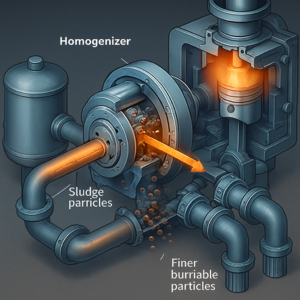 Fuel incompatibility isn’t just a technical hiccup—it’s a silent budget killer. When different fuel types are blended, whether intentionally or as a byproduct of switching suppliers, their chemical and physical properties clash in ways that aren’t always visible at first. The real damage unfolds over time, manifesting as sludge—a thick, tar-like residue that clogs systems, grinds operations to a halt, and inflates costs in ways most operators don’t anticipate until it’s too late.
The Chemistry Behind the Chaos
At its core, fuel incompatibility stems from the asphaltene instability that occurs when incompatible fuels are mixed. Asphaltenes—heavy, carbon-rich molecules found in residual fuels—are normally suspended in fuel by natural solvents called resins. But when fuels with different chemical profiles are blended, these resins can no longer keep the asphaltenes in solution. The result? Asphaltenes precipitate out, clumping together into sticky, abrasive particles that form sludge.
This process accelerates under certain conditions:
- Temperature fluctuations: Rapid heating or cooling disrupts the delicate balance between asphaltenes and resins, speeding up precipitation.
- Shear stress: Pumping fuel through narrow pipelines or valves can physically agitate the mixture, forcing asphaltenes to separate faster.
- Contaminants: Water, microbial growth, or even trace metals from storage tanks can act as catalysts, making sludge formation more aggressive.
In marine applications, where vessels often switch between heavy fuel oil (HFO), low-sulfur fuel oil (LSFO), and very low-sulfur fuel oil (VLSFO) to comply with emissions regulations, incompatibility is almost guaranteed. A 2020 study by Lloyd’s Register found that over 60% of fuel-related engine failures in the shipping industry were directly linked to sludge buildup from incompatible blends. The problem isn’t limited to ships, either—power plants, refineries, and industrial boilers face the same issues when transitioning between fuel sources.
More information on Toxic Voyages: The Hidden Dangers of VCM and Butadiene
The Financial and Operational Fallout
Sludge doesn’t just sit idle in tanks or pipelines. It migrates, accumulating in filters, separators, and injectors, where it wreaks havoc on equipment. The costs of this buildup are far-reaching and often underestimated:
1. Filter Replacements: The Silent Budget Drain
Filters are the first line of defense against sludge, but they’re also the first to fail. In a typical marine engine, automatic backflushing filters can clog in as little as 24–48 hours when dealing with incompatible fuels. Each replacement costs between $500 and $2,000 per filter, depending on the system, and in severe cases, operators may go through dozens per month. For a large container ship with multiple engines, this can translate to $50,000–$100,000 annually in filter-related expenses alone.
But the real cost isn’t just the filters—it’s the labor. Crews must constantly monitor and swap out filters, diverting manpower from other critical tasks. In one documented case, a VLCC (Very Large Crude Carrier) operating in the North Sea reported three filter changes per day during a voyage, requiring an extra engineer to be assigned full-time to the task. The vessel’s operator later estimated that labor costs for filter maintenance increased by 40% during the sludge-heavy period.
2. Downtime: When Every Minute Counts
Sludge doesn’t just clog filters—it can shut down entire systems. In 2019, a European power plant using a blend of HFO and biofuel experienced a catastrophic injector failure after sludge buildup caused a 20% drop in fuel flow. The plant was forced to switch to backup generators, resulting in 12 hours of unplanned downtime. The financial impact? Over €250,000 in lost production, not including the cost of emergency repairs.
In the maritime sector, downtime is even more punishing. A Panamax bulk carrier in 2021 suffered a main engine shutdown mid-voyage after sludge blocked its fuel injectors. The vessel was adrift for 18 hours while repairs were made, costing the operator $80,000 in lost charter time and $45,000 in emergency technician fees. The root cause? A last-minute fuel switch at port, where the new batch was incompatible with the remaining fuel in the tanks.
3. Waste Disposal: The Regulatory Nightmare
Sludge isn’t just a mechanical problem—it’s an environmental liability. Once removed from systems, it’s classified as hazardous waste in most jurisdictions, requiring specialized disposal. In the EU, for example, sludge from marine fuels falls under the EU Waste Framework Directive, mandating that it be incinerated in approved facilities or treated as chemical waste. The cost? €300–€800 per ton, depending on the region.
A Greek shipping company learned this the hard way when it was fined €1.2 million for illegally dumping sludge at sea after its onboard storage tanks overflowed. The company had been storing sludge for months, assuming it could offload it at the next port—but when no facility would accept the waste, the crew resorted to an illegal discharge. The fine didn’t include the €500,000 in cleanup costs or the reputational damage that followed.
Even when disposed of legally, the logistics are a headache. A Singapore-based refinery reported spending $1.5 million annually on sludge disposal, including transportation to a licensed incinerator 300 km away. The process required specialized tanker trucks, permits, and round-the-clock security to prevent theft or illegal dumping.
Why Traditional Solutions Fall Short
Faced with sludge, operators often turn to quick fixes—but these rarely address the root cause and can even make the problem worse.
1. Manual Cleaning: A Losing Battle
Scraping sludge out of tanks or pipelines is labor-intensive, dangerous, and temporary. In 2018, a Norwegian offshore supply vessel spent three days manually cleaning its fuel tanks after sludge clogged its separators. The crew used high-pressure hoses and chemical solvents, but within two weeks, the sludge had returned. Why? Because the incompatible fuel blend was still in the system, and the cleaning process hadn’t addressed the underlying chemical instability.
Manual cleaning also poses safety risks. Sludge often contains hydrogen sulfide (H₂S), a toxic gas that can be fatal in high concentrations. In 2020, two crew members on a Liberian-flagged tanker were hospitalized after inhaling H₂S fumes while cleaning a sludge-clogged tank. The incident led to a $200,000 fine for the vessel’s operator and a three-month delay in the ship’s schedule.
2. Additive Treatments: A Band-Aid on a Bullet Wound
Fuel additives—detergents, dispersants, and stabilizers—are often marketed as a magic bullet for sludge. In reality, they’re more like a band-aid. While some additives can temporarily suspend sludge particles in fuel, they don’t eliminate the incompatibility that caused the problem in the first place. Once the additive wears off, the sludge returns—often worse than before.
A Middle Eastern refinery learned this lesson after spending $2 million on additives over two years. The initial results were promising: sludge buildup in its boilers decreased by 30%. But within six months, the additives stopped working entirely. Lab tests later revealed that the asphaltenes had adapted, forming even larger, more stubborn clumps. The refinery was forced to scrap its additive program and invest in a fuel homogenization system—a solution it could have implemented from the start.
3. Fuel Switching: Trading One Problem for Another
Some operators try to avoid sludge by sticking to a single fuel type, but this isn’t always practical—or cost-effective. In the maritime industry, for example, vessels must switch between HFO and LSFO to comply with IMO 2020 sulfur regulations. Even when using the same fuel type, batch variations from different suppliers can introduce incompatibility.
A Japanese ferry operator attempted to standardize its fuel by sourcing all its LSFO from a single supplier. The strategy worked—until the supplier changed its refining process, introducing a new blend that was incompatible with the ferry’s existing fuel. Within two weeks, sludge had clogged the vessel’s fuel purifiers, leading to engine misfires and a $150,000 repair bill. The operator was forced to revert to blending fuels, accepting that sludge was an unavoidable cost of doing business.
The bottom line? Traditional solutions treat the symptoms of fuel incompatibility, not the disease. Until operators address the root cause—the chemical instability of blended fuels—sludge will continue to drain budgets, disrupt operations, and create regulatory headaches.