

Red Flags: How Scammers Lure Seafarers
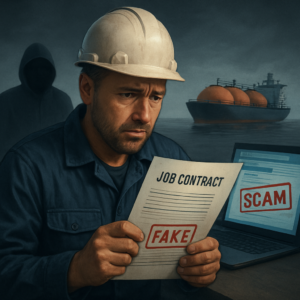 Picture this: You’re scrolling through job boards, maybe even checking your messages late at night, when an offer lands in your inbox. It’s for a Chief Engineer position on a gas carrier—$13,500 a month, no experience in LNG required, and they’re ready to fly you out next week. The catch? You need to pay a “medical clearance fee” upfront, just to secure your spot. Sound too good to be true? That’s because it almost always is.
Scammers targeting seafarers have refined their tactics over the years, turning desperation and ambition into a lucrative business. They don’t just post fake job ads—they engineer entire narratives designed to bypass your skepticism. Here’s how they do it, and how to spot the traps before you’re the one left holding the bill.
The Urgency Trap: “We Need You Yesterday”
One of the most reliable tools in a scammer’s arsenal is artificial urgency. They’ll claim the vessel is about to depart, the previous candidate fell through, or the company is under pressure to fill the role immediately. The message is clear: decide now, or lose the opportunity forever.
Take, for example, the case of a Filipino seafarer who received a WhatsApp message from a recruiter named “Igor” in early 2023. The offer was for a Second Engineer position with Alpa Marne, promising $9,800 a month—nearly double the market rate for the role. The catch? Igor needed a $1,200 “seafarer’s registration fee” wired within 24 hours to “process the contract.” When the candidate hesitated, Igor sent a fake crew list with the victim’s name already on it, along with a Photoshopped email from the “company’s HR department” confirming the urgency. The seafarer paid. The job, of course, never existed.
More information on Switching to LPG Tankers: A Starter’s Roadmap
Scammers know that pressure clouds judgment. They’ll often cite “company policy” or “port authority regulations” to justify why you can’t take time to verify their claims. If someone is pushing you to act before you’ve even had a chance to research the company or speak to a reference, walk away.
The Salary Mirage: When the Numbers Don’t Add Up
Let’s talk about money. Specifically, salaries that seem plucked from a fantasy. A Chief Engineer on a gas carrier earning $13,500 a month isn’t unheard of—but it’s rare, especially for candidates without prior LNG experience. Scammers use these eye-popping figures to override your critical thinking. After all, who wouldn’t want to believe they’ve just landed the deal of a lifetime?
In 2022, a group of seafarers from Ukraine and Russia were targeted by a fake company called . The job postings, shared in Telegram groups and on Facebook, advertised Third Officer positions with a starting salary of $8,500—far above the industry standard. When applicants reached out, they were told the high pay was due to a “special contract” with a Middle Eastern client. The scammers even provided a slick, professional-looking website (which was later revealed to be a near-identical copy of a legitimate crewing agency’s site). The red flag? The salaries were consistently 30-50% higher than what reputable agencies were offering for the same roles.
Here’s the rule of thumb: If a salary seems too good to be true, it probably is. Before getting excited, cross-check the offer with industry standards. Websites like The Maritime Executive or Seatrade Maritime often publish salary surveys. If the numbers don’t align, proceed with caution.
The Upfront Payment Scam: “Just a Small Fee to Get Started”
This is where scammers get creative—and where most victims realize they’ve been duped. The request for money can come in many forms, but the script is almost always the same: “This is standard procedure,” “It’s refundable,” or “The company will reimburse you.” Spoiler alert: It’s not, and they won’t.
Common fees scammers demand include:
- Medical examination fees: “You need a special LNG medical clearance—it costs $800, but it’s mandatory.”
- Agency or registration fees: “We’re a licensed agency, and our processing fee is $1,500.”
- Visa or flight deposit: “We’ll book your ticket, but we need a $2,000 deposit to secure it.”
- Training or certification costs: “You need an additional STCW endorsement for gas carriers—it’s $600.”
In one particularly brazen scam, a group operating under the name Riga Oceanic targeted Indian seafarers with fake job offers for tanker vessels. The scammers claimed the company was based in Latvia and had a fleet of 12 ships. After “selecting” candidates, they demanded a $1,000 “security deposit” to “hold the position.” When one candidate asked for an invoice, they received a PDF with a fake company letterhead and a Latvian bank account number. The money was gone within hours.
Legitimate crewing agencies do not ask for money upfront. If a company is pressuring you to pay for anything—whether it’s a medical exam, a visa, or a “processing fee”—it’s a scam. Reputable employers cover these costs themselves or deduct them from your first salary, never before you’ve even set foot on the vessel.
The Fake Company Playbook: How Scammers Build Illusions
Scammers don’t just invent job offers—they invent entire companies. And they’re disturbingly good at it. Here’s how they do it:
- Stolen identities: They’ll copy the name, logo, and even the website of a real crewing agency or shipping company. For example, Latmar Crew was a fake version of a legitimate Latvian agency. The scammers created a near-identical website, complete with a “team” page featuring stock photos of smiling professionals.
- Fake documents: They’ll send you contracts, crew lists, or even “official” emails from the company’s “HR department.” These documents often look convincing at first glance, but closer inspection reveals inconsistencies—like misspelled names, incorrect company addresses, or logos that don’t quite match the real thing.
- Fake references: Some scammers will even provide “references” from other seafarers who’ve supposedly worked for the company. These references are often fake accounts or paid shills. In one case, a victim called a “reference” provided by a scammer, only to hear a voice recording of a generic “thank you for calling” message.
In 2021, a scam involving a fake company called Mari Horizon Crewing (a play on the real Marine Horizon) targeted seafarers in the Philippines. The scammers used a Gmail address (marinehorizoncrewing@gmail.com) and a WhatsApp number with an Estonian country code (+372). They sent contracts with a forged signature from the “managing director” and even provided a fake MLC (Maritime Labour Convention) certificate. The scam only unraveled when victims tried to verify the company’s registration in the Philippines and found no record of it.
How to verify a company’s legitimacy:
- Check if they’re listed on the International Chamber of Shipping (ICS) or ITF (International Transport Workers’ Federation) databases.
- Search for their registration in the country they claim to be based in (e.g., Latvian Business Register for Latvia, Estonian Business Register for Estonia).
- Look for reviews on platforms like Maritime Connector or Seamanship.ph.
- Ask for their IMO number (for shipping companies) or license number (for crewing agencies). Legitimate companies will have no problem providing this.
The Communication Red Flags: Gmail, WhatsApp, and “Igor”
Scammers love unofficial communication channels because they’re hard to trace and easy to abandon. Here’s what to watch for:
- Free email domains: If a company is contacting you from a Gmail, Yahoo, or Outlook address, it’s a major red flag. Legitimate crewing agencies and shipping companies use corporate email domains (e.g., @alphamarine.com, not @alphamarinecrew@gmail.com).
- WhatsApp or Telegram as the primary contact: While some legitimate recruiters use WhatsApp for quick communication, no serious company will conduct all their hiring processes through it. If they refuse to speak on the phone, provide a landline number, or meet in person, it’s a scam.
- Generic recruiter names: Scammers often use common names like “Igor,” “Alex,” or “John” to avoid standing out. In one case, a group of scammers used the name “Igor Petrov” across multiple fake companies, including Des Crew and Riga Ocean. When victims searched for “Igor Petrov” online, they found dozens of complaints—but no real person.
- Poor grammar and spelling: While not all scammers are non-native English speakers, many fake job offers are riddled with errors. Legitimate companies invest in professional communication.
In 2023, a scammer posing as a recruiter for Latma Crew contacted a group of seafarers via WhatsApp. The messages were sent from a Latvian number (+371), but the email address was latmarcrewing@gmail.com. When one candidate asked for a phone call, the scammer claimed the “office phone lines were down” and insisted on continuing the conversation via WhatsApp. The scammer even sent a fake “company ID” with a stock photo of a man in a suit. The giveaway? The ID had a typo in the company’s name: “Latma Crewing Services” instead of “Latmar Crew Services.”
If you’re in doubt, reverse-search the phone number using tools like Truecaller or Sync.ME. Scammers often reuse numbers, and you might find complaints from other victims.
The Psychological Play: Why These Scams Work
Scammers don’t just rely on fake documents and high-pressure tactics—they exploit human psychology. Here’s why their tricks are so effective:
- Fear of missing out (FOMO): The idea that you might lose a life-changing opportunity can override your better judgment. Scammers know this and use phrases like “limited slots available” or “only two positions left.”
- Authority bias: They’ll pose as “senior recruiters,” “managing directors,” or even “captains” to make their offers seem more legitimate. The use of titles and jargon can make you feel like you’re dealing with a real professional.
- Reciprocity: Some scammers will offer “free” services—like resume reviews or “priority processing”—to make you feel indebted to them. Later, they’ll use this to justify why you need to pay a fee.
- Social proof: Fake testimonials, Photoshopped crew lists, and even fake social media profiles of “happy employees” are all designed to make you believe others have successfully taken the deal.
In one particularly insidious scam, a group targeting Indian seafarers created a fake Facebook group called “LNG Gas Carrier Jobs 2024.” The group was filled with posts from “seafarers” who had supposedly gotten jobs through the scammers, complete with photos of them on “vessels” (which were later revealed to be stock images). The scammers even organized a fake “webinar” where a man posing as a “captain” answered questions about working on gas carriers. The webinar was nothing more than a pre-recorded video, but it was enough to convince dozens of victims to pay the “processing fees.”
The lesson? Trust your gut. If something feels off—whether it’s the recruiter’s tone, the speed of the hiring process, or the way they’re asking for money—it probably is. Scammers rely on your desire to believe in a better future. Don’t let that desire blind you to the warning signs.