

VLGC Salaries: Captains and Officers at the Top
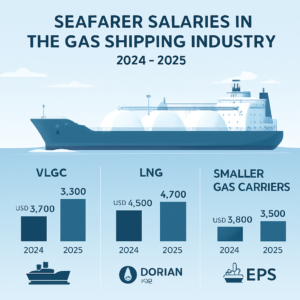 When it comes to commanding a Very Large Gas Carrier (VLGC), the financial rewards reflect the immense responsibility—and risk—of overseeing a vessel that can transport up to 84,000 cubic meters of liquefied petroleum gas (LPG) across oceans. These ships are the workhorses of the energy trade, and the men and women who run them are compensated accordingly. But not all VLGC roles are created equal. Salaries fluctuate based on experience, company policies, and even the subtle politics of maritime employment. Let’s break down what captains and chief officers can realistically expect in 2024-2025—and why some are pocketing significantly more than others.
The Base Salary Breakdown: What’s the Going Rate?
At the top of the hierarchy, VLGC captains are among the highest-paid professionals in the maritime industry. In 2024, the base salary for a captain on a VLGC typically ranges from $14,000 to $16,000 per month, with some elite operators pushing the upper limit to $17,000 or more for seasoned masters with a flawless track record. For context, that’s nearly double what a captain on a standard bulk carrier might earn, and for good reason: VLGCs demand precision, deep technical knowledge, and the ability to navigate high-stakes cargo operations.
Just one rung below, chief officers (or first mates) on VLGCs command salaries between $11,800 and $13,000 per month. While the gap between captain and chief officer may seem modest on paper, the real earnings disparity often comes from bonuses, overtime, and company-specific incentives—which we’ll dive into shortly. Still, even at the lower end of this range, a chief officer on a VLGC is earning far more than their counterparts on smaller gas carriers or tankers.
Who Pays the Most? The Top Players in VLGC Compensation
Not all shipping companies are created equal when it comes to pay scales. Some of the most lucrative VLGC contracts come from specialized gas carriers with deep pockets and a reputation for rewarding loyalty. Here’s a snapshot of the heavy hitters:
- Dorian LPG – A leader in the VLGC space, Dorian is known for competitive base salaries and a robust bonus structure. Captains here can expect $15,000–$16,500, while chief officers hover around $12,500–$13,500. The company also offers seniority bonuses—a rare perk in an industry where job-hopping is common. Stay with Dorian for five years, and your monthly paycheck could swell by an additional $1,000–$2,000.
- Eastern Pacific Shipping (EPS) – Another major player, EPS is aggressive with its compensation, particularly for officers with prior VLGC experience. Captains at EPS can pull in $15,500–$17,000, while chief officers see $12,800–$14,000. The company also sweetens the deal with re-joining bonuses—a lump sum of $5,000–$10,000 for officers who return after a contract elsewhere. It’s a clever way to retain talent in a cutthroat market.
- BW LPG – One of the largest VLGC operators in the world, BW LPG offers salaries on par with Dorian and EPS, but with a twist: performance-based bonuses. Captains here can earn an extra $1,500–$3,000 per month if their vessel meets strict efficiency and safety benchmarks. Chief officers see similar incentives, though the payouts are slightly lower.
- Avance Gas – A smaller but well-regarded operator, Avance pays slightly below the top tier but makes up for it with shorter contract durations (typically 4 months instead of 6) and generous leave policies. Captains earn $14,500–$15,800, while chief officers get $12,000–$13,000.
It’s worth noting that Japanese and Korean VLGC operators (like NYK, MOL, and K-Line) tend to pay slightly less than their Western counterparts—often $1,000–$2,000 below the industry average. However, they compensate with longer-term job security and better benefits, such as housing allowances and family support programs. For officers who prioritize stability over short-term earnings, these companies can be an attractive option.
What Moves the Needle? Factors That Influence VLGC Salaries
While the base salary ranges are well-defined, several variables can push earnings higher—or, in some cases, drag them down. Here’s what really matters:
1. Experience: The Seniority Premium
In the VLGC world, experience isn’t just valued—it’s monetized. A captain with 10+ years on gas carriers can command $1,000–$2,000 more per month than a newcomer to the role. Chief officers, too, see a bump: those with 5+ years in the rank often earn at the top of the $11,800–$13,000 range, while less experienced officers may start closer to $11,000.
But here’s the catch: not all experience is equal. A captain who’s spent a decade on VLCCs (Very Large Crude Carriers) won’t automatically qualify for the highest VLGC pay. Gas carriers operate under different safety protocols, cargo handling procedures, and regulatory frameworks. Companies want proven VLGC experience, and they’re willing to pay a premium for it.
2. Vessel Size and Complexity
Not all VLGCs are identical. The newest, most advanced ships—like those equipped with LPG dual-fuel engines or carbon capture systems—require crews with specialized training. Captains and officers who can operate these cutting-edge vessels often earn 5–10% more than those on older, less sophisticated tonnage.
Additionally, some VLGCs are dedicated to specific trade routes (e.g., U.S. Gulf to Asia), which can come with higher pay due to increased operational demands or geopolitical risks. For example, a VLGC regularly transiting the Strait of Hormuz or the South China Sea may offer higher salaries to account for the added stress and security concerns.
3. Company Policies: Bonuses, Overtime, and Hidden Perks
Base salary is only part of the story. The real money in VLGC roles often comes from bonuses and allowances. Here’s where things get interesting:
- Seniority Bonuses – As mentioned earlier, companies like Dorian LPG reward long-term loyalty. After five years, a captain might see their monthly pay jump from $15,000 to $17,000—a 13% increase just for sticking around.
- Re-Joining Bonuses – EPS and BW LPG use these to lure back experienced officers. A chief officer who left for a competitor and returns might pocket a $7,000 bonus on top of their base salary.
- Performance Bonuses – Some companies tie bonuses to fuel efficiency, safety records, or on-time deliveries. A captain who consistently meets these targets could add $2,000–$3,000 per month to their earnings.
- Overtime and Leave Pay – VLGC contracts typically include 10–12 hours of paid overtime per week, which can add $1,500–$2,500 to a monthly paycheck. Additionally, some companies offer paid leave allowances—a rare but valuable perk in an industry where time off is often unpaid.
- Regional Allowances – Officers on VLGCs trading in high-risk areas (e.g., West Africa or the Middle East) may receive hazard pay, boosting their earnings by 10–15%.
4. Regional Variations: Where You Work Matters
While VLGC salaries are generally high across the board, there are subtle regional differences:
- Singapore and Dubai – These hubs are home to many VLGC operators, and salaries here tend to be at the higher end of the scale. Companies in these regions also offer tax-free earnings for expat officers, which can effectively double take-home pay.
- Europe (Norway, Greece, UK) – VLGC operators in these regions pay well but often include taxes and social contributions, which can eat into net earnings. However, they make up for it with stronger labor protections and better benefits.
- Japan and Korea – As mentioned earlier, salaries here are slightly lower, but the trade-off is job stability and long-term contracts. Many Japanese and Korean VLGC officers stay with the same company for 10+ years, which can lead to pension benefits and career progression that Western companies rarely offer.
More information on Fake Gas Carrier Jobs: How to Spot Scams & Avoid Fraud
Why Do VLGC Roles Command Premium Wages?
At this point, you might be wondering: Why are VLGC salaries so much higher than those on other vessel types? The answer comes down to three key factors:
1. The Cargo Itself: High Stakes, High Rewards
LPG is volatile, flammable, and under extreme pressure. A single mistake in cargo handling—whether during loading, unloading, or transit—can lead to catastrophic consequences. VLGC officers aren’t just managing a ship; they’re overseeing a floating bomb. The industry compensates them accordingly.
Compare this to a bulk carrier hauling grain or coal, where the biggest risk is a delayed delivery. The stakes simply aren’t the same.
2. Specialized Knowledge and Training
Operating a VLGC requires advanced certifications that go beyond standard maritime training. Officers must complete:
- IGC Code (International Gas Carrier Code) certification – A rigorous course covering gas cargo operations, safety protocols, and emergency response.
- Advanced Firefighting and Hazardous Materials Training – Because when things go wrong on a VLGC, they go very wrong.
- Dynamic Positioning (DP) Certification – Many VLGCs use DP systems for precise maneuvering in ports, adding another layer of complexity.
This specialized training narrows the talent pool, driving up wages for those who qualify.
3. Market Demand and Supply
The global LPG trade is booming, driven by demand from Asia (particularly India and China) and the U.S. shale gas revolution. VLGCs are the backbone of this trade, and shipping companies are scrambling to secure experienced crews. When demand outstrips supply, wages rise—and right now, VLGC officers are in short supply.
Additionally, the aging workforce in maritime means many experienced VLGC officers are nearing retirement. Companies are offering higher salaries and better benefits to attract and retain the next generation of talent.
The Bottom Line: What Can VLGC Officers Really Earn?
So, after all the variables, bonuses, and regional quirks, what does a VLGC officer’s total compensation look like? Here’s a realistic breakdown:
- Captain (Dorian LPG, 10+ years experience, seniority bonus):
- Base salary: $16,000
- Seniority bonus: $1,500
- Performance bonus: $2,000
- Overtime: $2,000
- Total: $21,500/month
- Chief Officer (EPS, 5+ years experience, re-joining bonus):
- Base salary: $13,000
- Re-joining bonus (prorated monthly): $800
- Performance bonus: $1,500
- Overtime: $1,800
- Total: $17,100/month
- Captain (Japanese operator, 15+ years experience):
- Base salary: $14,500
- Loyalty bonus: $1,000
- Overtime: $1,500
- Total: $17,000/month (plus long-term benefits)
Of course, these are best-case scenarios. A captain or chief officer on a smaller VLGC with no bonuses might earn closer to the base salary range. But for those who play their cards right—gaining experience, choosing the right company, and leveraging bonuses—VLGC roles can be among the most lucrative in the maritime industry.
And that’s before we even factor in the tax advantages of working for a Singaporean or Middle Eastern operator, where earnings are often tax-free. For officers willing to embrace the lifestyle, the financial rewards are hard to beat.
Author: Ch.Eng