

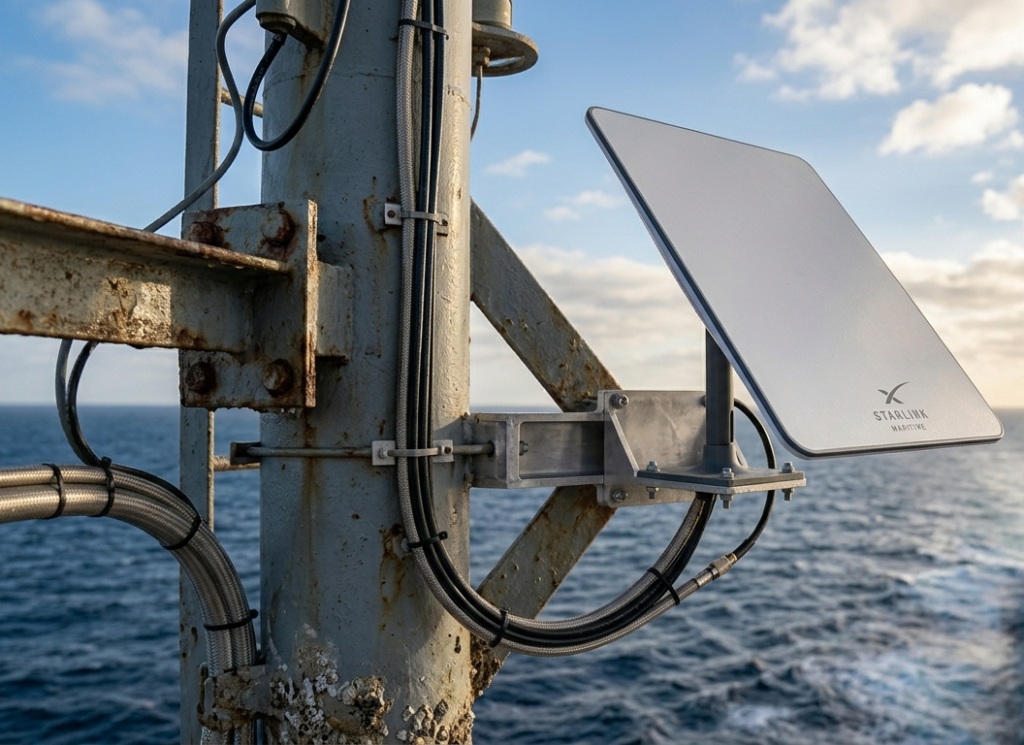
The era when internet access at sea was a slow, overpriced luxury is officially coming to an end. The maritime industry is undergoing a massive digital transformation, and the Starlink Maritime system is firmly leading this process.
The shift from traditional geostationary satellites (VSAT) to Low Earth Orbit (LEO) constellations is fundamentally changing the rules of the game, providing ships with high-speed internet that can confidently compete with land-based providers.
But is everything as smooth as it seems in practice? Let’s break down the technological advantages and real feedback from seafarers.
🚀 A Technological Breakthrough: What Starlink Maritime Offers Ships
The difference in this new technology lies in its technical specifications and adaptation to harsh marine realities:
- Ultra-Low Latency (Ping): Because Starlink satellites orbit at an altitude of only about 550 km above Earth, signal latency drops to a record 30–60 ms. This makes stutter-free video calls, instant messaging, and cloud-based work possible.
- Real Broadband at Sea: Data transmission speeds often now exceed 100–250 Mbps. Ships are no longer “technological black holes.”
- Ruggedized Hardware: “Flat High Performance” terminals are engineered specifically for motion. With an IP56 protection rating, they easily withstand vibrations, extreme temperatures, and heavy saltwater spray.
⚓ Impact on Vessel Operations and Crew Welfare
Introducing high-speed internet is not just a technological upgrade; it is a vital strategy for crew retention and mental health support.
1. Combatting Isolation: Seafarers can communicate freely with their families, stream content, and manage personal affairs. This radically improves the moral climate onboard.
2. Safety and Navigation: Constant connectivity allows for real-time weather updates, route adjustments, and continuous communication with shore-based management.
3. Smart Fleet (IoT): Shipping companies can monitor sensor data and machinery online in real-time, enabling predictive maintenance.
More information on Revolutionizing Maritime Connectivity: How Starlink is Changing the Game for Ships and Crews
💬 Seafarer Experience and Reviews: An Inside Look
Analysis of private professional maritime communities shows that the implementation of Starlink is met with a passionate response from crews. However, the availability of the connection depends heavily on the policy of the specific shipowner.
- Generous Companies: Some crew members report that their companies purchase 5 TB packages, providing the crew with unlimited internet in common areas for gaming and streaming. There are also business plans providing 10 TB packages or even full unlimited data.
- Limits and Costs: Other companies have more modest conditions. Some seafarers share experiences of having to buy 10 GB of traffic for $50, while on oil tankers under the same company, it might be $30. It is noted that mandatory and large updates for modern applications quickly “eat up” limited traffic, making it an expensive luxury.
- Company Markups: There are cases where seafarers have to pay $10 per 1 GB of ship internet, which causes outrage, considering the actual cost of global plans from the provider.
🛠️ The “Fly in the Ointment”: Installation Challenges and Pitfalls
Despite its status as a game-changer, Starlink does not work on a simple “plug and play” basis. Seafarers and technical experts highlight several important nuances:
- Mast and Crane Shadows: The antenna requires an perfectly clear view of the sky. Any obstacles, such as ship superstructures or cranes, can lead to signal loss. Therefore, choosing the right installation spot on the ship is critical.
- Smart Redundancy: True reliability requires professional network configuration. For critical systems to function smoothly, Starlink is often used as the primary channel, but it must be integrated with backup systems (often using Mikrotik routers) to distribute traffic and prevent downtime.
- Plan Selection: Fleet managers have access to flexible regional and global plans, allowing them to optimize costs depending on the vessel’s sailing area.
🔮 Final Thoughts
The Starlink Maritime system has officially moved high-speed ocean internet from the “luxury” category to a basic operational standard. This technology is erasing the boundaries between shore and sea, making fleet operations more efficient and crew life more comfortable and socially integrated. While some shipowners still try to save on traffic, the global transition to LEO satellites is already irreversible.