

The Allure of High-Risk, High-Reward Shipping Jobs
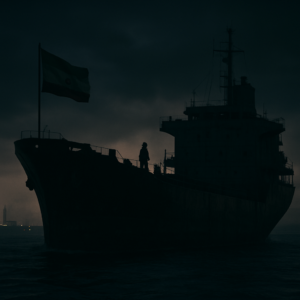 There’s a reason why the maritime industry has always had its share of gamblers—men and women willing to roll the dice on jobs that promise big payouts but come with even bigger risks. For some seafarers, the decision to sign onto a sanctioned vessel isn’t born out of ignorance or desperation, but a calculated bet on the chance to earn in a few months what others make in a year. The ships may fly under false flags, the cargo manifests might be forged, and the ports of call could be in nations under heavy sanctions, but the money? That’s very, very real.
Take the Ullswater, for example—a vessel that’s become something of a legend in certain circles. Officially, it’s just another gas carrier plying its trade in the Mediterranean. Unofficially, it’s a ship that’s moved Iranian LPG under a web of shell companies and falsified paperwork, slipping through the cracks of international oversight. For the crew that’s served on her, the experience is often framed in two parts: the first, a rush of excitement at the paychecks; the second, the slow creep of unease as the reality of what they’re involved in sets in.
One second engineer, who asked to be called “Dmitri” for this story, put it bluntly: “I knew what I was getting into. Or at least, I thought I did.” He’d been working standard contracts in the Black Sea for years, making decent but unremarkable money. Then, through a crew agency in Limassol, he was offered a spot on the Ullswater. The pay? Nearly triple his usual rate. The catch? The contract was vague about the ship’s ownership, and the cargo was listed as “petrochemicals” with no further details. “They told me it was just another gas carrier,” Dmitri said. “No red flags, no warnings. Just a lot of zeros on the offer letter.”
More information on Gas Fleet Salaries 2024-2026: Who Pays the Most?
The Money Talks—And It Talks Loudly
For most seafarers, the financial incentives are the siren song that drowns out the warnings. Standard tanker jobs pay well, but they’re also predictable, grinding, and often come with long stretches away from home. A chief officer on a sanctioned vessel, however, can pull in $12,000 to $15,000 a month—sometimes more—with bonuses for “high-risk operations” that can add another 20-30% to the total. For a Filipino able seaman or an Indian oiler, that kind of money isn’t just life-changing; it’s generational. It’s the difference between sending your kids to a local school and putting them through university. It’s the difference between renting a cramped apartment in Manila and buying a house outright.
Then there’s the speed of it. A standard contract might last four to six months, with a month or two off in between. On a sanctioned ship, the rotations are often shorter—three months on, one month off—because the owners know the crew is under more stress and need to be cycled out before fatigue or paranoia sets in. But the real draw is the accelerated earnings. A seafarer who spends two years on sanctioned vessels can walk away with enough savings to retire early, start a business, or simply never worry about money again. For those who’ve spent a decade or more in the industry, watching their peers struggle on standard wages while a lucky few post photos of new cars or homes bought outright, the temptation is hard to resist.
One Ukrainian captain, who worked on the Serenity Gas before it was seized by authorities in 2022, described the financial pressure this way: “I had a mortgage, two kids in private school, and a wife who wanted to move to Spain. The money I was making on a clean tanker? It wasn’t enough. Not even close. When the agency called and said, ‘We’ve got a ship, three months, $20K a month,’ I didn’t ask questions. I just said yes.” He paused, then added, “I regret it now. But at the time? I would’ve signed anything.”
The Recruitment Machine: How Agencies Sell the Dream
No one stumbles into a job on a sanctioned vessel by accident. These positions are filled through a network of crew agencies—some legitimate, some less so—that specialize in placing seafarers on ships where the paperwork is, at best, creative. The pitch is always the same: high pay, short contracts, minimal questions asked. The risks? Those are either glossed over or framed as “industry standard” challenges.
Agencies play a crucial role in downplaying the dangers. They’ll tell a prospective crew member that the ship is “flagged in a neutral country” (ignoring that the flag might be a one-ship registry with no real oversight). They’ll describe the cargo as “sensitive” rather than “sanctioned.” And they’ll often present the job as a one-off opportunity—something to take advantage of now, before the market changes. One Filipino rating, who worked on a vessel carrying Iranian oil, recalled his agency’s sales pitch: “They said, ‘This is a special project. The pay is high because it’s a short-term thing. After this, you’ll never have to worry about money again.’ They made it sound like a golden ticket.”
The reality, of course, is far murkier. Many of these agencies operate in a legal gray area themselves, registering in countries with lax labor laws and little interest in probing the origins of a ship’s cargo. They’ll often require crew members to sign nondisclosure agreements (NDAs) before boarding, warning them that discussing the ship’s operations—even with family—could result in legal action or blacklisting. For seafarers who’ve already quit their previous jobs and are counting on the paycheck, the pressure to stay silent is immense.
And then there’s the peer pressure. In tight-knit maritime communities, word spreads fast when someone lands a high-paying gig. A chief engineer who’s just returned from a three-month stint on a sanctioned vessel isn’t just flush with cash; he’s also the subject of envy and curiosity. “Everyone wants to know how you did it,” said a Greek officer who worked on a ship carrying Syrian oil. “They don’t ask about the risks. They just want to know who to call for the next job.”
The Illusion of Control: “I Can Handle It”
For many seafarers, the decision to take a job on a sanctioned vessel is rooted in a belief that they can control the risks. They tell themselves that they’re just doing their jobs, that they’re not responsible for the ship’s paperwork or its cargo. They convince themselves that as long as they keep their heads down and don’t ask too many questions, they’ll be fine. And for a while, that illusion holds.
But the cracks start to show when the ship is delayed in port for “customs issues,” or when the captain receives a satellite call from an unknown number, speaking in coded language. Or when the crew is told to turn off their AIS transponders—a red flag that the ship is operating in the dark, invisible to tracking systems. One third mate, who worked on a vessel carrying Venezuelan oil, described the moment he realized how deep he was in: “We were in the middle of the Atlantic, and the captain got a message: ‘Change course. New destination.’ No explanation. Just a new set of coordinates. That’s when I knew this wasn’t just another job.”
The psychological toll is real, even if the crew doesn’t talk about it. Seafarers on sanctioned vessels often report heightened anxiety, sleepless nights, and a constant low-level fear of being boarded by authorities. Some cope by rationalizing their involvement: “I’m just a mechanic. I don’t care what’s in the tanks.” Others double down, telling themselves that the money is worth the stress. But for a few, the weight of what they’re doing becomes too much. The Ukrainian captain who worked on the Serenity Gas admitted, “I started drinking more. Not a lot, but enough to take the edge off. Every time we docked, I’d hold my breath until we were underway again. That’s no way to live.”
The Unspoken Truth: It’s Not Just About the Money
While the financial incentives are the most obvious draw, they’re not the only reason seafarers take these jobs. For some, it’s about adventure—the thrill of being part of something secretive, something that feels like it’s operating outside the normal rules. For others, it’s about pride. In an industry where experience is everything, serving on a sanctioned vessel can be a way to prove you’re willing to take on the toughest assignments, to do what others won’t. And for a few, it’s simply about survival. In countries where maritime jobs are scarce and wages are stagnant, a high-risk contract might be the only way to keep a career afloat.
A Pakistani electrician, who worked on a ship carrying Iranian condensate, put it this way: “I had two choices: take this job and send money home, or watch my family struggle. What would you do?” He paused, then added, “I don’t like lying about where I’ve worked. But I like being broke even less.”
The allure of these jobs is undeniable. The money is transformative. The contracts are short. The risks, at least in the moment, feel manageable. But for every seafarer who walks away with a fat bank account and a clean conscience, there’s another who ends up blacklisted, stranded in a foreign port, or worse. The question isn’t why so many take the gamble—it’s why, in an industry built on risk, anyone would expect them not to.
Author: Ch.Engineer