

The Birthplace of Giants: Why South Korea Dominates Shipbuilding
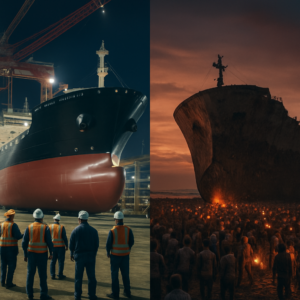 I still remember the first time I set foot in the dry dock at Hyundai Heavy Industries in Ulsan. The sheer scale of it hit me like a physical force—an open-air cathedral of steel and concrete, stretching farther than my eyes could follow. The dock was 670 meters long, 131 meters wide, and deep enough to swallow a 20-story building. And there, at its center, loomed the skeleton of what would become a 400,000-ton Very Large Crude Carrier (VLCC), its ribs of high-tensile steel rising like the bones of some mythical beast. I’d worked on ships before, but nothing prepares you for the moment you realize you’re standing inside the future hull of a vessel that will carry enough oil to fuel a small country.
South Korea didn’t just stumble into its dominance in shipbuilding. It was forged through decades of relentless innovation, government-backed ambition, and an almost obsessive pursuit of precision. Today, the country builds nearly half of the world’s commercial ships by tonnage, leaving competitors like China and Japan scrambling to keep up. But how did a nation with no natural resources and a coastline half the length of Norway’s become the undisputed king of shipbuilding? The answer lies in three pillars: scale, technology, and an ecosystem that turns blueprints into floating cities.
More information on Switching to LPG Tankers: A Starter’s Roadmap
The Dry Docks: Where Ships Are Born in Megablocks
Modern shipbuilding is less about hammering plates together and more about assembling a 3D jigsaw puzzle of prefabricated megablocks. At DSME’s Okpo shipyard, where I spent two years working on Maersk’s Triple-E class container ships, the process begins long before the first steel is cut. The ship is divided into hundreds of blocks, some weighing over 3,000 tons—equivalent to two fully loaded Boeing 747s. These blocks are built in parallel across the yard, then transported to the dry dock by self-propelled modular transporters (SPMTs), a fleet of multi-wheeled giants that move with eerie, hydraulic precision.
One of the most surreal moments of my career was watching a 1,500-ton engine room block—complete with pre-installed piping, wiring, and even some machinery—being lifted into place by a floating crane with a 3,600-ton capacity. The block swung gently in the air, suspended by cables thicker than my arm, before settling into its final position with a metallic groan that echoed across the dock. It was like watching a Lego set come to life, if Lego bricks were the size of apartment buildings.
The dry docks themselves are marvels of engineering. Hyundai’s No. 3 Dock in Ulsan is one of the largest in the world, capable of accommodating two VLCCs side by side. When a ship is ready for launch, the dock is flooded in a process that takes 12 hours. I’ve seen seasoned engineers hold their breath as the water rises, checking for leaks or misalignments that could spell disaster. The moment the ship first touches the water—the “float-up”—is always met with a collective exhale, followed by applause. It’s the first time the vessel truly becomes a ship, no longer just a collection of steel and dreams.
The Symphony of Precision: Robots, Lasers, and Digital Twins
If the dry dock is the stage, then the real magic happens in the fabrication shops, where robots and lasers do the work that humans once did with torches and chalk lines. At DSME, I worked alongside automated welding systems that could lay down a perfect bead of weld at speeds no human could match. These machines don’t just weld—they adapt in real-time, using sensors to adjust for variations in steel thickness or gaps in the joint. The result? Welds so precise that they’re stronger than the steel itself.
But the real game-changer is the use of digital twins. Every ship built in South Korea today has a virtual counterpart—a real-time, 3D model that tracks every weld, every bolt, and every coat of paint. I remember walking through the engine room of a nearly completed LNG carrier, tablet in hand, comparing the physical space to its digital twin. If a pipe was even a centimeter out of place, the system flagged it. This isn’t just about quality control; it’s about eliminating human error before it becomes a problem.
South Korea’s investment in R&D is staggering. The government pours billions into shipbuilding innovation, funding everything from AI-driven design optimization to eco-friendly coatings that reduce fuel consumption. At Hyundai, I saw engineers testing carbon-fiber propellers and air-lubrication systems that create a micro-bubble layer under the hull to reduce drag. These aren’t just incremental improvements—they’re revolutionary leaps that keep Korean yards ahead of the curve.
The Human Element: A Workforce That Never Sleeps
For all the talk of robots and digital twins, shipbuilding is still a human endeavor. And in South Korea, that means a workforce that operates with military precision. The yards run 24/7, with shifts changing like clockwork. I’ve seen crews of welders, electricians, and pipefitters—many of them foreign workers from the Philippines, Indonesia, and Vietnam—move in perfect sync, like ants in a colony. Communication is everything. With workers speaking a dozen different languages, instructions are often given through a mix of hand signals, diagrams, and broken English.
One of my most vivid memories is of a midnight shift during the final stages of a container ship’s construction. The air was thick with the smell of welding fumes and saltwater, and the dock was lit by floodlights that turned night into day. A team of Filipino welders was working on the ship’s superstructure, their torches casting eerie blue arcs in the dark. Suddenly, a miscommunication led to a critical pipe being installed backward. The mistake wasn’t caught until the next morning, and by then, the pipe had already been encased in insulation. Fixing it required ripping out a section of the deck, costing tens of thousands of dollars and delaying the project by a week. The lesson? In shipbuilding, there’s no room for ambiguity.
Yet, despite the pressure, there’s a camaraderie that forms in these yards. I’ve shared meals with welders who’ve worked in the same spot for 20 years, engineers who’ve dedicated their lives to perfecting a single type of valve, and crane operators who can lower a 500-ton block with millimeter precision. These are the unsung heroes of the industry—the people who turn blueprints into reality.
Why South Korea Leaves the Competition in Its Wake
China may build ships faster and cheaper, but South Korea builds them better. The difference comes down to three things: quality, innovation, and an ecosystem that can’t be replicated overnight.
- Government Backing: The Korean government treats shipbuilding as a strategic industry, offering subsidies, tax breaks, and low-interest loans to yards like Hyundai, DSME, and Samsung Heavy Industries. During the 2008 financial crisis, when orders dried up, the government stepped in with a $10 billion bailout to keep the yards afloat. China, by comparison, has a more fragmented approach, with hundreds of smaller yards competing for scraps.
- Skilled Labor: South Korea’s workforce is among the most highly trained in the world. Many engineers and technicians are graduates of specialized maritime universities, and the country’s apprenticeship programs ensure a steady pipeline of talent. In China, labor is cheaper, but turnover is high, and the skill level varies wildly.
- Innovation: While China focuses on volume, South Korea invests in cutting-edge technology. From LNG-powered ships to autonomous navigation systems, Korean yards are always pushing the envelope. Japan, once the leader in shipbuilding, has fallen behind because it failed to adapt quickly enough to new technologies.
Take the Triple-E class container ships, for example. When Maersk wanted to build the largest and most efficient container ships in the world, they didn’t go to China or Japan—they went to DSME in South Korea. Why? Because DSME could deliver a ship that was not just big, but smart. The Triple-E’s twin-skeg hull design reduces fuel consumption by 37%, and its waste-heat recovery system captures energy that would otherwise be lost. These aren’t just incremental improvements; they’re game-changers that redefine what a ship can be.
The Launch: When Years of Work Slide into the Water
No matter how many ships you’ve seen launched, the moment never loses its magic. I was there for the christening of a 20,000 TEU container ship at Hyundai’s Ulsan yard. The ship, gleaming in fresh paint, sat in the dry dock like a sleeping giant. The ceremony was a blur of speeches, champagne bottles, and the traditional breaking of a coconut against the bow—a nod to the old maritime superstition that a ship must “bleed” before its first voyage.
Then came the moment of truth. The dock gates opened, and water rushed in, lifting the ship inch by inch. The crowd fell silent as the vessel began to move, its massive hull sliding toward the sea with a deep, resonant rumble. For a heart-stopping second, it seemed to hesitate, as if reluctant to leave the safety of the dock. Then, with a final surge, it was free—floating for the first time, its bow cutting through the water like a knife.
The launch is always emotional, but this one hit me harder than most. Maybe it was the years of work that had gone into this ship, or the knowledge that it would spend the next three decades crossing oceans, carrying goods that would end up in homes and stores around the world. Or maybe it was the realization that, for all the technology and precision, a ship is still a living thing—a creation of steel and sweat, born to defy the sea.
As the ship sailed out of the harbor, its horn sounded—a deep, mournful blast that echoed across the water. I like to think it was saying thank you.