

The Prelude: Planning an STS Operation
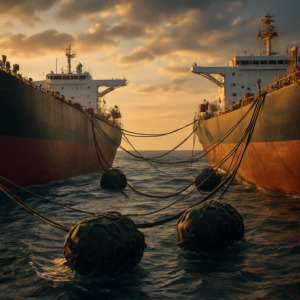 You don’t just wake up one morning, point two tankers at each other, and start pumping oil. An STS operation is like a high-stakes ballet—every move is choreographed months in advance, and one wrong step can turn the whole performance into chaos. The planning phase isn’t just paperwork; it’s the foundation that keeps two 200,000-ton giants from turning into scrap metal in the middle of the ocean.
1. The Chess Game of Initial Planning
Before a single mooring line is thrown, someone has to answer the big questions: Where? When? How? And, most importantly, Will this actually work?
- Route and Location: Not every patch of water is suitable for an STS. We’re talking about areas with enough depth (so neither ship runs aground), minimal traffic (so we don’t block a shipping lane), and, ideally, some natural shelter from wind and waves. Most STS operations happen in designated “transfer zones” near ports, but sometimes we have to improvise—like that time off the coast of Malta when the usual spot was clogged with fishing boats, and we had to shift 10 miles east. The charterers weren’t thrilled, but better safe than sorry.
- Weather Windows: The ocean doesn’t care about your schedule. A 3-meter swell can turn a routine transfer into a nightmare. We rely on forecasts from multiple sources—NOAA, local meteorological services, even the captain’s old-school barometer. If the wind’s picking up or a storm’s rolling in, the operation gets scrubbed. No exceptions. I’ve seen crews push their luck, thinking, “It’ll be fine,” only to spend the next six hours white-knuckling the rail as the fenders groan under the strain.
- Vessel Compatibility: Not all tankers are created equal. You’ve got your VLCCs (Very Large Crude Carriers), Suezmax, Aframax—the list goes on. Before we even think about mooring, we check:
- Size and Draft: Can both ships safely approach each other without one dragging its keel? If the receiving vessel is too small, it might get tossed around like a cork.
- Mooring Equipment: Are the winches strong enough? Do we have enough lines? A 300-meter VLCC needs a lot more holding power than a coaster.
- Cargo Systems: Are the pumps compatible? What’s the transfer rate? If one ship’s pumping at 5,000 m³/h and the other can only handle 3,000, we’ve got a problem.
More information on Toxic Voyages: The Hidden Dangers of VCM and Butadiene
I remember a job in the North Sea where the charterer insisted on pairing a brand-new Aframax with an old Suezmax that hadn’t seen maintenance in years. The chief engineer on the Suezmax nearly had a heart attack when he saw the state of their cargo pumps. We ended up having to slow the transfer rate to a crawl, and what should’ve taken 12 hours dragged into 20. Lesson learned: never assume compatibility—verify.
2. The Puppet Masters: Port Authorities, Charterers, and STS Providers
An STS operation isn’t a two-ship affair. It’s a three-ring circus, and if one ringmaster drops the ball, the whole show collapses.
- Port Authorities: Even if the transfer happens 50 miles offshore, the local port authority still has to sign off. They’ll check:
- That the operation complies with local and international regulations (MARPOL, SOLAS, you name it).
- That there’s a contingency plan in case of a spill. (Spoiler: There’s always a contingency plan, and it’s always terrifying to read.)
- That the transfer zone isn’t going to interfere with commercial traffic or, God forbid, a naval exercise.
In some ports, like Rotterdam or Singapore, the authorities are so strict that you’d think they’re trying to prevent a maritime apocalypse. In others… well, let’s just say I’ve worked in places where the “inspection” consisted of a guy in flip-flops nodding at a clipboard.
- Charterers: These are the folks who hired the ships, and they’re usually in a hurry. Their job is to balance cost, speed, and safety—often in that order. They’ll push for faster transfers, tighter schedules, and cheaper service providers. It’s our job to push back when they’re being reckless. I’ve had charterers argue that “a little wind never hurt anyone” while we’re staring at a forecast calling for 25-knot gusts. Newsflash: a little wind can hurt a lot of people when you’ve got two ships the size of skyscrapers rubbing against each other.
- STS Service Providers: These are the specialists who handle the actual mooring and transfer. They bring the fenders, the hoses, the communication gear, and—most importantly—the experience. A good STS provider is worth their weight in gold. A bad one? Well, let’s just say I’ve seen fenders pop like balloons because someone skimped on quality. These guys also handle the STS Plan, a document that outlines every step of the operation, from approach speeds to emergency shutdown procedures. If you’ve ever wondered what 50 pages of legalese and technical diagrams looks like, congratulations—you’re about to find out.
Communication between all these parties is key. I’ve been on jobs where the charterer and the STS provider were giving us conflicting instructions, and it’s like herding cats. One time, the charterer insisted we start the transfer at dawn, while the STS provider said the current would be too strong until noon. We ended up standing by for four hours, burning fuel, while the two sides argued over satellite phone. Moral of the story? If the left hand doesn’t know what the right hand is doing, someone’s going to lose a finger.
3. Pre-Arrival Checks: Trust, But Verify
You can plan all you want, but if the equipment fails, you’re screwed. That’s why the pre-arrival checks are non-negotiable. Here’s what we go through before the ships even meet:
- Mooring Equipment:
- Lines: We inspect every mooring line for fraying, kinks, or weak spots. A snapped line in the middle of a transfer is a nightmare—imagine a 50-meter rope whipping around at 100 km/h. Not fun.
- Winches: Are they operational? Do they have enough braking power? If a winch fails while we’re tensioning a line, the whole mooring pattern can collapse.
- Fairleads and Chocks: These are the guides that keep the lines from chafing against the deck. If they’re worn down or misaligned, the lines will wear through faster than a cheap pair of jeans.
- Fenders: These are the giant rubber bumpers that keep the ships from crushing each other. We check:
- Inflation pressure (too soft, and they’ll compress too much; too hard, and they’ll act like concrete).
- Condition (are there cuts, abrasions, or signs of dry rot?).
- Attachment points (are the chains and shackles secure?).
I’ve seen fenders fail because someone didn’t bother to check the inflation valves. One minute, everything’s fine; the next, the ships are grinding against each other like tectonic plates. Not a sound you ever want to hear.
- Cargo Systems:
- Pumps: Are they primed? Are the seals intact? A pump failure mid-transfer means we’re dead in the water—literally.
- Valves: Every valve in the cargo line needs to be checked for leaks and proper operation. A stuck valve can cause pressure surges that rupture hoses.
- Hoses: Are they the right size? Are the flanges compatible? Are there any signs of wear? A blown hose is one of the fastest ways to turn an STS operation into an environmental disaster.
- Vapor Recovery: If we’re transferring volatile cargo, we need to make sure the vapor recovery system is working. Otherwise, we’re venting flammable gases into the air like a floating refinery.
- Communication Gear: Radios, AIS, even good old-fashioned signal flags. If we can’t talk to the other ship, we can’t coordinate. I’ve seen operations delayed because someone forgot to charge the handheld radios. Pro tip: Always have a backup.
One time, during a pre-arrival check in the Gulf of Mexico, we found that half our mooring lines had been stored improperly and were covered in mold. The chief officer nearly lost his mind. We had to scramble to borrow lines from another ship, which delayed us by a day. Since then, I’ve made it a habit to personally inspect the mooring gear before every STS. Call me paranoid, but I’d rather be paranoid than adrift in the middle of the ocean with a snapped line.
4. Risk Assessments and Safety Briefings: Because Hope Is Not a Strategy
STS operations are dangerous. Full stop. You’ve got two massive ships, thousands of tons of flammable liquid, and a whole lot of things that can go wrong. That’s why we don’t just assume everyone knows what they’re doing—we make sure.
- The Risk Assessment: This is a document that identifies every possible hazard and outlines how we’ll mitigate it. It covers:
- Environmental Risks: What if there’s a spill? What if the wind picks up? What if a rogue wave hits?
- Mechanical Risks: What if a hose bursts? What if a winch fails? What if the fenders give out?
- Human Risks: What if someone falls overboard? What if there’s a fire? What if the crew on the other ship doesn’t follow protocol?
The risk assessment isn’t just a formality—it’s our playbook. If something goes wrong, we don’t have time to improvise. We follow the plan.
- The Safety Briefing: Before the operation starts, the entire crew gathers for a briefing. The captain or chief officer walks us through:
- The STS Plan (what’s happening, when, and how).
- The emergency procedures (where to muster, how to shut down the transfer, what to do in case of a spill).
- The roles and responsibilities (who’s handling the lines, who’s monitoring the pumps, who’s on standby with the fire hoses).
- The communication protocols (who talks to the other ship, who talks to the STS provider, who talks to the port authority).
I’ve been in briefings where the captain just reads from a PowerPoint like a bored professor. Those are the ones where mistakes happen. The good captains? They make it interactive. They ask questions. They make sure everyone—from the greenest deckhand to the most seasoned engineer—knows exactly what’s expected of them.
One thing that’s always stressed is situational awareness. During an STS, it’s easy to get tunnel vision—you’re focused on your task, and you forget to look around. That’s how accidents happen. I’ve seen guys nearly get crushed between fenders because they weren’t paying attention to the other ship’s movement. Now, I make it a habit to glance up every few minutes, just to check the big picture.
5. When the Weather Doesn’t Cooperate: A Real-World Example
No matter how much you plan, Mother Nature always gets the final say. I learned that the hard way during an STS off the coast of South Africa.
We were transferring crude from a VLCC to an Aframax in a designated zone about 20 miles offshore. The weather forecast called for light winds and calm seas—perfect conditions. The STS provider was on board, the fenders were inflated, and we were ready to go. Then, about an hour before the approach, the wind started picking up. Not a big deal, we thought. We’d seen worse.
By the time the Aframax was alongside, the wind had jumped to 25 knots, and the swell was pushing 2.5 meters. The fenders were compressing and rebounding like they were made of rubber bands. The mooring lines were singing under the strain. The captain on the VLCC—an old-school guy who’d seen it all—took one look at the situation and said, “Nope. We’re not doing this.”
At first, the charterer pushed back. “We’re already here. Let’s just get it done.” But the captain stood his ground. He knew that if we proceeded, we’d be risking:
- A snapped mooring line (which could whip across the deck and take someone’s head off).
- A ruptured fender (which would mean metal-on-metal contact between the ships).
- A hose failure (which could spill thousands of barrels of crude into the ocean).
We delayed the operation by 12 hours. The charterer wasn’t happy, but when the wind finally died down and we completed the transfer without a hitch, even they had to admit it was the right call. That day taught me two things:
- Never trust a weather forecast 100%. Always have a backup plan.
- The captain’s word is final. If they say it’s not safe, it’s not safe. End of story.
In the end, the delay cost the charterer a few thousand dollars in extra fuel and port fees. But you know what would’ve cost them more? A snapped line, a crushed fender, or—God forbid—a spill. When it comes to STS operations, slow is smooth, and smooth is safe.
The emphasis on pre-arrival checks is spot on. I’ve seen too many near-misses due to poorly maintained mooring lines. A solid risk assessment is truly the best defense we have during STS operations.
I appreciate the detailed look at fender checks. Proper inflation pressure is something that often gets overlooked until the vessels are grinding against each other. ‘Slow is smooth, and smooth is safe’ is a mantra every seafarer should live by.