

The lubrication of large two-stroke marine diesel engines, operating at speeds up to 250 rpm and delivering power outputs of up to 100,000 kW, is a critical and independent process. The cost of cylinder oil for a typical vessel is immense, potentially reaching about 2.3 million euros over its lifetime. Globally, the shipping fleet consumes approximately 1.18 million tonnes of cylinder oil annually. With lubricant costs ranging from 900 to 1,400 euros per tonne, the total annual economic burden is estimated to be between 1.1 and 1.6 billion euros.
Corrosion Challenges and Traditional Lubrication
Marine bunker fuels are generally of relatively low quality and possess a high sulphur content, which inevitably leads to the formation of sulphuric acid during the combustion process. This acid promotes the corrosion of the soft matrix elements in the cast iron cylinder liners. Consequently, harder cementite particles are released, damaging the liner surface and causing further abrasive wear.
To counteract these acids, cylinder lubricants are formulated with basic (alkaline) additives. However, traditional systems face a significant technical challenge in distributing these additives evenly across the entire cylinder surface. This can result in a characteristic uneven wear pattern: the area close to the fuel injectors remains in good condition, while areas further away suffer from corrosive wear. At the same time, over-lubrication is highly detrimental, as an excess of lubricant additives leads to hard, calcium-based deposits on piston crowns and in ring grooves, which can eventually cause liner scuffing.
More information on Marine Fuel Separators: Design, Working Principle, Details
The Impact of Emission Control Areas (SECAs) on Lubricants
Current MARPOL Annex VI regulations strictly cap fuel sulphur content at 1.5% in Sulphur Emission Control Areas (SECAs), such as the Baltic and North Seas. To comply, vessels must either switch to low-sulphur fuel when entering these zones or install exhaust gas cleaning systems (scrubbers), which cost between 600,000 and 1.2 million euros.
When switching fuels, a significant challenge arises: if the cylinder oil’s Base Number (BN) remains unchanged and is not matched to the new low-sulphur fuel, utilizing a compromise lubricant will lead to either excessive deposit formation or increased corrosive wear.
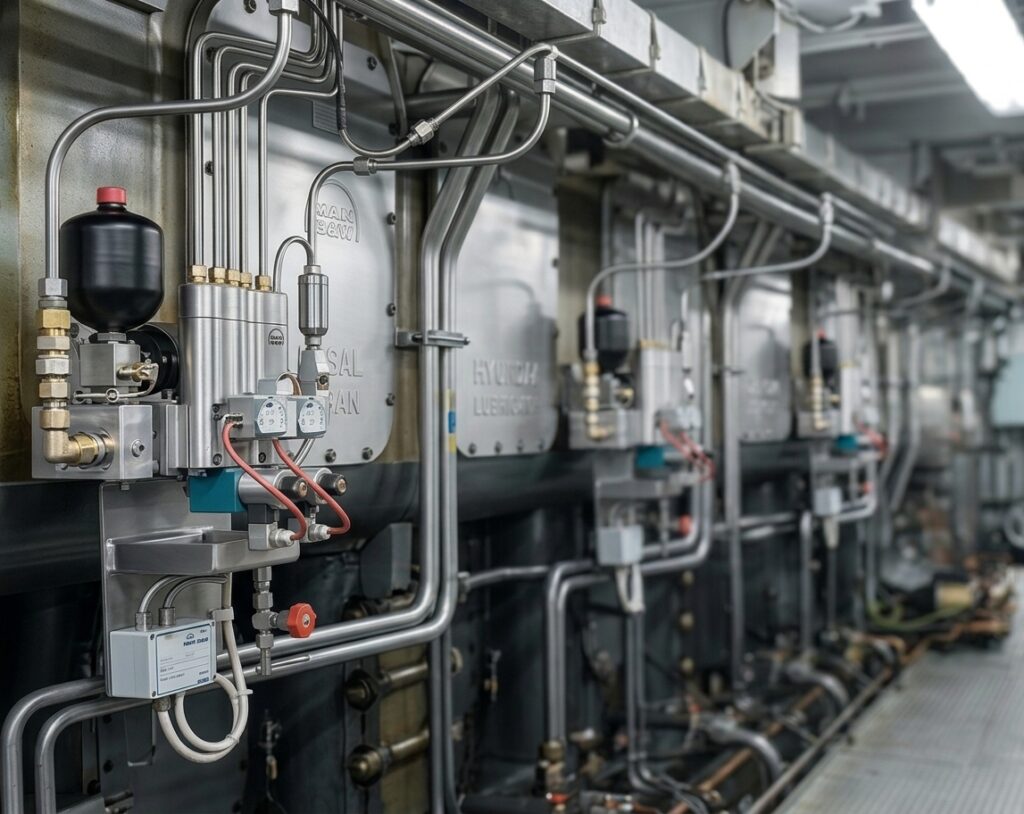
Working Principle of the Electronic Lubricator (Alpha Lubrication System)
Traditional mechanical lubricators deliver oil at a variable rate, normally around 0.9 to 1.2 g/kWh, by mechanically adjusting the volume injected on each engine stroke. In contrast, advanced electronic systems, such as the MAN B&W Alpha Lubrication System, achieve this through a fundamentally different dosing method.
The core principle of the electronic lubricator is that it changes the time interval between injections rather than adjusting the physical volume delivered per stroke. The lubricant is injected into the cylinder during a single stroke, after which the algorithm skips several strokes without any injection until the next scheduled application.
This feedback-based technology maintains an ideal hydrodynamic film and delivers the precise amount of anti-corrosion additives required, effectively eliminating over-lubrication and minimizing overall cylinder oil consumption. The system optimally balances the lubricant supply rate with adhesive and abrasive wear rates, maximizing the lifespan of the cylinder and piston components.
Advantages of Feedback-Based Electronic Systems
The integration of computer-controlled electronic lubricator systems provides ship operators with numerous operational advantages:
- Individual Control: Lubricating conditions can be strictly managed in a manner that is unique to each individual engine cylinder. This considerably extends the service life of the equipment, including the period between piston-ring replacements.
- Component Wear Compensation: The system can improve piston-ring sealing within the cylinder over the engine’s lifespan. It automatically accounts for changes in component clearances caused by ring or liner wear, helping to reduce the occurrence of combustion gas blow-by.
- Adaptation to External Conditions: Electronic management can automatically compensate for variations in the quality of the supplied lubricating oil. Furthermore, the system can adapt to changing sea states, which have been shown to influence the operating oil film thickness on piston rings.
- Integration with Condition Monitoring: Electronic injection systems provide an excellent opportunity for integration with condition monitoring tools. This enables the detection of latent engine issues through their impact on the oil supply control parameters.
- Precise Additive Dosing: Certain feedback systems allow for the control of a separate additive supply line. They accurately match the delivery of alkaline additives to the exact sulphur level in the fuel being burned, thereby minimizing any corrosive effects.