

The Hull: Where Cargo Meets Safety
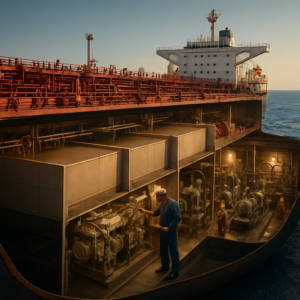 The hull of a modern oil tanker isn’t just a steel shell—it’s a meticulously engineered fortress designed to carry volatile cargo while protecting the ocean from disaster. At the heart of this design are the 12 cargo tanks, arranged in a symmetrical grid: six on the port (left) side and six on the starboard (right) side. This layout isn’t arbitrary. It ensures weight distribution remains balanced, preventing the vessel from listing dangerously during loading, unloading, or rough seas. Each tank is a self-contained compartment, isolated by cofferdams—empty spaces that act as firebreaks and contamination barriers. On our vessel, the largest tanks hold up to 12,000 cubic meters of crude oil, while the smaller ones near the bow and stern are tapered to fit the hull’s narrowing shape.
But the real innovation lies beneath the surface: the double-bottom and double-hull design. This isn’t just an industry standard—it’s a lifeline for the environment. Here’s how it works:
- Double Bottom: A secondary layer of steel separates the cargo tanks from the ocean floor. If the outer hull is breached—say, during a grounding—the seawater floods the ballast tanks in the double bottom instead of mixing with the oil. This buys critical time to assess damage and prevent a spill.
- Double Hull: The cargo tanks are also enclosed by side ballast tanks, creating a buffer zone along the vessel’s flanks. In a collision, the outer hull absorbs the impact, while the inner hull remains intact. The Exxon Valdez disaster in 1989, where a single-hulled tanker spilled 37,000 tons of oil into Alaska’s Prince William Sound, was the catalyst for this design. Today, MARPOL regulations mandate double hulls for all new tankers, and older vessels have been phased out or retrofitted.
Yet even the best hull design can’t compensate for human error. Take the case of the MV Prestige in 2002. The single-hulled tanker, already weakened by corrosion, split in half off the coast of Spain after its crew improperly ballasted the vessel during a storm. The result? 64,000 tons of oil fouled 2,000 kilometers of coastline. The disaster underscored a critical truth: ballast isn’t just about stability—it’s about survival.
More information on Switching to LPG Tankers: A Starter’s Roadmap
The Ballast Tanks: A Delicate Balance
When a tanker unloads its cargo, it becomes dangerously light. Without ballast, the vessel would ride too high in the water, exposing the propeller and rudder, reducing maneuverability, and—worst of all—making it vulnerable to parametric rolling, a violent motion that can capsize even large ships. To counter this, we flood the 12 dedicated ballast tanks (plus two additional tanks in the forepeak and afterpeak) with seawater. Here’s the breakdown:
- Side Ballast Tanks: Located between the inner and outer hulls, these tanks flank the cargo holds. When filled, they lower the vessel’s center of gravity, improving stability.
- Double-Bottom Ballast Tanks: These run along the keel, providing longitudinal strength and preventing the hull from hogging (bending upward) or sagging (bending downward) under its own weight.
- Forepeak and Afterpeak Tanks:
- Forepeak Tank: Located at the bow, this tank is used to adjust trim (the vessel’s pitch). Filling it dips the bow, improving hydrodynamics and reducing fuel consumption. It’s also critical for ice navigation—a full forepeak helps break ice by lifting the bow onto the floe.
- Afterpeak Tank: Situated at the stern, this tank controls the vessel’s aft draft. Keeping it full ensures the propeller remains submerged, preventing cavitation (bubbles that erode the blades) and loss of propulsion. On our tanker, we can shift 2,000 tons of ballast between the forepeak and afterpeak in under an hour to fine-tune the vessel’s attitude.
But ballast water isn’t just a tool—it’s a global environmental threat. When a tanker takes on ballast in one port and discharges it in another, it can introduce invasive species—from toxic algae to zebra mussels—that devastate local ecosystems. The MV Golden Venture, for example, was implicated in the spread of Asian kelp to the U.S. West Coast in the 1990s, which smothered native marine life. To combat this, the Ballast Water Management Convention (2017) requires all vessels to treat ballast water before discharge. On our tanker, we use a three-stage system:
- Filtration: A 50-micron screen removes sediment, plankton, and larger organisms.
- UV Treatment: High-intensity ultraviolet light sterilizes the water, killing bacteria and viruses.
- Electrochlorination: A small dose of chlorine (produced onboard from seawater) ensures no organisms survive the journey. The treated water is then monitored for compliance before discharge.
Failure to comply isn’t just an environmental risk—it’s a financial one. In 2021, a tanker was fined $2.1 million in the U.S. for discharging untreated ballast water. But the stakes are higher than fines. Improper ballasting can lead to catastrophic instability. In 2015, the MV Bulk Jupiter sank off Vietnam after its crew over-ballasted the forepeak, causing the vessel to plunge bow-first into heavy seas. All but one of the 19 crew members perished. The lesson? Ballast isn’t just about filling tanks—it’s about precision.
The Unseen Guardians: Cofferdams and Void Spaces
Between the cargo tanks and the ballast tanks lie cofferdams—narrow, empty spaces that serve as the hull’s last line of defense. These aren’t just gaps; they’re engineered safeguards. If a cargo tank leaks, the oil collects in the cofferdam, where sensors trigger alarms before it can reach the ballast tanks (and, by extension, the ocean). On our vessel, the cofferdams are also inerted—filled with nitrogen to prevent explosive vapors from accumulating.
Then there are the void spaces: unused compartments that add structural integrity. These aren’t just “dead space”—they’re shock absorbers. In a collision, they deform first, absorbing energy before it reaches the cargo tanks. The MV Erika, which broke apart in 1999 off France, lacked sufficient void spaces, and its hull fractured like glass under the strain of heavy seas. The spill—20,000 tons of oil—led to stricter hull stress monitoring requirements.
Every inch of a tanker’s hull is a calculated compromise between capacity, safety, and efficiency. The cargo tanks carry the payload, the ballast tanks keep the vessel stable, and the double hull stands guard against disaster. But even the best design is only as strong as the people who operate it. A single miscalculation in ballasting, a skipped inspection of a cofferdam, or a delayed response to a hull breach can turn a routine voyage into a global catastrophe. That’s why, when I walk the deck and see the maze of pipes and hatches, I don’t just see steel—I see responsibility.