

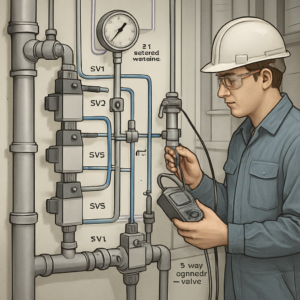
 The Samgong control panel doesn’t just flip switches—it orchestrates a tightly synchronized ballet of water and pressure, where every millisecond counts. At the heart of this operation lies the timing chart, a precise sequence of three interdependent phases that dictate how the separator bowl opens, clears, and reseals. Misjudge even one of these intervals, and the system either fails to discharge sludge properly or—worse—dumps perfectly good fuel into the waste tank. Let’s break down how these phases work, why their timing is non-negotiable, and how they map to the physical mechanics of the separator.
The Three-Phase Sequence: A Chain Reaction of Precision
The FSH-1P-TR’s timing chart is built around three core parameters: T603 (Sealing Water), T602 (Replacement Water), and T601 (Discharge). These aren’t standalone timers; they’re dominoes. Each phase triggers the next, and their durations overlap in a way that ensures the bowl’s internal pressure is always where it needs to be—no more, no less. Here’s how the sequence unfolds:
- Phase 1: Sealing Water (T603) – Preparing the BowlBefore the separator can even think about discharging sludge, it needs to create a hydraulic lock. This is where T603 comes in. When activated, sealing water is injected into the bowl’s lower chamber, pushing against the sliding piston. This pressure forces the piston upward, compressing the bowl’s discs and sealing the sludge space. Think of it like priming a pump—without this step, the bowl would simply collapse when opened, and the discharge would fail.Critical detail: T603 doesn’t just turn on and off. It runs for a set duration (typically 3–5 seconds) to ensure the piston is fully seated. Too short, and the seal is weak; too long, and you waste water and delay the next phase.
- Phase 2: Replacement Water (T602) – Clearing the PathHere’s where things get clever. Once the bowl is sealed, the system needs to displace the clean fuel still trapped in the sludge space. If you opened the bowl now, that fuel would mix with the sludge and be lost. T602 solves this by injecting replacement water into the bowl’s upper chamber. This water pushes the fuel upward and out through the clean fuel outlet, effectively “flushing” the system before discharge.Critical detail: T602 must start before T601 (Discharge) begins and continue running until the bowl is fully open. If it cuts off too early, fuel remains in the sludge space; if it runs too long, it dilutes the sludge or causes water to enter the clean fuel line. The overlap between T602 and T601 is where the magic happens—and where most mistakes are made.
- Phase 3: Discharge (T601) – Opening the BowlWith the bowl sealed and the fuel displaced, the system is finally ready to open. T601 triggers the solenoid valve that releases operating water from the bowl’s lower chamber. As the pressure drops, the sliding piston moves downward, opening the sludge ports. The accumulated sludge is ejected under centrifugal force, and the bowl is cleared.Critical detail: T601’s duration is the most sensitive of the three. Too short, and the bowl doesn’t open fully, leaving sludge behind; too long, and the system starts drawing in air or—worse—begins to reseal prematurely, trapping sludge inside. This is why T601’s timing is often set just long enough to ensure a complete discharge, but not a millisecond more.
The Timing Chart in Action: A Visual Breakdown
To truly grasp how these phases interact, it helps to see them laid out on a timeline. Below is a simplified ASCII-style timing diagram showing the overlap and duration of T603, T602, and T601. Note how T602 and T601 run concurrently for a portion of the cycle—this is the window where fuel displacement and discharge happen simultaneously.
Time (seconds) →
0       1       2       3       4       5       6       7       8
|-------|-------|-------|-------|-------|-------|-------|-------|
T603:   [=======] (Sealing Water)
T602:           [=======================] (Replacement Water)
T601:                   [=========] (Discharge)
Key observations from the diagram:
- T603 starts first and runs alone for 1–2 seconds to establish the seal.
- T602 begins before T601 and continues until the bowl is fully open. This ensures fuel is displaced before and during discharge.
- T601’s start is delayed until the seal is confirmed and fuel displacement is underway. Its duration is the shortest but most critical.
- Overlap is intentional. T602 and T601 run together for 2–3 seconds, creating the pressure differential needed to eject sludge without losing fuel.
Why These Timers Aren’t Independent
It’s tempting to treat T601, T602, and T603 as separate knobs you can tweak in isolation. This is a mistake. The FSH-1P-TR’s timing chart is a closed loop—adjust one parameter, and the others must compensate. Here’s what happens when you ignore this rule:
- If T603 is too short:The sealing water doesn’t fully pressurize the bowl. When T601 triggers, the piston doesn’t move smoothly, leading to incomplete discharge. Sludge remains in the bowl, reducing efficiency and forcing more frequent cleaning cycles.
- If T602 starts too late or ends too early:Clean fuel isn’t fully displaced before the bowl opens. The result? Fuel loss. Even a few seconds of misalignment can send liters of good fuel into the sludge tank, costing money and increasing waste.
- If T601 is too long:The bowl stays open longer than necessary, risking air ingestion or premature resealing. In extreme cases, the system may even begin to close before all sludge is ejected, trapping contaminants inside.
The takeaway? These timers are codependent. When setting them up, you’re not just dialing in durations—you’re balancing a pressure curve. The goal is to create a smooth transition from sealing to displacement to discharge, with no gaps or overlaps that could disrupt the flow. This is why manufacturers provide default settings based on separator size and fuel type: they’ve already done the math to ensure the phases align. Your job is to fine-tune those defaults for your specific operating conditions—not reinvent the wheel.
In practice, this means:
- Starting with the manufacturer’s recommended timings and adjusting in small increments (e.g., 0.5-second changes).
- Monitoring the sludge tank for signs of fuel contamination (indicating T602 is too short) or incomplete discharge (indicating T603 or T601 is off).
- Using the separator’s manual override to test each phase individually before running a full cycle. This lets you verify that the bowl seals, displaces, and opens as expected.
Remember: the timing chart isn’t just a schedule—it’s a pressure management system. Treat it like one, and your separator will run like clockwork. Treat it like a set of independent timers, and you’ll be chasing leaks, losses, and inefficiencies for weeks.