
The Iran-China Trade Route: A Sanctions Hotspot
 The maritime corridor stretching from Iran’s oil-rich ports to China’s industrial hubs isn’t just another shipping lane—it’s one of the most heavily contested trade routes in the world. At the heart of this tension lies a simple economic reality: Iran, cut off from much of the global financial system by U.S. sanctions, relies on China as its largest customer for crude oil and condensate. In return, China secures a steady supply of discounted energy, often at prices well below market rates. But this transaction comes with a steep geopolitical cost. Every barrel of Iranian oil that reaches Chinese shores does so in defiance of U.S. sanctions, turning the vessels that transport it into moving targets for enforcement agencies like the Office of Foreign Assets Control (OFAC).
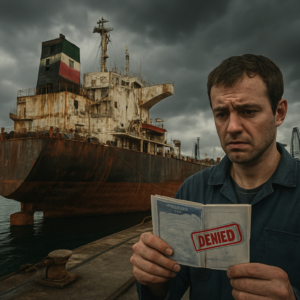
For seafarers, this route is a high-stakes gamble. The moment a tanker docks at Bandar Abbas, Kharg Island, or any other Iranian port to load oil or gas, it crosses an invisible line. The vessel, its owner, and even its crew can be flagged by OFAC, effectively blacklisting them from the U.S. financial system—and, by extension, from much of the global maritime industry that still operates within its rules. The consequences aren’t just bureaucratic; they’re career-altering. A single voyage to Iran can mean the difference between a future working for a top-tier Western shipping company and being locked out of the industry’s most lucrative opportunities.
More information on Toxic Voyages: The Hidden Dangers of VCM and Butadiene
Why This Route Is Under the Microscope
The Iran-China oil trade isn’t just a commercial arrangement—it’s a direct challenge to U.S. foreign policy. Since the Trump administration’s “maximum pressure” campaign in 2018, the U.S. has sought to cripple Iran’s economy by cutting off its oil exports, which historically accounted for nearly half of the country’s revenue. But China, which has long viewed Iran as a strategic partner in its Belt and Road Initiative, has refused to play along. Instead, it has doubled down on imports, often using state-backed entities to facilitate transactions that bypass U.S. sanctions. The result? A shadow economy where oil flows freely, but the ships that carry it operate in a legal gray zone, constantly at risk of being caught in the crossfire.
OFAC’s scrutiny of this route is relentless. The agency doesn’t just target the vessels themselves—it goes after the entire supply chain. That means shipping companies, insurers, port agents, and even fuel suppliers can find themselves on the wrong side of U.S. law if they’re found to be facilitating trade with Iran. For example, in 2020, OFAC sanctioned a network of companies linked to Iran’s Islamic Revolutionary Guard Corps (IRGC), including several tankers that had loaded oil at Kharg Island before delivering it to China. The message was clear: anyone involved in this trade, no matter how far removed from Iran, is fair game.
The Companies Operating in the Gray Zone
Not all shipping companies are willing to take the risk—but some specialize in it. Firms like Fleet Grant, a Dubai-based operator with a fleet of aging tankers, have become synonymous with the Iran-China trade. These companies often fly flags of convenience (Panama, Liberia, or the Marshall Islands) and are known for their willingness to work with sanctioned entities. Their vessels are frequently older, poorly maintained, and crewed by seafarers who may not fully grasp the risks—or who have few other options in an industry that increasingly shuns those with ties to Iran.
Chinese owners, too, play a major role. While Beijing officially denies violating U.S. sanctions, many privately owned Chinese shipping firms have built their business models around transporting Iranian oil. These companies often operate under the radar, using complex corporate structures to obscure ownership and avoid direct OFAC scrutiny. Some have even been linked to state-backed entities, further complicating the web of responsibility. For example, in 2022, the U.S. Treasury sanctioned a Chinese network that had allegedly helped Iran sell hundreds of millions of dollars’ worth of oil, using a fleet of tankers that frequently changed names and flags to evade detection.
The most notorious players, however, are the operators of the so-called “shadow fleet”. These are vessels that exist almost entirely outside the formal maritime system, often with no clear ownership, no proper insurance, and no regard for international safety standards. They’re the maritime equivalent of money-laundering operations, designed to make Iranian oil “disappear” into the global supply chain without a trace. And they’ve become indispensable to Iran’s ability to keep exporting oil despite sanctions.
How the Shadow Fleet Evades Sanctions
The tactics used by these vessels are as creative as they are brazen. Here’s how they do it:
- Ship-to-Ship (STS) Transfers: Instead of sailing directly from Iran to China, tankers will rendezvous in international waters—often near the Strait of Malacca or the Gulf of Oman—to transfer their cargo to another vessel. This second ship, which may have no prior ties to Iran, then delivers the oil to its final destination. The original tanker, now “clean,” can return to Iranian waters for another load. These transfers are often conducted at night, with both vessels disabling their Automatic Identification System (AIS) transponders to avoid detection.
- Flag Hopping: Many shadow fleet vessels change their flags frequently, sometimes mid-voyage, to obscure their movements. A tanker might fly the flag of Palau one month, switch to Cameroon the next, and then disappear entirely from public registries. This makes it nearly impossible for authorities to track their activities or hold their owners accountable.
- Disabling AIS Transponders: AIS is the maritime equivalent of an airplane’s transponder—it broadcasts a vessel’s location, speed, and identity to other ships and coastal authorities. But for tankers carrying Iranian oil, going “dark” is standard practice. By turning off their AIS, these vessels can slip through sanctions enforcement undetected. The problem? It also makes them far more dangerous. Without AIS, they’re invisible to other ships, increasing the risk of collisions, groundings, and environmental disasters.
- Fake Documents and Shell Companies: Paperwork is the shadow fleet’s best friend. Many of these vessels operate under false bills of lading, misdeclared cargoes, or entirely fabricated ownership records. Some even use “flags of non-compliance”—countries like Tanzania or Comoros that are known for lax oversight and minimal enforcement of maritime laws.
- Port Hopping in Sanctions-Friendly Countries: Even if a tanker can’t offload its cargo directly in China, it can use intermediary ports in countries that turn a blind eye to sanctions. Malaysia, the UAE, and even some European ports have been accused of facilitating these transfers, often under the guise of “storage” or “blending” operations that mask the oil’s Iranian origin.
The result is a cat-and-mouse game where U.S. authorities are constantly playing catch-up. OFAC has ramped up its enforcement, imposing fines and sanctions on companies caught in the act, but the shadow fleet’s tactics evolve just as quickly. For every vessel that gets blacklisted, another takes its place—often with a new name, a new flag, and a new crew unaware of the risks they’re taking.
The Geopolitical Powder Keg
This isn’t just about oil—it’s about power. The Iran-China trade route is a microcosm of the broader struggle between the U.S. and its rivals for influence in the Middle East and beyond. For Iran, every barrel of oil that reaches China is a lifeline, a way to fund its government, its military, and its proxies across the region. For China, it’s a way to assert its economic independence and challenge U.S. dominance in global energy markets. And for the U.S., it’s a direct threat to its sanctions regime, which relies on the dollar’s dominance and the willingness of other countries to comply with its rules.
The stakes are high, and the tensions show no signs of easing. In recent years, the U.S. has seized Iranian oil cargoes in international waters, imposed secondary sanctions on Chinese entities, and even threatened to cut off access to the U.S. financial system for any company found to be facilitating trade with Iran. Meanwhile, Iran has responded by harassing and seizing foreign vessels in the Persian Gulf, further escalating the risks for seafarers caught in the middle.
For the men and women working on these ships, the geopolitical chess game is a daily reality. They know that every voyage could be their last in the mainstream maritime industry. They know that their names, their passports, and their careers could end up on an OFAC blacklist with little warning. And yet, for many, the alternative—unemployment, financial ruin, or worse—isn’t an option. The Iran-China trade route may be a sanctions hotspot, but for those who sail it, it’s also a lifeline.