
The Cost of Complacency: When Small Mistakes Become Million-Dollar Lessons
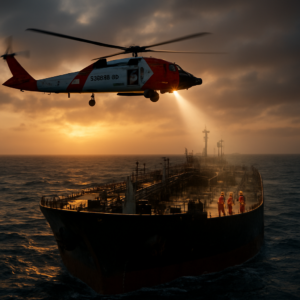 There’s a moment in every mariner’s career when you realize the ocean doesn’t care about your experience, your rank, or how many years you’ve spent at sea. It’s the moment when a routine operation unravels into chaos, when a split-second oversight becomes a financial and environmental nightmare. I’ve seen it happen twice—once in the sweltering heat of Lomé, where a container ship’s wake nearly turned our tanker into an ecological disaster, and again in Côte d’Ivoire, where a single unsecured accommodation ladder cost the company $150,000 and a black mark on its reputation. These weren’t freak accidents. They were the direct result of complacency, of assuming that just because something *should* hold, it *will*. The U.S. Coast Guard doesn’t tolerate that kind of thinking—and after what I’ve witnessed, neither do I.
The Wake That Nearly Sank Us: Lomé, West Africa
It was a Tuesday in Lomé, the kind of day where the air feels thick enough to chew. Our tanker, the Manuela Lighieri, was moored at the single-point buoy, loading diesel for a client in Nigeria. The port was crowded—fishing boats, supply vessels, and a handful of larger ships jockeying for position in the limited space. We’d been there for two days, and the crew was running on autopilot. The mooring lines had been checked, the hoses connected, and the cargo operations were humming along without issue. No one expected trouble. That was our first mistake.
At 13:47, the VHF crackled to life. A Panamax container ship, the MSC Valencia, was making its approach to the outer anchorage. The pilot’s voice was calm, almost bored, as he announced their ETA. What he didn’t mention—and what we didn’t realize until it was too late—was that the Valencia was cutting it *too* close. She was moving at 12 knots, far faster than she should have been in a congested port, and her bow wave was building into something monstrous.
I was in the mess hall, halfway through a plate of jollof rice, when the first jolt hit. The entire ship lurched violently to starboard, like we’d been sideswiped by a train. My coffee sloshed over the rim of the mug, scalding my hand. Before I could react, the second wave hit—this one even bigger. The Manuela Lighieri groaned like a wounded animal as the mooring lines screamed under the strain. On deck, the bosun was shouting into his radio, his voice barely audible over the chaos.
I sprinted to the main deck, my heart hammering. What I saw made my stomach drop. The container ship’s wake had created a suction effect, pulling us toward the buoy with terrifying force. Our mooring lines—eight of them, each as thick as a man’s arm—were snapping like twine. One by one, they gave way, their ends whipping across the deck with enough force to decapitate a man. In less than 30 seconds, we’d lost 70% of our lines. We were now held in place by a single cargo hose, a 12-inch-thick rubber-and-steel lifeline pumping 5,000 tons of diesel per hour.
The hose was stretched to its absolute limit. The flanges groaned, the bolts creaked, and the rubber bulged ominously. If it ruptured, we’d have a full-blown environmental disaster on our hands—thousands of barrels of diesel gushing into the harbor, coating the coastline, killing marine life, and triggering a cleanup operation that would cost millions. Worse, we’d be blacklisted by every major port in West Africa. The company would survive. The crew? We’d be looking for new jobs.
The chief officer was already on the bridge, barking orders into the radio. The engine room had been alerted, and the main engine was coming online. We needed thrust—*now*—to relieve the pressure on that hose. But starting a marine diesel isn’t like turning a key in a car. It takes time, and every second felt like an eternity.
On deck, the third mate was coordinating with the deck crew to secure a makeshift line to the buoy. The problem? The remaining mooring lines were still attached to the ship, their snapped ends dangling in the water like severed nerves. If we tried to winch ourselves back, we risked fouling the propeller. The chief engineer’s voice crackled over the radio: “Engine ready in two minutes.” Two minutes might as well have been two hours.
More information on Switching to LPG Tankers: A Starter’s Roadmap
Then, the hose gave its first warning. A sharp ping echoed across the deck as one of the flange bolts sheared. A fine mist of diesel sprayed into the air, catching the sunlight like a rainbow of impending doom. The bosun didn’t hesitate. He grabbed a fire hose and blasted the flange with seawater, washing away the diesel before it could ignite. It was a temporary fix, but it bought us time.
Finally, the main engine roared to life. The ship shuddered as the propeller bit into the water, and slowly, agonizingly, we began to pull away from the buoy. The cargo hose stretched one last time—then relaxed. We’d made it. The hose held. The diesel stayed in the tanks. The environmental catastrophe had been averted by seconds.
The aftermath was a blur of damage reports and finger-pointing. The MSC Valencia’s captain claimed he’d “maintained a safe speed,” but the port authority wasn’t buying it. Fines were issued, insurance premiums skyrocketed, and our company’s reputation took a hit. But the real lesson? Complacency kills. We’d assumed the mooring lines would hold because they always had. We’d assumed the container ship would keep a safe distance because, well, that’s what ships *do*. We were wrong. And in the world of USCG inspections, assumptions like that will get your vessel detained faster than you can say “oil spill response plan.”
The $150,000 Ladder: Côte d’Ivoire’s Costly Oversight
If Lomé was a lesson in the dangers of external forces, our time in Côte d’Ivoire was a masterclass in how internal negligence can cripple a ship. This time, the culprit wasn’t a rogue container ship or a freak wave. It was a single, exhausted crew member who forgot to secure the accommodation ladder before turning in for the night.
We were docked in Abidjan, loading cocoa beans for Europe. The port was notorious for its extreme tides—up to six meters between high and low water. The accommodation ladder, a massive steel-and-aluminum structure, was our only means of getting crew and inspectors on and off the ship. It was also a ticking time bomb if not properly managed.
The problem started at 03:00, when the tide began its rapid descent. The watchman, a young AB from the Philippines, had just come off a double shift. He’d been on his feet for 16 hours, and his eyes were burning with fatigue. When he made his final rounds, he checked the ladder’s securing pins—or so he thought. In reality, he’d only glanced at them. The pins were in place, but the safety chains, the secondary securing mechanism, had been left dangling. No one noticed. Not the watchman. Not the officer on duty. Not even the chief officer during his pre-dawn inspection.
At 05:30, the tide hit its lowest point. The accommodation ladder, now suspended in mid-air, groaned under its own weight. The securing pins, designed to handle vertical loads, were never meant to bear the full brunt of a six-meter drop. One by one, they sheared. The ladder lurched violently, its lower platform slamming into the concrete quay with a metallic crack that echoed across the harbor. Then, as the tide began to rise again, the ladder was crushed between the ship and the dock.
I was in the engine room when I heard the noise. It sounded like a car crash, if the car was made of 10 tons of steel. By the time I reached the main deck, the damage was done. The ladder was a twisted wreck, its handrails bent like pretzels, its hydraulic pistons snapped like twigs. The lower platform had been sheared clean off, and the gangway was now resting at a 45-degree angle, its steps warped beyond repair. Worse, the impact had damaged the ship’s hull plating, requiring immediate dry-dock repairs.
The financial fallout was immediate. A new accommodation ladder? $120,000. Dry-dock repairs to the hull? $25,000. Port fees for the delay? $5,000. But the real cost was reputational. The incident was reported to the IMO, and our ship was flagged for additional inspections. The company’s safety record took a hit, and morale on board plummeted. The watchman, a good kid who’d just made a mistake, was reassigned to shore duties. The chief officer, who’d signed off on the ladder’s security, was given a formal warning.
And the lesson? There are no small oversights in port operations. The USCG doesn’t care if you’re tired, or if you’ve been on duty for 16 hours, or if the ladder *looked* secure. They care about results. In their eyes, a $150,000 mistake is just as unacceptable as a $1.5 million one. Because at the end of the day, both could have been prevented with a little more vigilance.
That’s the thing about complacency. It doesn’t announce itself with fanfare. It creeps in during the quiet moments, when the crew is tired, when the port is familiar, when the job feels routine. But the ocean doesn’t do routine. And neither does the USCG.
This chapter is designed to drop the reader directly into the action, using vivid storytelling and technical details to highlight the stakes of maritime operations. The HTML formatting ensures it integrates seamlessly with the rest of your article while maintaining readability and impact.