

The Physics of Liquefaction: Why Gas Must Become Liquid
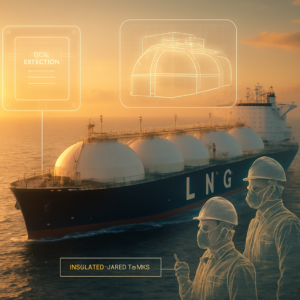 Natural gas, primarily methane, is a ghost in its gaseous state—invisible, diffuse, and nearly impossible to contain in meaningful quantities. To harness its energy, we must perform a kind of alchemy: transforming it from an ethereal vapor into a dense, transportable liquid. This transformation isn’t just convenient—it’s a scientific necessity. Without liquefaction, the global trade in natural gas would collapse, and with it, the energy security of nations that rely on imports. But how does this process work? And why does methane, a gas that fills a room at room temperature, shrink to 1/600th of its volume when cooled to -163°C?
The Science of Shrinking: Temperature, Pressure, and the Battle Against Molecules
At its core, liquefaction is a battle against the chaotic dance of gas molecules. In their natural state, methane molecules zip around at high speeds, colliding with each other and the walls of any container, filling every inch of available space. This is why a single cubic meter of methane gas at room temperature and pressure contains only about 0.7 kilograms of actual substance—the rest is empty space. To make gas economically viable for transport, we need to pack those molecules as tightly as possible.
More information on Switching to LPG Tankers: A Starter’s Roadmap
The key lies in manipulating two fundamental variables: temperature and pressure. The relationship between them is governed by the principles of thermodynamics, specifically the behavior of gases described by the ideal gas law (PV = nRT). Here’s how it works in practice:
- Cooling the Gas: As temperature drops, the kinetic energy of methane molecules decreases. They slow down, losing their frenetic motion, and begin to cling to each other. At -161.5°C (the boiling point of methane at atmospheric pressure), the molecules are moving so sluggishly that they condense into a liquid. This is the critical threshold for liquefied natural gas (LNG).
- Applying Pressure: While cooling is the primary driver of liquefaction, pressure plays a supporting role. By compressing the gas, we force the molecules closer together, making it easier for them to transition into a liquid state. However, methane’s critical temperature—the point above which it cannot be liquefied by pressure alone—is -82.6°C. This means that even under extreme pressure, methane will remain a gas unless it’s cooled below this threshold. For LNG production, cooling is non-negotiable.
To put this into perspective, imagine trying to compress a 50-story skyscraper into the volume of a standard 20-foot shipping container. That’s roughly the scale of what liquefaction achieves. A single LNG tanker, with its four massive storage tanks, can carry the equivalent of 3.1 billion cubic feet of natural gas in its liquid form. If that same gas were transported in its original state, you’d need a pipeline stretching across oceans—or a fleet of tankers so large it would make the world’s shipping lanes look like a traffic jam in a bathtub.
The Challenges of Playing with Fire (and Ice)
Liquefying natural gas is one thing; keeping it liquid is another. The moment LNG is produced, it begins a silent war against the laws of physics. At -163°C, methane is only 13°C above its freezing point. Any heat that seeps into the system—whether from the outside environment, friction, or even the residual warmth of the ship’s engines—threatens to boil off the liquid, turning it back into a gas. This isn’t just inefficient; it’s dangerous. Methane is highly flammable, and even a small leak in a confined space can lead to catastrophic consequences.
So how do LNG carriers maintain this delicate balance? The answer lies in a combination of insulation, engineering precision, and constant vigilance:
- The Thermos Effect: LNG tanks are essentially giant, high-tech thermoses. The multi-layered insulation system—comprising layers of polyurethane foam, plywood, and stainless steel membranes—acts as a barrier against heat transfer. This insulation is so effective that a well-maintained tank can keep LNG at -163°C for up to 15 days without any additional cooling. However, some boil-off is inevitable. Modern LNG carriers harness this “boil-off gas” to fuel their engines, turning a potential loss into a resource.
- The Pressure Paradox: While LNG is stored at near-atmospheric pressure, the tanks must still withstand the stresses of a rolling ocean. The stainless steel membranes inside the tanks are corrugated, allowing them to expand and contract as the liquid sloshes and the ship moves. This flexibility is critical—without it, the tanks would crack under the strain, leading to leaks or even structural failure.
- The Human Factor: Maintaining -163°C isn’t just about technology; it’s about people. Crews on LNG carriers undergo rigorous training to monitor the cargo’s condition, using sensors that track temperature, pressure, and boil-off rates in real time. A single oversight—a valve left slightly open, a sensor malfunction—can turn a routine voyage into a disaster.
One of the most striking examples of these challenges played out in 2018, when the LNG Sakura, one of the world’s largest LNG carriers, experienced a partial containment system failure during a voyage from Australia to Japan. A small crack in one of the tank’s membranes allowed LNG to seep into the insulation space, causing a rapid boil-off and a dangerous buildup of pressure. The crew had to act fast, venting the gas in a controlled manner while rerouting to the nearest port for repairs. The incident was a stark reminder that even the most advanced technology is only as reliable as the humans operating it.
From Desert to Doorstep: How Liquefaction Fuels the Global LNG Trade
Without liquefaction, the global LNG trade as we know it wouldn’t exist. Consider the journey of natural gas from the North Field in Qatar, the world’s largest non-associated gas field, to the terminals of Japan, the world’s largest importer of LNG. The distance between these two points is roughly 6,000 nautical miles—a journey that would be impossible if the gas remained in its gaseous state.
Here’s how it works:
- Extraction and Pre-Treatment: Natural gas is extracted from the North Field and transported via pipeline to Qatar’s liquefaction plants, such as Ras Laffan. Before liquefaction, the gas undergoes a purification process to remove impurities like water, carbon dioxide, and sulfur compounds, which could freeze and clog the liquefaction equipment.
- The Liquefaction Process: The purified gas is cooled in a series of heat exchangers using a refrigerant cycle. The most common method, the propane pre-cooled mixed refrigerant (C3MR) process, uses a blend of hydrocarbons to gradually chill the gas to -163°C. This step is energy-intensive, consuming up to 10% of the gas’s energy content—a trade-off that’s more than worth it for the volume reduction.
- Loading and Transport: The LNG is pumped into the tanks of a carrier like the Q-Max, the largest class of LNG ships in the world, capable of holding 266,000 cubic meters of LNG. These ships are marvels of engineering, with double hulls, advanced insulation, and boil-off management systems that ensure the cargo arrives safely.
- Regasification at Destination: Upon reaching Japan, the LNG is offloaded at terminals like Sodegaura or Himeji, where it’s warmed back into a gas using seawater or specialized heat exchangers. The regasified LNG is then injected into Japan’s pipeline network, powering homes, factories, and power plants.
This entire process is a testament to human ingenuity. In 2022 alone, Qatar exported 77 million tons of LNG, much of it bound for Asia. Without liquefaction, this trade would require an impractical network of pipelines spanning continents and oceans—or an equally impractical fleet of gas carriers the size of small cities. LNG makes it possible to compress the energy equivalent of 1.5 billion barrels of oil into a single year’s exports from Qatar, all while keeping the global energy market running smoothly.
—
The Unseen Costs: Why -163°C Is Worth the Effort
Liquefaction isn’t cheap. The energy required to cool natural gas to -163°C, maintain that temperature during transport, and then regasify it at the destination adds significant costs to the supply chain. So why go through all this trouble? The answer lies in the economics of scale and the tyranny of distance.
Natural gas fields are often located in remote regions—think the frozen tundra of Siberia, the offshore platforms of Australia, or the deserts of the Middle East. Building pipelines from these locations to major markets is often prohibitively expensive or politically unfeasible. For example, the proposed Nord Stream 2 pipeline, which would have carried Russian gas to Europe, faced years of geopolitical opposition before being shelved indefinitely. LNG, by contrast, offers flexibility. A single liquefaction plant can serve multiple markets, and a single LNG carrier can be rerouted mid-voyage to respond to changes in demand.
Consider the case of Cheniere Energy’s Sabine Pass terminal in Louisiana, the first large-scale LNG export facility in the lower 48 U.S. states. Before Sabine Pass came online in 2016, the U.S. was a net importer of natural gas. Today, it’s the world’s top LNG exporter, with cargoes bound for Europe, Asia, and South America. This transformation was only possible because liquefaction allowed the U.S. to unlock its shale gas reserves and ship them to markets halfway around the world. Without LNG, that gas would have remained stranded, its energy potential untapped.
There’s also the matter of energy density. A single LNG carrier can deliver the same amount of energy as three Very Large Crude Carriers (VLCCs) transporting oil. This efficiency is critical for countries like Japan and South Korea, which import nearly all of their energy. For them, LNG isn’t just a commodity—it’s a lifeline.
The Future of Liquefaction: Pushing the Boundaries of Physics
As global demand for natural gas grows, so too does the pressure to make liquefaction more efficient. Researchers are exploring ways to lower the energy requirements of the process, such as using magnetic refrigeration or cryogenic carbon capture to reduce the cooling load. Others are experimenting with floating liquefaction plants, which can be deployed offshore near gas fields, eliminating the need for long pipelines.
One of the most promising developments is the rise of small-scale LNG, which allows for the liquefaction of gas in smaller quantities for niche markets. This could open up new opportunities for remote communities or industries that currently rely on diesel or coal. For example, in Norway, small-scale LNG is being used to fuel ferries and trucks, reducing emissions in a country where hydropower dominates the electricity grid.
Yet, for all these innovations, the fundamental physics of liquefaction remain unchanged. Methane will always need to be cooled to -163°C to become a liquid, and that liquid will always need to be kept cold to stay that way. The challenge isn’t just to master these principles—it’s to do so at a scale that can power the world.
In the end, liquefaction is more than just a technical process. It’s a bridge between the invisible and the tangible, the remote and the accessible, the impossible and the essential. Without it, the global energy trade would grind to a halt—and with it, the lights in millions of homes around the world.