

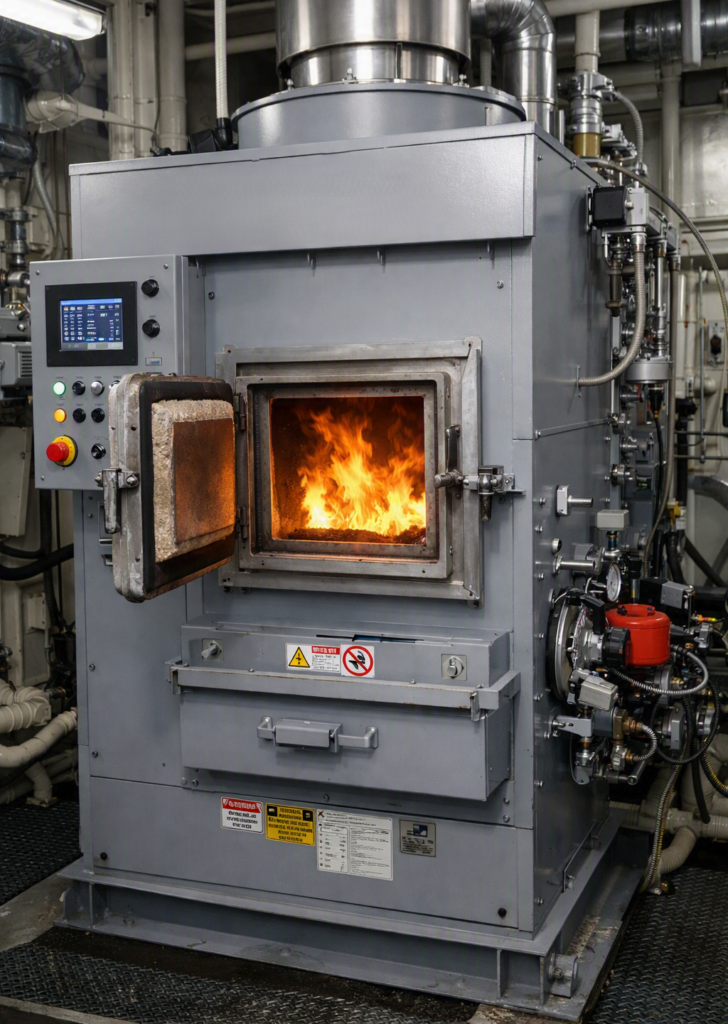
Efficient and safe operation of a marine incinerator is critical for complying with environmental requirements under MARPOL (Annexes V and VI) regarding waste and sludge disposal on board. During continuous operation under rolling conditions at sea and when burning aggressive media (such as oil sludge, waste oils, and solid refuse), marine engineers frequently encounter specific technical failures.
Below is a detailed look at 5 common marine incinerator faults, their likely root causes, and practical troubleshooting recommendations.
1. Flame Failure (Ignition Failure or Burner Flame-Out)
Symptoms
The incinerator burner attempts to start, but after a brief flash of flame, safety interlocks trip, the combustion process stops, and a “Flame Failure” alarm illuminates on the control panel.
Root Causes
- Contamination of the flame detector: Soot or an oil film buildup on the optical element of the flame scanner (photocell, UV, or ionization sensor) blocks flame radiation detection.
- Improper fuel/sludge atomization: Worn burner nozzle, low fuel/diesel supply pressure, or water present in the fuel line.
- Ignition system issues: Worn ignition electrodes, excessive air gap, or weak spark formation.
- Incorrect air-fuel ratio: Excess primary combustion air blows out the flame during ignition.
Solutions
- Shut down the system, remove the flame detector, and thoroughly clean its optical lens from soot and oil contamination.
- Check the diesel supply pressure and clean the fuel filters if necessary.
- Inspect the burner nozzle, clean the tip, and verify the spray pattern.
- Check the condition of the ignition electrodes, adjust the proper gap, and ensure stable spark generation.
More information on Incinerator: Purpose, Design, and Working Principle on Board
2. High Combustion Temperature / Overheating
Symptoms
A sharp temperature spike in the primary or secondary combustion chamber exceeding safe limits, triggering the safety thermal switch, forcing a shutdown of sludge feed, and switching the system to rapid cooling mode.
Root Causes
- Excessive calorific value of wastes: Feeding too much high-calorie sludge or high-viscosity oil that releases heat too rapidly.
- Sludge valve control failure: Sticking or incomplete closing of the regulating sludge valve, causing fuel delivery to continue despite automation commands.
- Insufficient cooling/secondary air flow: Combustion/cooling air fan malfunction or drop in delivery performance due to clogged air filters.
Solutions
- Manually stop the liquid waste feed and switch the burner to clean diesel cooling mode.
- Check automatic sludge valves for tightness, sticking, or leakage.
- Verify the combustion air fan’s operational status, clean intake filters, and check impeller performance.
3. Low Draft / High Back Pressure in the Combustion Chamber
Symptoms
Flue gas pressure alarm triggers, a burning smell or smoke appears in the incinerator room, and solid waste loading door opening gets locked.
Root Causes
- Clogged chimney and spark arrestor: Heavy accumulation of soot and unburnt mineral residue on internal flue pipe walls or within the spark arrestor.
- Exhaust gas/draft fan failure: Worn out bearings on the exhaust fan, electrical drive fault, or soot buildup on the impeller blades causing imbalance and pressure drop.
- Pressure sensor malfunction: Clogged impulse line of the chamber pressure transmitter due to soot accumulation.
Solutions
- Perform mechanical or chemical cleaning of the chimney and spark arrestor in accordance with maintenance routines.
- Stop the exhaust fan, inspect the impeller blades, remove soot deposits, and check alignment and bearing assemblies.
- Blow through the pressure sensor impulse lines and verify pressure gauge readings.
4. Refractory Lining Damage, Cracking, or Deformation
Symptoms
Severe heating of the incinerator’s outer steel casing (detected visually or via a pyrometer), appearance of cracks, spalling, or breakdown of the refractory brick/concrete inside the combustion chamber.
Root Causes
- Thermal shock: Rapid burner start at maximum capacity when the chamber is cold, or rapid cooling using water.
- Exceeding maximum combustion temperatures: Extended operation on over-concentrated high-calorific sludges.
- Natural wear and tear: Repeated heating and cooling cycles causing structural fatigue in refractory materials.
Solutions
- Conduct a thorough inspection of the refractory lining after the incinerator has completely cooled down.
- Repair minor cracks using a specialized high-temperature refractory mortar or mastic.
- In case of significant structural damage, perform complete or partial replacement of damaged refractory blocks or castable lining.
5. Solid Waste Loading Interlock and Door Failure
Symptoms
Inability to open the solid waste loading door, or the incinerator fails to initiate a burning cycle due to limit switch errors or safety interlocks.
Root Causes
- Contamination of the interlock mechanism: Accumulation of ash, debris, or coked residue around the charging hatch seals.
- Defective limit switches or electromagnetic locks: Contact oxidation, mechanical wear of door position sensors.
- Pneumatic system failure: Drop in compressed air pressure within the control line for loading door actuators and dampers.
Solutions
- Clean sealing surfaces of the loading door and drive mechanism from ash and deposits.
- Check electrical limit switches, position sensors, and clean oxidized contacts.
- Verify working pressure in the ship’s pneumatic line, inspect pneumatic cylinders, and check directional control valves for air leaks.
Conclusion
Trouble-free operation of a marine incinerator depends directly on strict adherence to operation rules, regular cleaning of sensors, burners, and flues, and monitoring the condition of the refractory lining and automation systems. Prompt identification and resolution of minor faults prevent major breakdowns and guarantee shipboard environmental compliance with MARPOL requirements.