

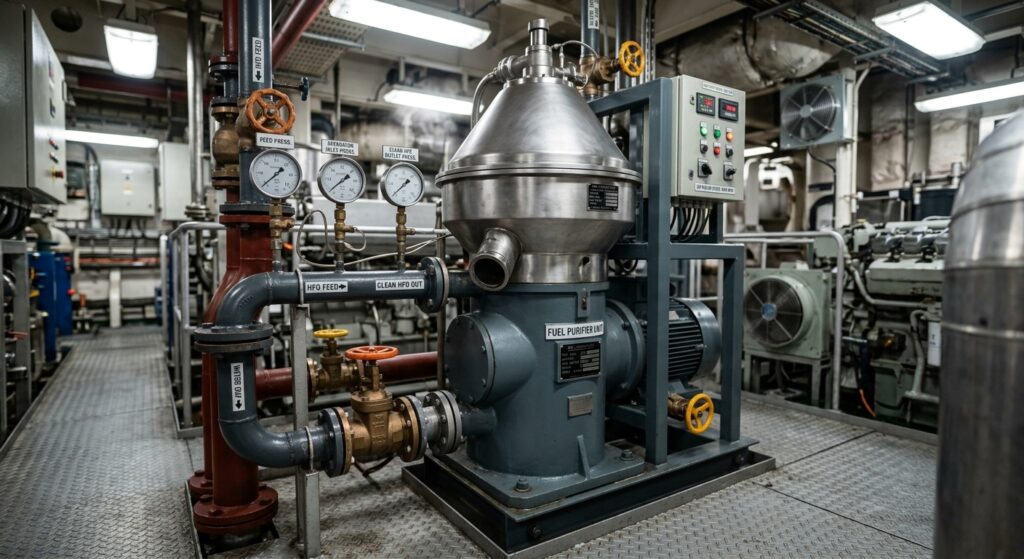
Safe and efficient operation of marine diesel engines directly depends on the quality of heavy fuel oil (HFO) purification. Any failure in the operation of centrifugal purifiers leads to water and mechanical impurities entering the fuel system, causing accelerated wear of high-pressure fuel pump (HPFP) plunger pairs, fuel injector clogging, and severe damage to the cylinder-piston group.
Below are 5 of the most common faults encountered in marine fuel purifiers, their root causes, and practical solutions for troubleshooting.
1. Loss of Water Seal and Fuel Overflow to Drain
Symptoms
Unpurified fuel stops flowing to the daily service tank and begins discharging through the overflow pipe or escaping together with the separated water.
More information on Seawater Reverse Osmosis: Principle, Design, and Maintenance
Root Causes
- Excessively large gravity disc diameter: The boundary phase (“interface” or “neutral layer”) shifts toward the bowl periphery, reaching the outer diameter of the top disc, causing heavy fuel to overflow together with water.
- Lack or insufficiency of priming water: If water is not supplied to the bowl prior to starting the fuel feed, a hydraulic water seal fails to form, and fuel discharges directly through the water outlet.
- Sludge space contamination: Heavy sludge accumulation blocks fluid flow passages within the bowl.
- Fuel preheating drop: A drop in fuel temperature alters the density of the oil, disrupting hydrodynamic equilibrium.
Solutions
- Stop the purifier and replace the gravity disc with a smaller internal diameter option according to the manufacturer’s nomograms and tables.
- Ensure mandatory priming water supply before starting fuel feed to establish a stable water seal.
- Perform a manual or automatic bowl cleaning to remove accumulated sludge.
- Restore and maintain the nominal fuel preheating temperature.
2. Water Present in Purified Fuel
Symptoms
Water appears in the daily service tank, fuel becomes cloudy, and persistent fogging or droplets are observed in the clean fuel outlet sight glass.
Root Causes
- Gravity disc diameter too small: The interface shifts toward the bowl rotation axis. Water occupies part of the disc stack separating surface and gets carried away with the clean fuel stream.
- Clogged disc stack: Heavy contamination of inter-disc spaces with mechanical impurities hinders proper phase separation.
- Excessive throughput: Fuel feed rate exceeds allowable separation capacity.
Solutions
- Stop the purifier and replace the gravity disc with a larger internal diameter disc.
- Dismantle the bowl and wash the disc stack thoroughly.
- Reduce the fuel feed rate using control valves or the supply pump adjustment.
3. High Bowl Vibration and Noise
Symptoms
Vibration sensors trigger, abnormal humming or rattling occurs, and heavy shaking of the purifier frame and housing is observed.
Root Causes
- Uneven sludge accumulation: Non-uniform deposit buildup around the bowl periphery creates severe dynamic imbalance of rotating masses.
- Bearing wear: Damage or wear to the vertical spindle bearings or horizontal shaft bearings.
- Fatigued or broken shock absorbers: Damaged or sagging spring shock absorbers on the top bearing assembly, designed to damp operating vibrations.
- Assembly errors: Mismatching assembly alignment marks (matchmarks) on bowl components following overhaul.
Solutions
- Perform an unscheduled manual or automatic sludge discharge, or clean internal bowl surfaces manually.
- Inspect vertical spindle bearings and replace worn components.
- Replace the set of spring shock absorbers on the upper bearing housing.
- Reassemble the bowl, strictly aligning factory matchmarks on all rotating components.
4. Failure of Automatic Sludge Discharge Cycle
Symptoms
Sludge is not ejected during the automated discharge sequence, the sludge space overfills, and the purification process degrades or stops.
Root Causes
- Operating water supply failure: Low pressure or complete absence of operating (control) water supply to the sliding bowl bottom mechanism.
- Clogged operating channels: Blocked operating water nozzles, solenoid valves, or strainers in the operating water circuit.
- Worn main seals: Damaged or worn main seal ring (D-ring) of the sliding bowl bottom, causing operating water leakage and failure to seal the bowl.
Solutions
- Check pressure in the operating water supply line and clean inline strainers.
- Clean operating water distribution channels and control nozzles.
- Dismantle the bowl and replace the main seal ring of the sliding bowl bottom.
5. Low Discharge Pressure of Purified Fuel
Symptoms
Pressure reading on the clean fuel discharge gauge drops below normal levels, triggering the low backpressure alarm.
Root Causes
- Paring disc wear: Mechanical wear or damage to the stationary paring disc (centripetal pump) vanes, which convert kinetic energy of the rotating liquid into static pressure.
- Clogged fuel filter: Contamination of the inlet or discharge fuel strainers/filters.
- Air ingress: Air leaks on the suction line or through fuel supply pump shaft seals.
Solutions
- Inspect the paring disc, check axial clearances, and replace if worn.
- Flush or replace fuel filter elements.
- Eliminate air leaks on the suction piping and replace damaged gaskets.