

Freshwater autonomy on board commercial vessels is essential for safe, economical, and flexible operations. Alongside traditional vacuum evaporators, marine Seawater Reverse Osmosis (SWRO) desalination systems are increasingly favored across modern merchant and offshore fleets.
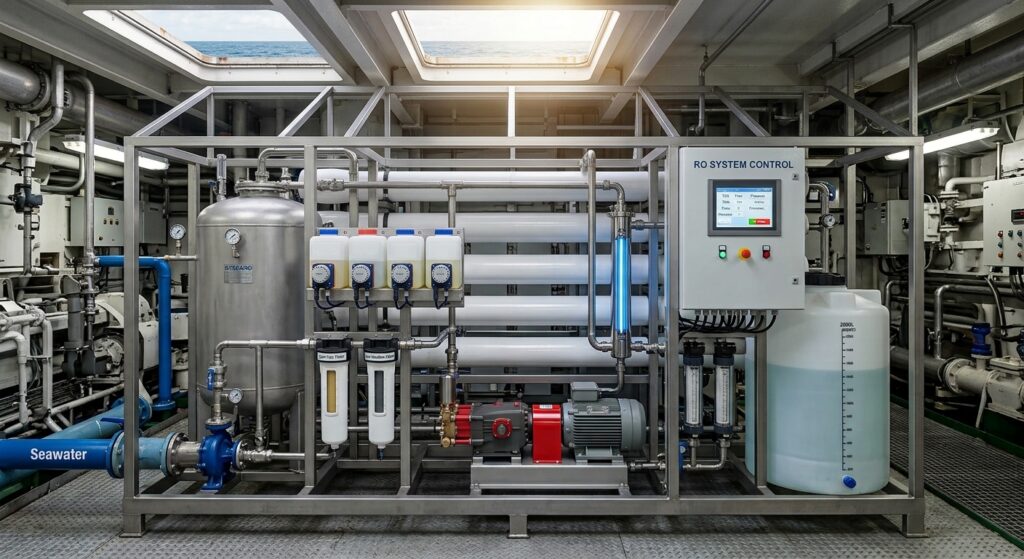
This comprehensive guide explores the physical principles of membrane desalination, the step-by-step operation of marine SWRO plants, key system components, and essential maintenance practices.
What is a Marine Seawater Reverse Osmosis (SWRO) System?
A marine reverse osmosis system is an advanced membrane-based purification plant designed to desalinate high-salinity seawater into pure, potable water that complies with international standards, such as WHO drinking water guidelines or national quality standards.
More information on Marine Fuel Separators: Design, Working Principle, Details
Unlike waste-heat vacuum fresh water generators (FWGs)—which rely on high main engine cooling water temperatures—SWRO systems operate purely on electrical power. This key advantage allows SWRO plants to produce fresh water under any operational condition: at full sea speed, during slow steaming, or while anchored or berthed in port. Modern marine SWRO modules range from compact vessel-specific skids to large-scale plants producing anywhere from 15 to 3,000 m³/day.
Physical and Chemical Principles of Reverse Osmosis
Membrane desalination relies on reversing the naturally occurring physical phenomenon of osmosis.
In natural osmosis, when two solutions of different salt concentrations are separated by a semi-permeable membrane, water molecules spontaneously migrate from the less concentrated solution into the more concentrated solution until osmotic pressure equilibrium is reached.
To reverse this flow and extract pure fresh water from seawater, an external mechanical pressure must be applied to the seawater side that significantly exceeds its natural osmotic pressure.
- The natural osmotic pressure of standard seawater is approximately 2.5 to 3.0 MPa (25 to 30 bar).
- In a marine SWRO system, a high-pressure pump pressurizes incoming seawater to 5.0 to 8.0 MPa (50 to 80 bar).
- Under this high pressure, water molecules are forced through the microscopic pores of a polyamide thin-film composite membrane, while dissolved salts, minerals, bacteria, and organic molecules are rejected and flushed away in a concentrated brine stream.
Step-by-Step Working Principle of a Marine RO Desalination Plant
The desalination process inside a marine reverse osmosis plant follows four key stages:
1. Seawater Intake and Multi-Stage Pre-Treatment
Seawater is drawn through the vessel’s sea chest using a feed pump. Because raw seawater contains suspended solids, silt, algae, and marine microorganisms that can rapidly foul or degrade sensitive membranes, thorough pre-treatment is critical:
- Sand (Media) Filter: Removes coarse suspended solids and mechanical debris.
- Fine Cartridge Filters (5 µm and 1 µm): Provide micro-filtration to trap ultra-fine particulates before reaching the high-pressure pump.
- Chemical Dosing System:
- Flocculants: Coagulate fine colloidal matter into larger particles for easier removal.
- Bactericides: Prevent bio-fouling and microbial growth on filters and membranes.
- Reducing Agents: Neutralize free chlorine and strong oxidants that could permanently damage polyamide membranes.
- Antiscalants: Prevent hardness salts (like calcium carbonate and sulfate) from crystallizing on membrane surfaces.
2. High-Pressure Pressurization
The filtered feedwater enters a specialized high-pressure pump. The pump elevates system pressure to 5.0–8.0 MPa, providing the necessary driving force to continuously overcome seawater osmotic pressure.
3. Membrane Separation and Energy Recovery
Pressurized seawater enters high-strength pressure vessels containing spiral-wound polyamide composite membrane elements. The feed stream is split into two distinct outputs:
- Permeate (Fresh Water): Purified water molecules that pass through the membrane pores. Permeate flows into a central collector tube and is directed to the freshwater holding tank.
- Concentrate (Brine): A high-salinity stream containing rejected salts and minerals. Instead of directly discarding this stream, the high-pressure brine passes through an Energy Recovery Device (ERD), which transfers hydraulic energy from the waste brine to incoming feed water, reducing power consumption by up to 30%.
4. Post-Treatment, Quality Monitoring, and Distribution
Before entering shipboard fresh water tanks, the produced water undergoes final treatment and automated quality checks:
- Ultraviolet (UV) Sterilizer: Provides final disinfection to eliminate any remaining pathogens.
- Online Salinometer / TDS Monitoring: Conductivity sensors continuously measure Total Dissolved Solids (TDS).
- Automated 3-Way Dump Valve: If salinity exceeds pre-set limits, the valve automatically diverts non-compliant water overboard or back to the inlet, preventing contamination of freshwater storage.
Key Components of a Marine SWRO Skid
Marine reverse osmosis plants are typically supplied as compact, skid-mounted units built with corrosion-resistant materials suitable for marine environments:
- Feed and Submersible Pumps: Ensure stable seawater intake from the sea chest.
- Pre-Filtration Assembly: Multi-media sand filters and fine cartridge filters (5 µm & 1 µm).
- Chemical Dosing Station: Metering pumps for antiscalants, flocculants, and chlorine-neutralizing agents.
- High-Pressure Pump: Crafted from duplex or super-duplex stainless steel to withstand high pressures and harsh marine environments.
- Membrane Elements and Pressure Vessels: FRP (Fiberglass Reinforced Plastic) or high-grade stainless steel pressure housings fitted with polyamide composite membranes.
- Energy Recovery Device (ERD): Captures hydraulic energy from the brine waste stream to boost energy efficiency.
- UV Disinfection Unit: Ensures biological safety of drinking water.
- Fresh Water Buffer Tank: Fabricated from inert food-grade polymers (PE/PP).
- PLC Control Panel: Features single-button start/stop functionality, automatic fresh water flushing, continuous TDS monitoring, and alarm safety interlocks (compatible with 220V–440V marine electrical systems).
- High-Pressure Piping and Valves: Corrosion-resistant piping manifolds engineered for 80 bar operational thresholds.
Maintenance Guidelines for Marine RO Systems
To maintain optimal permeate output and extend membrane operating life, marine engineers should follow regular maintenance routines:
- Monitor Pre-Filter Differential Pressure: High differential pressure across 5 µm and 1 µm filters indicates clogging and signals the need for cartridge replacement.
- Ensure Continuous Antiscalant Injection: Interruptions in chemical dosing can lead to irreversible mineral scaling on membrane surfaces.
- Automatic Fresh Water Flush (Auto-Flush): The system should automatically flush membrane pressure vessels with fresh water upon shutdown to prevent salt crystallization.
- Chemical Cleaning-in-Place (CIP): Conduct periodic CIP flushes using specialized acid or alkaline cleaning solutions when permeate flow drops or feed pressure rises excessively.
- Continuous Salinity and Temperature Tracking: Keep logs of feedwater temperature, pressure, and permeate TDS to identify membrane degradation early.
Conclusion
Marine Seawater Reverse Osmosis (SWRO) plants offer flexible, highly efficient, and independent fresh water generation for modern ships. Proper pre-treatment, controlled chemical dosing, and adherence to maintenance schedules ensure reliable operation, giving shipmasters and marine engineers full control over their fresh water supply regardless of engine loads or port calls.