

On modern commercial vessels, autonomy in fresh water supply is a critical factor for safe and efficient navigation. To provide the crew with drinking water and to replenish technical water for shipboard systems (such as steam boilers and engine cooling circuits), marine Fresh Water Generators (FWG) are universally deployed.
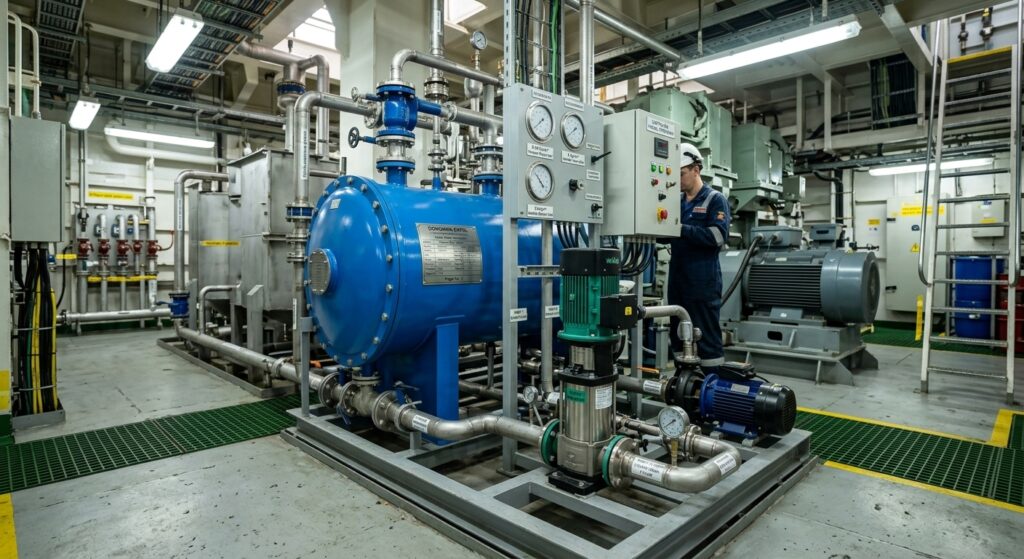
This article provides a comprehensive overview of the design, working principle, technical parameters, and operational practices for marine vacuum-type desalination plants, based on a standard 20 tonnes per day (20 TPD) installation.
What is a Marine Fresh Water Generator and Why is it Needed?
A marine Fresh Water Generator (FWG) is a waste heat recovery installation designed to produce distilled fresh water from seawater.
More information on Marine Fuel Separators: Design, Working Principle, Details
The main economic and technical advantage of a marine FWG lies in utilizing waste heat from the main engine cylinder cooling jacket water system. By capturing heat that would otherwise be rejected to the sea, the generator produces high-purity fresh water with virtually zero extra fuel expenditure.
Working Principle of a Marine Vacuum Fresh Water Generator
The operation of a marine fresh water generator relies on evaporating seawater under a deep vacuum, followed by condensing the generated vapor into pure distillate.
At normal atmospheric pressure, water boils at 100°C. However, maintaining a deep vacuum inside the evaporator shell significantly reduces the boiling point of seawater to approximately 40–45°C.
Key Stages of the Operational Cycle:
- Creating and Maintaining Vacuum:An ejector pump supplies seawater to a water ejector. As seawater flows through the nozzle of the ejector at high velocity, it creates a deep vacuum within the generator shell. The ejector continuously evacuates non-condensable gases (air) and extracts concentrated brine from the chamber.
- Evaporation of Feed Water:Seawater enters the evaporator section and flows over the heating elements. Hot main engine jacket cooling water (at around 80°C) or auxiliary steam acts as the heating medium. Under deep vacuum conditions, the seawater boils rapidly at low temperature and generates wet vapor.
- Separation and Moisture Elimination:The generated vapor rises toward the top of the shell. To prevent salt spray and liquid droplets from contaminating the distilled water, the vapor passes through a deflector plate and a high-efficiency stainless steel wire mesh separator—the demister. Entrained droplets are trapped by the mesh and fall back into the brine pool, while clean, dry vapor passes through.
- Vapor Condensation:The purified secondary vapor enters the condenser section, which is cooled by a continuous supply of cold seawater (typically around 32°C). Condensing on the cool heat exchanger tubes or plates, the vapor converts into pure distillate.
- Distillate Extraction and Salinity Control:A distillate pump draws fresh water from the condenser collection well and transfers it to the vessel’s fresh water storage tanks. A salinometer on the discharge line continuously measures water conductivity. If salinity exceeds the allowable threshold (typically 0–2 ppm up to 10 ppm), the salinometer triggers an alarm and energizes a solenoid valve, automatically recirculating non-compliant water back to the evaporator shell or overboard drain line.
Main Components and Equipment Overview
A marine fresh water generator unit is supplied as a compact skid consisting of the following key components:
- Evaporator: A plate or shell-and-tube heat exchanger that transfers heat from main engine jacket water to incoming seawater.
- Condenser: A heat exchanger responsible for cooling and condensing pure vapor using cold seawater.
- Water Ejector & Ejector Pump: The core assembly that creates vacuum and continuously removes brine from the shell.
- Demister: A multi-layer stainless steel mesh filter that eliminates moisture carry-over and prevents salt contamination.
- Distillate Pump: A specially designed centrifugal pump capable of extracting fresh water under low pressure / deep vacuum conditions.
- Salinometer & Solenoid Valve: An automated quality monitoring system that triggers alarms in the Engine Control Room (ECR) and on the Navigation Bridge.
- Feed Water Dosing Unit: A vacuum chemical feeder complete with a flow meter and storage tank for supplying scale inhibitor to the feed line.
Technical Specifications (Typical 20 TPD Plant)
The following table outlines the operational parameters of a representative 20 m³/day marine vacuum FWG unit:
| Parameter | Value / Specification |
| Daily Production Capacity | 20 tonnes/day (20 TPD) |
| Distillate Quality (Salinity) | 0 – 2 ppm |
| ME Jacket Water Flow (Heating) | 44 m³/h (Inlet temperature ~80°C) |
| Evaporator Heat Duty | ~600 kW (516,000 kcal/h) |
| Seawater Cooling Flow (Condenser) | 44 m³/h (Inlet temperature ~32°C) |
| Ejector Seawater Pump | 44 m³/h at 48 m head |
| Distillate Pump | 1.2 m³/h at 30 m head (0.75 kW motor) |
| Power Supply | 3-Phase, 440V, 60 Hz |
| Chemical Anti-Scale Dosing Rate | 2 – 259 ml/h (50 L tank) |
| Operating Weight | Approx. 700 kg |
Operation, Adjustment, and Maintenance Practices
Proper operational management by shipboard engineers ensures stable water production and protects heat transfer surfaces:
1. Preventing Thermal Shock
Heating water inlet and outlet valves must be operated slowly and smoothly. Rapid opening of hot jacket water valves creates severe thermal stress, leading to gasket displacement, plate deformation, or tube joint failure.
2. Regulating Production Capacity
FWG output is controlled by adjusting the flow rate of hot jacket water through the evaporator via a bypass valve. If main engine cooling water temperature drops, closing the bypass increases thermal input to maintain rated output.
3. Scale Control and Chemical Treatment
High boiling temperatures accelerate the deposition of calcium and magnesium salts (scale) on heat transfer surfaces. To minimize scaling:
- Maintain proper vacuum levels to keep boiling temperature low (~40–45°C).
- Inject anti-scale chemical continuously into the feed line using the vacuum dosing system.
4. Cold Seawater Operation
In cold seawater regions, over-condensation can occur, causing vacuum levels to drop too low and lowering the boiling temperature excessively. Engineers should throttle seawater flow through the condenser or slightly crack open the vacuum breaker valve to stabilize shell pressure.
Conclusion
The marine fresh water generator is a vital auxiliary plant that guarantees vessel independence during long ocean voyages. By maintaining proper vacuum conditions, monitoring distillate salinity, and ensuring routine anti-scale chemical dosing, marine engineers can preserve heat transfer efficiency and extend the service life of the generator.