

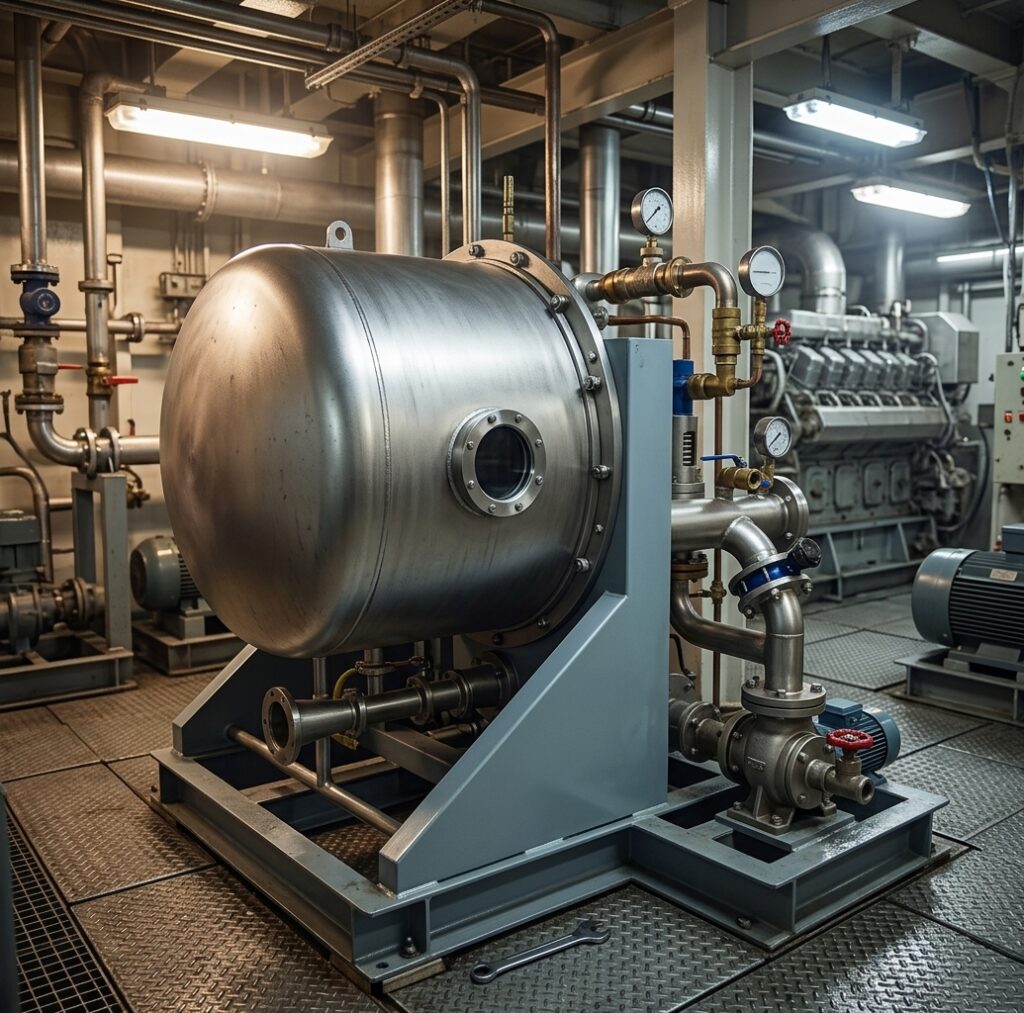
Reliable operation of a marine Fresh Water Generator (FWG) directly dictates vessel autonomy, operational efficiency, and the safety of the main propulsion plant. During the operation of vacuum-type evaporators—which utilize waste heat from main engine jacket cooling water—marine engineers frequently encounter specific technical issues.
Below is an expert SEO-optimized troubleshooting guide detailing 5 of the most common marine fresh water generator faults, their root causes, and practical corrective actions for shipboard engineers.
More information on 5 Common Marine Fuel Purifier Faults and How to Fix Them
Summary Table of Marine Fresh Water Generator Faults
| Fault / Problem | Likely Root Cause | Recommended Action |
| 1. Loss of Vacuum in Evaporator Shell | • Ejector pump pressure drop • Air leakage through gaskets/seals • Faulty vacuum breaker valve | • Check ejector pump and clean nozzle • Pressure-test shell and replace gaskets • Inspect and lap vacuum breaker valve |
| 2. High Distillate Salinity | • Fouled or damaged demister mesh • Leakage in condenser tubes/plates • Violent boiling / priming (overheating) | • Clean or replace wire mesh demister • Pressure-test condenser and fix leaks • Adjust heating water bypass valve |
| 3. Low Fresh Water Production | • Scale accumulation on evaporator plates • Low heating water temperature • Insufficient operating vacuum | • Perform Chemical Cleaning-in-Place (CIP) • Restore ME jacket water temperature • Eliminate vacuum leaks |
| 4. Evaporator Flooding & High Brine Level | • Blocked brine ejector nozzle or piping • Excessive feed water supply rate • Insufficient ejector driving pressure | • Clear brine ejector nozzle and suction line • Adjust feed water flow meter • Inspect ejector water supply pump |
| 5. Distillate Pump Cavitation & Loss of Suction | • Damaged pump mechanical shaft seal • Low water level in distillate well • Faulty discharge check valve | • Replace pump mechanical seal • Throttle discharge valve to balance flow • Clean and overhaul check valve |
1. Loss of Vacuum in the Evaporator Chamber
A drop in shell vacuum causes the boiling point of seawater inside the evaporator to rise above the optimal 40–45 °C range. Higher boiling temperatures drastically reduce freshwater yield and cause rapid calcium scale formation on heat exchanger surfaces.
Symptoms
The vacuum gauge reading drops, shell temperature increases, and the boiling action slows down or stops completely.
Root Causes
- Water Ejector Malfunction: A drop in pressure or flow from the ejector pump, or a clogged ejector nozzle, impairs the continuous evacuation of air and non-condensable gases from the shell.
- Air Ingress: Deteriorated rubber gaskets on sight glasses, inspection covers, distillate pump shaft seals, or shell flanges allow atmospheric air to leak into the vacuum space.
- Defective Vacuum Breaker Valve: Passing air through an improperly seated or fouled vacuum breaker valve.
Solutions
- Inspect the driving water pressure before the ejector. Clean the ejector pump inlet strainer and dismantle the ejector assembly to clear nozzle blockages.
- Apply a soap solution around casing joints or pressurize the shell slightly with air to locate air leaks. Replace degraded O-rings and flat gaskets.
- Overhaul the vacuum breaker valve, clean its seating surfaces, and lap the valve seat if scoring is present.
2. High Distillate Salinity and Salinometer Alarm
An increase in distillate conductivity above allowable thresholds (typically 0–2 ppm up to 10 ppm) triggers the salinometer alarm and activates the automatic 3-way solenoid valve to dump non-compliant water.
Symptoms
The salinometer alarm sounds on the Engine Control Room (ECR) panel, and the 3-way valve diverts distillate away from shipboard fresh water storage tanks back to the evaporator shell or overboard.
Root Causes
- Demister Damage or Fouling: A clogged or physically damaged wire mesh demister (droplet separator) allows entrained salty mist droplets to pass into the condenser section.
- Condenser Leakage: Pinholes or gasket failures in the condenser allow cold, untreated sea cooling water under pressure to enter the pure distillate stream.
- Violent Boiling (Priming / Carry-over): Excessive vacuum or high jacket water temperatures cause violent boiling, throwing brine droplets directly across the demister into the condenser.
Solutions
- Remove the mesh demister, soak it in fresh water or an approved cleaning agent to remove salt deposits, and check for physical perforation.
- Hydrostatically pressure-test the condenser side, identify leaking tubes or plate gaskets, and replace or plug affected elements.
- Regulate heating water flow using the main engine jacket water bypass valve to stabilize boiling intensity.
- Clean and recalibrate the salinometer sensor electrodes.
3. Low Fresh Water Production Capacity
The generator maintains proper vacuum and salinity levels, but the total daily volume of distillate produced falls well below the plant’s rated capacity.
Symptoms
Low water levels in the condenser collection well and reduced flow readings on the distillate flow meter despite normal vacuum readings.
Root Causes
- Scale Formation on Evaporator Plates: Hardness salts (calcium carbonate and magnesium hydroxide) deposit on heating surfaces due to interrupted or inadequate dosing of anti-scale chemicals.
- Insufficient Heat Input: Low jacket cooling water temperature from the main engine (below 80 °C) or partially closed heating medium valves.
- Condenser Marine Growth / Fouling: Mud, silt, or bio-fouling on the seawater cooling side of condenser plates/tubes impairs heat transfer efficiency.
Solutions
- Perform a Chemical Cleaning-in-Place (CIP) using an acid-based descaling solution to dissolve scale deposits from evaporator plates.
- Check the anti-scale chemical vacuum dosing station, refill the chemical tank, and calibrate the dosing rate according to guidelines.
- Adjust the main engine cooling system bypass valve to restore designated heating water temperatures.
- Flush and clean seawater cooling passages in the condenser section.
4. Evaporator Flooding and High Brine Level
Disruption of the balance between incoming seawater feed and brine discharge causes raw seawater to flood the evaporator shell.
Symptoms
The brine level rises above the upper sight glass line, liquid contacts the demister pad, and distillate salinity spikes rapidly.
Root Causes
- Clogged Brine Ejector: Debris or salt crystals block the brine ejector nozzle or the suction pipe leading from the bottom of the shell.
- Excessive Feed Water Flow: Incorrect adjustment of the feed water supply valve or flow meter.
- Low Ejector Supply Pressure: Reduced head from the ejector pump lowers the suction power needed to draw brine overboard.
Solutions
- Isolate the feed water supply, dismantle the brine ejector, and clear any debris from the nozzle and suction line.
- Re-adjust the feed water flow control valve according to the manufacturer’s performance curve.
- Inspect ejector pump performance and clean inline suction strainers.
5. Distillate Pump Cavitation and Loss of Suction
The distillate extraction pump operates under challenging conditions, taking suction from a well that is under a deep vacuum. Air leakage readily causes loss of suction.
Symptoms
Metallic knocking or cavitation noise in the pump casing, fluctuating discharge pressure gauges, and zero delivery to fresh water tanks.
Root Causes
- Mechanical Seal Wear: Atmospheric air leaks into the pump casing through a worn mechanical seal ring, breaking the suction vacuum.
- Low Level in Collector Well: Pump capacity exceeds generation rate, causing the pump to draw vapor/air from the vacuum chamber.
- Defective Discharge Check Valve: Backflow of air or water into the pump through a passing non-return valve on the discharge line.
Solutions
- Overhaul the pump and replace the mechanical shaft seal and O-rings.
- Throttle the pump discharge valve to balance extraction rate with actual distillate production and maintain a steady liquid seal in the well.
- Inspect, clean, or replace the non-return check valve on the pump discharge line.