

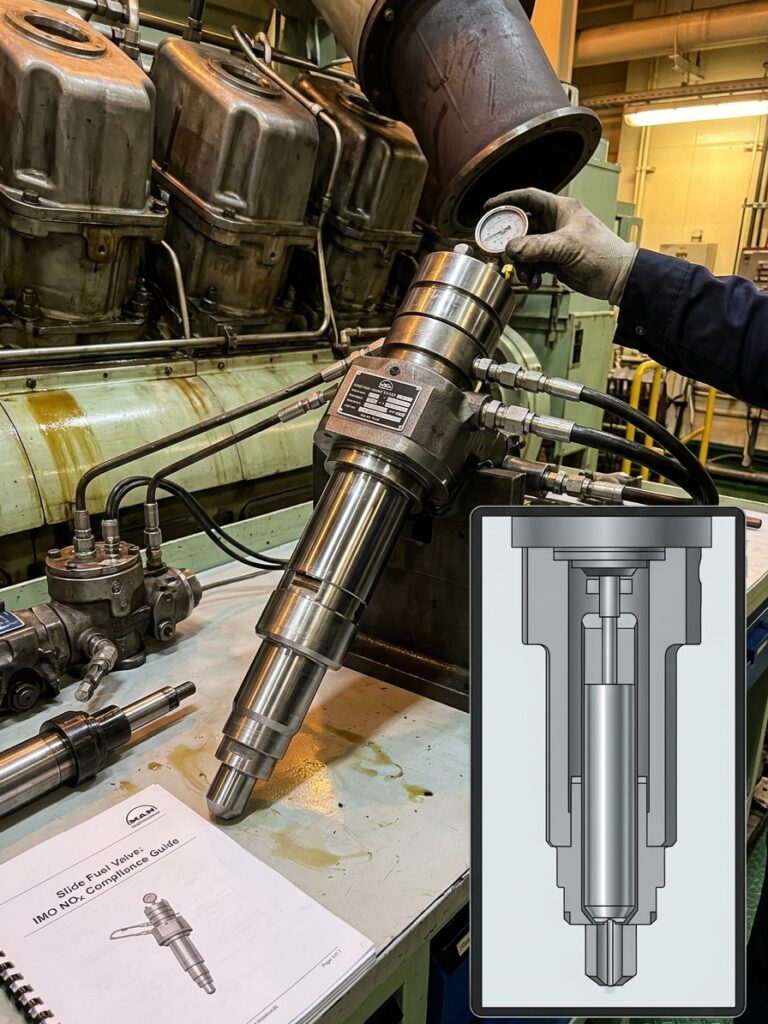
In modern merchant shipping and the operation of low-speed two-stroke marine diesel engines, optimizing combustion efficiency while satisfying strict International Maritime Organization (IMO) environmental regulations is a top priority. A critical technological advancement that has significantly improved heavy fuel oil atomization and minimized harmful emissions is the slide fuel valve.
The Problem with Conventional Fuel Injectors: The Sac Volume
In traditional marine diesel fuel injectors, a small unvented space exists inside the nozzle tip beneath the needle seat – commonly referred to as the “sac volume” or “cavity.”
When the high-pressure fuel injection pump completes its stroke and the fuel valve needle seats under spring pressure, a minor quantity of residual fuel remains trapped within this sac volume under relatively low pressure.
More information on Fresh Water Generator Faults: Common Problems and Solutions
During the subsequent expansion and combustion stroke, this residual fuel slowly leaks or evaporates through the nozzle spray holes into the combustion chamber. This produces several detrimental operational problems:
- Poor Atomization and Dripping: The fuel is not broken down into microscopic droplets but enters the cylinder as large droplets or continuous drips.
- Incomplete Combustion: Leads to heavy smoke formation, soot accumulation, and unburned carbon residue.
- Cylinder and Exhaust Component Fouling: Heavy carbon deposits accumulate on the piston topland, piston rings, and throughout the exhaust valve duct.
- Increased NOx Emissions: Uncontrolled local burning pockets with elevated temperatures encourage the formation of nitrogen oxides ($\text{NO}_x$).
Construction and Detailed Working Principle of the Slide Fuel Valve
The primary structural distinction of a slide fuel valve is its zero-sac volume design, which completely eliminates the unvented fuel cavity at the nozzle tip.
Injection Phase
- Pressure Build-Up: As the fuel injection pump delivers high-pressure fuel to the valve, hydraulic force acts on the tapered thrust face of the spindle needle, overcoming the spring preload and lifting the needle off its seat.
- Sliding Nozzle Uncovering: The lower extension of the spindle is engineered as a precision sliding slide (or sleeve) that closely fits inside the nozzle bore, blanking off the nozzle spray holes. As the spindle moves upward, this slide uncovers the spray holes instantly—only after the fuel pressure has reached its designated opening limit.
- Optimized Combustion: Fuel is injected at maximum nominal pressure from the very beginning, creating an ideal atomized spray pattern with microscopic droplet distribution.
Cut-Off Phase
- Pressure Drop: When the fuel injection pump finishes its stroke, system pressure rapidly drops, allowing the valve spring to push the spindle downward.
- Instantaneous Sliding Closure: The sliding portion of the spindle moves downward, physically sealing the inlets of the nozzle spray holes before the main needle fully seats on its conical face.
- Residual Displacement: As the slide moves into position, it physically displaces and isolates any remaining fuel away from the spray holes.
- Final Result: No fuel remains in contact with the nozzle orifices after shut-off. Fuel injection terminates sharply without secondary pressure waves, post-injection dripping, or fuel boiling off into the combustion chamber.
Key Operational Benefits of Slide Fuel Valves
Switching to slide fuel injection provides vessel owners and marine engineers with substantial operational and environmental advantages:
- Lower Nitrogen Oxide (NOx) Emissions: The precise injection cut-off and optimized spray pattern enable engines to meet IMO $\text{NO}_x$ emission limits directly at the source.
- Cleaner Exhaust Ducting and Boilers: Fouling on the piston topland, exhaust valve housing, and exhaust gas economizer (boiler) is drastically reduced. Exhaust passages remain remarkably clean even after thousands of hours of continuous operation.
- No Penalty on Specific Fuel Oil Consumption (SFOC): Unlike several alternative emission-reduction techniques that compromise fuel economy, slide fuel valves reduce $\text{NO}_x$ without increasing overall fuel consumption.
- Reduced Reliance on Secondary After-treatment: Emissions compliance is achieved internally through improved combustion efficiency, reducing the need for complex secondary systems like Selective Catalytic Reduction (SCR) or urea injection under standard operational conditions.
Real-World Performance and Engine Retrofitting
Slide fuel valves are installed as standard equipment on modern two-stroke engines and can also be retrofitted onto existing engines with cylinder bores of 60 cm and larger.
Trial Data and Operational Observations
Field data from commercial vessel operations and workshop testing demonstrate measurable performance gains:
- Substantial Emission Reductions: Test trials on 60-bore two-stroke engines recorded $\text{NO}_x$ levels dropping to approximately $12.5\text{ g/kWh}$ at $75\%$ engine load, with no increase in fuel consumption.
- Shipboard Operational Metrics: Comparative measurements taken aboard commercial vessels confirmed a reduction in $\text{NO}_x$ emissions of up to 30%, bringing baseline figures down from $19.0\text{ g/kWh}$ to $13.4\text{ g/kWh}$.
- Extended Service Condition: Visual inspections of exhaust valve ducts after hundreds of operational hours show minimal soot buildup, ensuring longer overhaul intervals for exhaust valves and turbocharger turbines.
Maintenance Guidelines for Marine Engineers
While slide fuel valves offer high reliability, maintaining them requires strict adherence to maintenance procedures:
- Testing on the Injector Test Rig: When verifying the opening pressure on a manual test pump, observe the sharpness of the fuel cut-off. The slide mechanism must cut off injection instantly without any visible trailing drops.
- Inspecting the Sliding Surface: The tight tolerance between the slide and the nozzle body makes the assembly sensitive to fuel contaminants. Always ensure proper fuel purification through settling and centrifugal separation to prevent surface scoring or sticking of the sliding element.
- Cleaning Spray Orifices: Never use improper metallic tools to clear clogged spray holes. Always use calibrated cleaning wires matching the exact diameter specified by the manufacturer to preserve spray hole geometry.