

The Invisible Battlefield: Why Underwater Cables Are Under Siege
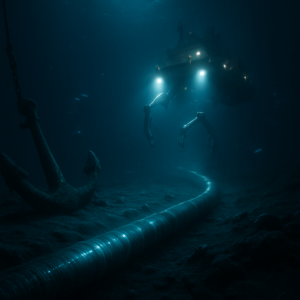 Beneath the ocean’s surface, a silent war rages—one that most of us never see but all of us depend on. The world’s internet, financial markets, and even military communications rely on a sprawling network of deep-sea cables, thin as garden hoses yet tough enough to withstand crushing pressures. Yet despite their armored exteriors, these underwater lifelines face relentless threats. Some come from the depths themselves; others, from the very hands of those who benefit from them. The battlefield is invisible, but the stakes couldn’t be higher.
So who—or what—is waging this war? The answer might surprise you. Forget the Hollywood image of saboteurs in submarines or razor-toothed sharks gnawing at fiber optics. The real culprits are far more mundane, yet devastating in their own right. Roughly 70% of all cable damage is caused by human activity, while the remaining 30% falls to the unpredictable fury of nature. And though modern engineering has neutralized some threats, others remain stubbornly persistent.
More information on Switching to LPG Tankers: A Starter’s Roadmap
The Human Factor: Anchors, Trawlers, and a Trail of Disruption
If you’ve ever watched a cargo ship drop anchor in a busy port, you’ve witnessed one of the internet’s greatest vulnerabilities in action. Those massive metal hooks, designed to hold hundreds of thousands of tons in place, are also perfectly capable of shearing through steel-reinforced cables like dental floss. And they do—constantly.
Commercial shipping is the single biggest threat to underwater cables, responsible for nearly half of all human-caused damage. In 2017, a single errant anchor near Marseille sliced through three major cables in one stroke, disrupting internet access across parts of Africa and the Middle East for days. The problem isn’t just carelessness; it’s geography. Many cables are laid along heavily trafficked shipping lanes, where vessels drop anchor without realizing they’re parking on top of the digital equivalent of a power line. Even when ships avoid designated cable routes, storms or mechanical failures can force them to anchor in restricted zones—with catastrophic results.
Fishing trawlers are the other half of this underwater menace. The weighted nets dragged along the seafloor to scoop up fish don’t discriminate—they snag, drag, and snap cables with alarming frequency. In 2022, a Vietnamese fishing vessel accidentally hooked a cable in the South China Sea, pulling up a 50-meter section before the crew even realized what they’d caught. The repair took weeks, costing millions in lost connectivity. And while some regions have imposed fishing exclusion zones around cable paths, enforcement is spotty. In busy waters like the North Sea or the East China Sea, trawlers often operate in the same areas where cables lie buried—sometimes just inches beneath the sediment.
The irony? Most of these incidents are completely avoidable. Modern cable-laying ships use plows to bury cables up to three meters deep in high-risk areas, and GPS tracking allows vessels to steer clear of known cable routes. Yet human error, outdated charts, and sheer bad luck ensure that hundreds of cable faults occur every year—each one a potential disaster for the global network.
Nature’s Wrath: When the Earth Fights Back
If humans are the internet’s reckless drivers, then nature is its unpredictable earthquake. The remaining 30% of cable damage comes from geological forces that can twist, snap, or bury cables in an instant—and there’s often little we can do to stop them.
Underwater earthquakes are the most dramatic offenders. In 2006, a 7.0-magnitude quake off the coast of Taiwan triggered a series of underwater landslides that severed nine major cables in a single day. The damage crippled internet and phone services across Asia, disrupting everything from stock trades to emergency communications. Repair ships took weeks to restore full connectivity, and the financial toll ran into the hundreds of millions. Even more chilling? That quake wasn’t an outlier. The Pacific Ring of Fire, a hotspot for seismic activity, is also home to some of the world’s busiest cable routes. When the earth shakes, the internet trembles.
Landslides, both earthquake-induced and spontaneous, are another silent killer. In 2020, a submarine avalanche off the coast of West Africa dragged a cable nearly a kilometer from its original path, stretching and snapping it like a rubber band. The event went unnoticed for days—until internet speeds in Nigeria and South Africa began to crawl. By the time engineers pinpointed the break, the damage was done. Unlike human-caused faults, which tend to be localized, natural disasters can take out multiple cables at once, turning a routine repair into a logistical nightmare.
Even the ocean’s currents play a role. In some regions, strong underwater flows can scour away sediment, leaving cables exposed like roots on eroded soil. Once uncovered, they’re far more vulnerable to anchors, trawlers, and even their own weight. In the Mediterranean, for example, cables laid in the 1990s have been gradually uncovered by shifting sands, forcing operators to rebury them at great expense.
The scariest part? We can’t predict most of these events. While seismic monitoring helps warn of impending earthquakes, landslides and currents remain largely unpredictable. All engineers can do is fortify cables in high-risk zones—thicker armor, deeper burial, and redundant routes—and hope for the best.
The Shark Myth: How a Hollywood Trope Became a Tech Fix
No discussion of underwater cable threats would be complete without addressing the most persistent (and entertaining) myth of them all: sharks. For decades, the idea of razor-toothed predators mistaking fiber-optic cables for prey has been a staple of tech lore. And, for a time, it wasn’t entirely fiction.
In the 1980s, when the first transatlantic fiber-optic cables were laid, engineers noticed something strange: sharks were biting them. Not often, but enough to cause concern. The culprit? The cables’ electromagnetic fields, which some marine biologists believe mimicked the bioelectric signals of prey. For a shark, a cable might as well have been a giant, slow-moving fish. The problem was serious enough that companies like AT&T began wrapping cables in extra layers of steel tape to deter curious predators.
Fast forward to today, and the shark threat has been largely neutralized. Modern cables are shielded with non-conductive materials, rendering them invisible to a shark’s electroreceptors. The last confirmed shark-related cable fault? Over a decade ago. Yet the myth persists, a testament to how easily a single viral image (like the infamous 1987 photo of a shark biting a cable) can outlive the reality.
That’s not to say marine life poses no risk. In some regions, shipworms—a type of saltwater clam—have been known to bore into cable insulation, though their damage is usually superficial. More commonly, crabs and lobsters have been caught using cables as makeshift highways, their sharp claws occasionally nicking the outer layers. But these are minor annoyances compared to the havoc wreaked by anchors, trawlers, and tectonic plates.
Still, the shark myth endures because it’s a useful reminder: even the most advanced technology is vulnerable to the natural world. And while we’ve solved the shark problem, new threats are always emerging. As climate change alters ocean currents and deep-sea mining becomes more common, the invisible battlefield beneath the waves is only getting more crowded.