
The Brain Behind the Beast: Command Center at Sea
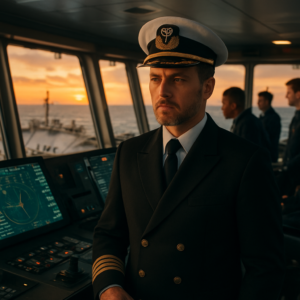 Step onto the bridge of a modern LNG tanker, and you might mistake it for the flight deck of a spaceship—or at least the control room of a nuclear power plant. Gone are the days of wooden wheels, brass telegraphs, and crews scrambling across decks with handwritten logs. This is a place where 20 people oversee a 282-meter-long leviathan with the precision of a Swiss watch and the adaptability of a living organism. The bridge isn’t just where the ship is steered; it’s the nerve center where navigation, engineering, and cargo operations converge in real time, all under the watchful eye of integrated digital systems that never blink.
The Digital Helm: Where Steel Meets Silicon
The first thing that strikes you is the absence of a traditional helm. In its place sits a sleek, ergonomic console dominated by a pair of large, high-resolution screens and a joystick that looks like it was borrowed from a fighter jet. This is the Dynamic Positioning System (DPS), the ship’s digital brainstem. The joystick doesn’t directly move the rudder or engines—instead, it sends commands to the ship’s computer, which calculates the most efficient way to execute the maneuver. Want to turn the ship 30 degrees to starboard? The system might adjust the thrusters, rudder, and even the pitch of the propellers in a carefully orchestrated ballet to avoid overcorrecting or wasting fuel.
At the heart of this system is the Integrated Navigation System (INS), a network of sensors, radars, GPS units, and sonar that feeds real-time data into a central hub. The INS doesn’t just plot the ship’s course; it cross-references it with weather forecasts, tidal patterns, and even the movements of other vessels in the area. If a storm is brewing 200 nautical miles ahead, the system doesn’t just warn the crew—it suggests alternative routes, calculates the fuel impact, and adjusts the ETA. The officer on watch isn’t just a navigator; they’re a systems manager, overseeing a machine that’s constantly learning and adapting.
But here’s the thing: no matter how advanced the tech, it’s still just a tool. The real magic happens in the interplay between human intuition and artificial intelligence. Take, for example, the time Second Officer Elena Vasquez was on watch during a transit through the Strait of Malacca. The INS had flagged a cluster of fishing vessels ahead, but something didn’t sit right with her. The radar returns were erratic, and the AIS (Automatic Identification System) signals were intermittent—classic signs of smaller boats trying to avoid detection. She overrode the system’s suggested course, slowing the ship and sounding the horn in a series of long blasts. Minutes later, a swarm of unlit fishing boats emerged from the darkness, their nets stretching across the intended path. The INS would have avoided them eventually, but Elena’s gut instinct bought them critical seconds. “The computer sees data,” she says. “I see patterns.”
More information on Fake Gas Carrier Jobs: How to Spot Scams & Avoid Fraud
Engine Room in the Cloud: Remote Monitoring and AI-Assisted Oversight
Twenty years ago, the engine room of a tanker was a labyrinth of pipes, valves, and dials, staffed by a team of engineers who spent their shifts covered in grease, ears tuned to the hum of machinery. Today, the engine room of an LNG carrier is still a marvel of engineering—but you won’t find anyone down there unless something’s gone wrong. Instead, the Engine Control Room (ECR) is a quiet, climate-controlled space adjacent to the bridge, where a single engineer monitors a bank of screens displaying every vital sign of the ship’s colossal powerplant.
The ship’s two-stroke, dual-fuel engines—each the size of a small apartment building—are equipped with thousands of sensors that track everything from cylinder pressure to exhaust gas temperatures. This data is fed into the Ship Performance Monitoring System (SPMS), which uses AI to predict maintenance needs, optimize fuel consumption, and even adjust engine settings in real time. If a bearing starts to overheat, the system doesn’t just sound an alarm—it cross-references the issue with the ship’s maintenance logs, checks the spare parts inventory, and suggests the best course of action. In some cases, it can even self-correct, adjusting fuel flow or lubrication to prevent a shutdown.
But redundancy is the name of the game. The ship’s engines are designed with triple fail-safes: if the primary control system fails, a secondary system takes over instantly. If that fails, a tertiary mechanical backup ensures the engines can still be operated manually. The same principle applies to the cargo systems. LNG tankers carry their cargo at -162°C, and even a minor leak can turn into a catastrophic event. That’s why the Cargo Control Room (CCR) is equipped with independent monitoring systems that double-check each other’s readings. If one sensor detects a pressure spike in a tank, another sensor must confirm it before the system takes action. “We don’t trust any single point of failure,” says Chief Engineer Raj Patel. “If the AI says the pressure is rising, but the backup gauge says it’s stable, we investigate. No exceptions.”
This level of automation doesn’t eliminate the need for human expertise—it elevates it. The crew’s role has shifted from hands-on operators to systems supervisors, tasked with interpreting data, troubleshooting anomalies, and making split-second decisions when the unexpected happens. Raj recalls a voyage through the Suez Canal when the ship’s main engine suddenly lost power. The SPMS had flagged a potential issue with the fuel injection system, but the AI’s suggested fix—a gradual reduction in load—would have left them drifting in the canal’s narrow confines. Instead, Raj and his team diagnosed a clogged fuel filter and switched to a backup system in under three minutes. “The computer can tell you what’s wrong,” he says. “But it can’t tell you why. That’s where we come in.”
Cargo Operations: A Symphony of Pipes and Pixels
If the bridge is the ship’s brain, then the cargo control room is its beating heart. Here, the crew manages the loading, unloading, and monitoring of up to 50,000 tons of liquefied natural gas—a process that’s equal parts chemistry, physics, and high-stakes logistics. The cargo tanks are kept at cryogenic temperatures, and even a minor miscalculation can lead to a rapid phase transition (boil-off) or, worse, a structural failure. That’s why the Cargo Management System (CMS) is designed to be as foolproof as possible.
The loading process begins long before the ship docks. The CMS communicates with the terminal’s systems to ensure compatibility, verifying everything from the composition of the LNG to the pressure ratings of the loading arms. Once the ship is alongside, the system takes over, controlling the flow of gas through a network of insulated pipes and valves. The crew monitors the process from the CCR, where screens display real-time data on tank levels, pressure, temperature, and boil-off rates. If a valve fails to open or a pump overheats, the system can isolate the affected section and reroute the flow without interrupting the operation.
But even the best systems can’t account for every variable. During a loading operation in Qatar, Third Officer Daniel Kim noticed something unusual: the boil-off rate in Tank 3 was higher than expected, even though the temperature and pressure readings were stable. The CMS had flagged it as a minor anomaly, but Daniel’s experience told him otherwise. He ordered a manual inspection and discovered a hairline crack in one of the tank’s insulation panels. Left unchecked, it could have led to a dangerous pressure buildup. “The system saw the numbers, but it didn’t see the trend,” Daniel says. “Sometimes you have to look beyond the data.”
Navigating the Unpredictable: Storms, Pirates, and Geopolitical Chess
For all its automation, an LNG tanker doesn’t operate in a vacuum. The world’s oceans are a dynamic, often hostile environment, and the crew must be ready to adapt at a moment’s notice. Weather is the most obvious challenge. A storm that looks manageable on a weather chart can turn into a nightmare when you’re in the middle of it, with 50,000 tons of volatile cargo sloshing in your tanks. That’s where the Voyage Optimization System (VOS) comes in. It doesn’t just track storms—it simulates their impact on the ship’s stability, fuel consumption, and structural integrity. If a low-pressure system is intensifying in the North Atlantic, the VOS can calculate whether it’s safer (and more economical) to slow down, speed up, or alter course entirely.
But nature isn’t the only threat. Geopolitical tensions can turn a routine voyage into a high-stakes chess match. In 2022, as tensions between Russia and Europe escalated, several LNG tankers found themselves rerouted mid-voyage to avoid exclusion zones or potential blockades. Captain Anna Kowalski was in command of one such ship, en route from Norway to Japan, when she received a sudden order to divert around the South China Sea. The INS recalculated the route, but Anna knew the real challenge wasn’t the extra miles—it was the fuel. The ship was carrying just enough LNG to reach its destination with a 5% buffer. Diverting would burn into that reserve, leaving little room for error. She worked with the chief engineer to adjust the engine’s fuel mix, burning a higher percentage of boil-off gas to conserve liquid fuel. “It was like threading a needle,” she says. “One wrong move, and we’d be calling for a rescue tug.”
Then there’s the ever-present threat of piracy. While modern LNG tankers are less attractive targets than oil tankers (LNG is harder to siphon and sell on the black market), they’re not immune. The bridge is equipped with Long-Range Acoustic Devices (LRADs), water cannons, and even secure citadels where the crew can retreat in an emergency. But the best defense is vigilance. The ship’s radar and AIS systems are constantly monitored for suspicious vessels, and the crew trains regularly for high-speed maneuvers to evade potential attackers. During a transit through the Gulf of Aden, Anna’s ship was approached by a skiff moving at high speed. The INS flagged it as a potential threat, and the crew sprang into action: sounding the alarm, activating the LRAD, and preparing to execute an evasive turn. The skiff veered off at the last moment, but the incident was a stark reminder that no amount of automation can replace situational awareness.
The Human Factor: Why 20 People Are Enough
So how does a crew of just 20 people manage a ship this complex? The answer lies in specialization, redundancy, and trust. Each crew member is cross-trained in multiple roles, but they also have deep expertise in their primary domain. The chief officer isn’t just a navigator—they’re a cargo specialist. The second engineer isn’t just a mechanic—they’re a data analyst. And everyone, from the captain to the deck cadet, is trained to step into a critical role if needed.
The ship’s watch system is designed to ensure that no single person is ever overwhelmed. The bridge is manned 24/7, with officers rotating in four-hour shifts. During critical operations—like loading, unloading, or transiting narrow channels—the captain and chief engineer are always on call, ready to step in if the automation hits a snag. And because the ship is designed with redundancy at every level, the crew can focus on oversight rather than firefighting.
But perhaps the most important factor is the crew’s ability to work as a team. On a traditional ship, the bridge and engine room might as well be on different planets. On an LNG tanker, they’re in constant communication, sharing data and insights in real time. When the ship’s main engine faltered in the Suez Canal, it wasn’t just Raj and his team who sprang into action—it was the entire bridge crew, adjusting the ship’s trim, monitoring the rudder response, and coordinating with the terminal to minimize delays. “We’re not just a crew,” Anna says. “We’re a unit. And that’s what makes this work.”
In the end, the bridge of an LNG tanker is a testament to how far maritime technology has come—and how far it still has to go. It’s a place where human ingenuity and artificial intelligence dance in a delicate balance, where split-second decisions can mean the difference between a routine voyage and a disaster. And while the ship may be a marvel of engineering, it’s the people at the helm—watching, learning, and adapting—who truly bring it to life.