
The Suez Canal Incident: A Wake-Up Call
 It was supposed to be just another routine transit—another stretch of blue water, another set of coordinates to log, another day closer to the next port. But for one Liberian-flagged vessel, a single decision turned a mundane passage through the Suez Canal into a nightmare that would ripple through maritime circles for months. The incident, later detailed in a flag administration circular, wasn’t just a cautionary tale; it was a brutal reminder of how quickly things can go wrong when assumptions clash with reality.
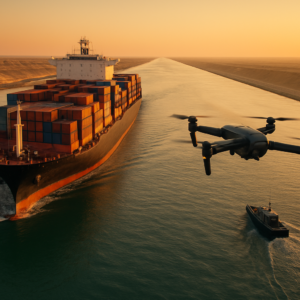
The crew member—let’s call him Alex—had saved up for months to buy a high-end quadcopter. A hobbyist with a passion for photography, he’d spent evenings scrolling through drone footage of sunsets over the ocean, imagining the shots he could capture from the deck of a moving ship. The Suez Canal, with its narrow banks, historic landmarks, and the constant hum of global trade, seemed like the perfect backdrop. So, as the vessel entered the canal, he did what any enthusiastic amateur would do: he unpacked his drone, powered it up, and sent it skyward.
What happened next unfolded with terrifying speed.
More information on Toxic Voyages: The Hidden Dangers of VCM and Butadiene
The Immediate Fallout
Within minutes of the drone taking flight, the vessel’s bridge received a sharp, urgent radio call from the Suez Canal Authority (SCA). The message was clear: immediately drop anchor and prepare for boarding. No explanations, no room for negotiation. The ship, now a floating crime scene in the eyes of Egyptian authorities, was ordered to halt its transit. Tugs were dispatched to secure its position, and before the crew could fully process what was happening, armed police officers were climbing the accommodation ladder.
The boarding team didn’t waste time with pleasantries. They confiscated the drone, demanded the memory card, and began questioning the crew. Alex, still in shock, was separated from the others. The atmosphere on board shifted from confusion to dread as the reality set in: this wasn’t a misunderstanding. This was a full-blown security breach.
The vessel was detained indefinitely. No timeline was given for its release. The captain, now facing the weight of the incident, was informed that he could be held personally liable—potential imprisonment or a fine so large it would cripple the shipowner’s finances. The company’s legal team scrambled to intervene, but in a country where drones are treated as potential espionage tools, the deck was stacked against them. Days turned into a week. The crew, stuck in limbo, watched as other vessels passed them by, their own schedules unraveling with each hour of delay.
Why Egypt Sees Drones as a Threat
To outsiders, it might seem like an overreaction. After all, drones are commonplace in many parts of the world—used for everything from real estate photography to wedding videos. But in Egypt, and particularly in the Suez Canal, the rules are different. The canal isn’t just a waterway; it’s a strategic chokepoint, a critical artery for global trade, and a high-value target for surveillance. The Egyptian government doesn’t distinguish between a hobbyist’s toy and a tool for intelligence gathering. In their eyes, any unauthorized aerial device is a potential security risk.
This isn’t just paranoia. The canal has been a flashpoint for geopolitical tensions for over a century. Its banks are lined with military installations, and its waters are patrolled by vessels from multiple nations. The idea that a foreign-flagged ship could be using a drone to capture footage—even innocently—is enough to trigger a hardline response. And the consequences aren’t just theoretical. Egypt has precedent for treating drone violations as serious offenses, with penalties that extend far beyond a slap on the wrist.
For the crew of that Liberian-flagged vessel, the incident became a masterclass in how quickly a seemingly harmless decision could spiral out of control. The drone, which was meant to capture beauty, instead became a liability—one that threatened their freedom, their livelihoods, and the financial stability of their employer.
The Turning Point
When I first read the circular detailing this incident, I was halfway through planning my own drone purchase. I’d already picked out the model, calculated the weight restrictions, and even sketched out a few shot ideas for my next contract. But after reading about Alex’s ordeal, something clicked. It wasn’t just about the risk of losing an expensive piece of equipment. It was about the human cost—the stress, the uncertainty, the sheer helplessness of being at the mercy of a foreign legal system with little recourse.
I thought about the captain, a seasoned professional with decades of experience, suddenly facing the prospect of a prison cell because of one crew member’s enthusiasm. I thought about the shipowner, staring at a bill that could run into the millions for a mistake that took seconds to make. And I thought about the crew, stuck in a bureaucratic nightmare, their careers and reputations hanging in the balance.
In that moment, the allure of drone footage paled in comparison to the stakes. The ocean is vast, but the rules that govern it are often narrow, unforgiving, and subject to interpretation. What’s legal in one port can be a felony in another. What’s a hobby in one country can be espionage in the next. And in a place like the Suez Canal, where the margin for error is nonexistent, the price of a mistake is simply too high.
I closed the circular, set aside my drone research, and made a decision: some risks aren’t worth taking. Not when the alternative is trading a few Instagram likes for the peace of mind that comes with knowing you won’t be the next cautionary tale.