
First Transit: A Rookie’s Baptism by Fire
 The night before our scheduled transit, I barely slept. The ship’s clock ticked toward 0400 like a countdown, each passing minute tightening the knot in my stomach. I’d spent the last three days hunched over charts in the wheelhouse, tracing the same 81-kilometer route with my finger, memorizing the names of the locks—Gatun, Pedro Miguel, Miraflores—like they were stations of the cross. At 22, this was my first real test as a third officer, and the Panama Canal wasn’t just another waypoint. It was the place where the sea’s rules bent to human will, where a mountain range had been carved into submission. And now, somehow, I was supposed to help guide 50,000 tons of steel through it.
Dawn broke thick and green over Colón, the air so saturated with humidity it felt like breathing through a wet towel. The MV Horizon Trader, a mid-sized tanker hauling refined petroleum, sat low in the water, her draft marks glaring at us like an accusation. We were four centimeters over the limit. Not enough to get us turned away outright, but enough to make the canal authorities nervous. Enough to make me nervous. Captain Vasquez had already been on the radio with the Panama Canal Authority (ACP) for an hour, his voice a low growl of Spanish and English, bargaining for leniency. The answer came back the same way it always did: “Reduce your draft or wait for the next tide.” Problem was, the next tide wasn’t for 36 hours, and our charterers would skin us alive if we missed our slot.
More information on Switching to LPG Tankers: A Starter’s Roadmap
That’s how I found myself on deck at 0530, watching the chief mate and a handful of ABs (able-bodied seamen) rig up a jury-rigged siphon system to drain the ship’s freshwater tanks. The plan was simple, desperate, and slightly absurd: we’d sacrifice our drinking water to shave off those last four centimeters. The chief, a grizzled Filipino named Reyes who’d been sailing since before I was born, barked orders like a drill sergeant. “More hose! And somebody find me a fucking bucket!” The water gurgled out in uneven spurts, splashing onto the deck plates, already slick with the morning’s first tropical downpour. I remember thinking how surreal it was—here we were, in the middle of one of the world’s greatest engineering feats, and our salvation might hinge on a length of garden hose and a prayer.
By 0700, we’d dumped nearly 200 tons of water overboard. The ship sat a little higher in the water, her lines slightly less burdened. The ACP inspector, a wiry Panamanian with a clipboard and the patience of a saint, gave us a final once-over. He didn’t smile, but he didn’t shake his head either. “You’re clear,” he said. “But if you ground in the locks, it’s on you.” Captain Vasquez clapped me on the shoulder. “Relax, muchacho. Today, you become a sailor.”
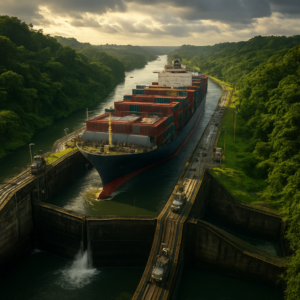
The first hint that we were truly entering the canal came not from the water, but from the sky. The rain, which had been a steady drizzle since dawn, suddenly intensified, hammering the deck in sheets so thick they blurred the horizon. It wasn’t just rain—it was a full-on tropical deluge, the kind that turns the world into a watercolor painting where everything runs together. The windshield wipers on the bridge struggled to keep up, their rhythmic thunk-thunk the only steady sound as we inched toward the Gatun Locks. Then, through the haze, I saw them: the massive concrete walls rising out of the mist like the sides of a canyon. My breath caught. I’d seen photos, read the specs, but nothing prepared me for the scale. The locks were monstrous, their chambers wide enough to swallow our ship with room to spare, their gates towering stories above us, riveted steel plates held together by a century of rust and resolve.
Our pilot, a stocky American named Mike with a voice like gravel and a manner that suggested he’d done this a thousand times before (he probably had), boarded at the first set of buoys. He took the conn without ceremony, barking orders in a mix of English and Spanish that the helmsman somehow parsed without hesitation. “Mantenga dos grados a babor… ahora, máquina avante despacio.” The engines rumbled beneath us, a deep, visceral vibration that traveled up through the soles of my boots. We were moving. Actually moving. Into the locks. Into history.
The real magic began when the gates groaned shut behind us. The chamber, a concrete bathtub the size of three football fields, started to fill. Water roared through the culverts hidden in the walls, a sound like a thousand fire hoses unleashed at once. The ship lifted, imperceptibly at first, then with gathering momentum. I pressed my palm against the bridge window, feeling the vibration through the glass. Outside, the “mules”—those squat, electric locomotives that would guide us through the locks—crept into view, their cables taut as guitar strings. There were six of them, three on each side, their operators perched in tiny cabs like cowboys riding mechanical bulls. They moved in eerie unison, their motors humming a low, electric whine that cut through the rain’s hiss. I’d read about them, of course, but seeing them in action was something else. They weren’t just pulling us; they were balancing us, keeping our 200-meter hull centered in a chamber where a single miscalculation could mean disaster.
Then, without warning, the rain stopped. Not tapered off, not eased—it just stopped, as if someone had flipped a switch. The sudden silence was disorienting. For a moment, the only sound was the water rushing into the lock, the mules’ motors, the creak of the ship’s hull adjusting to the rising tide. And then, as if on cue, the gates ahead of us began to open. Sunlight spilled into the chamber, golden and thick, illuminating the next stretch of canal. Mike lit a cigarette, exhaled a slow stream of smoke. “Welcome to Gatun Lake,” he said. “Try not to hit anything.”
The lake itself was a revelation. After the claustrophobic precision of the locks, the open water felt like a different world. Gatun stretched out before us, a vast, artificial sea ringed by jungle so dense it looked impenetrable. Howler monkeys screamed in the distance, their calls carrying across the water like something out of a Tarzan movie. The air smelled of wet earth and diesel, the scent of the tropics mingling with the industrial tang of our own ship. I leaned over the rail, watching the water slip past, dark and opaque. Somewhere beneath us, the original canal workers—those 20,000 souls lost to disease and exhaustion—lay buried in unmarked graves. The thought sent a chill down my spine, despite the heat.
But the canal wasn’t done with us yet. The Pedro Miguel Locks loomed ahead, a single-step descent that felt almost anticlimactic after Gatun’s three-chamber climb. Then came Miraflores, the final hurdle, where the Pacific waited on the other side. By then, the adrenaline had worn off, leaving behind a bone-deep exhaustion. I’d been on my feet for 12 hours, my uniform damp with sweat and rain, my hands trembling from too much coffee. As we passed through the last set of gates, the pilot handed back the conn with a nod. “You did good, kid,” he said. It wasn’t effusive praise, but coming from him, it felt like a medal.
When we finally cleared the breakwater and the Pacific opened up before us, I allowed myself a moment of something like awe. The sun was setting, painting the sky in streaks of orange and violet, the kind of sunset that makes you forget, just for a second, how brutal the world can be. I thought about the men who’d died building this place, the engineers who’d dreamed it into existence, the crews who’d passed through before me. And I thought about those four centimeters. How close we’d come to failure. How, in the end, it wasn’t just about the water we’d dumped or the calculations we’d made—it was about the sheer, stubborn will to keep moving forward.
That night, in my bunk, I listened to the ship’s familiar creaks and groans, the distant hum of the engines. Somewhere out there, the canal was already filling with the next vessel, another crew going through their own baptism by fire. And for the first time, I understood what it meant to be a sailor—not just someone who worked on ships, but someone who carried the weight of the sea, and all its history, in their bones.