

Functional Roles: Water vs. Solids Separation
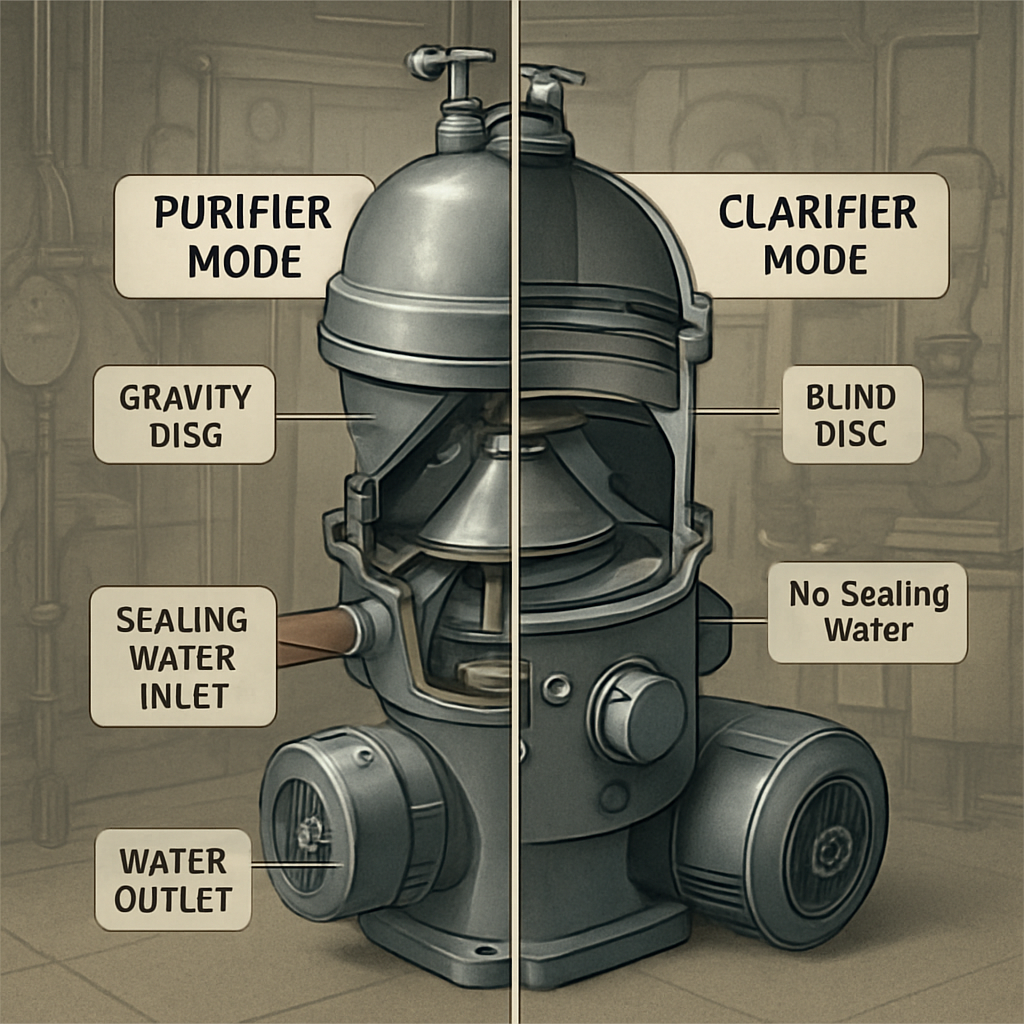 Let’s cut through the noise and get straight to the heart of the matter. In the high-stakes world of marine fuel and lube oil treatment, the purifier and clarifier aren’t just two pieces of equipment—they’re two distinct lines of defense, each with a non-negotiable role in keeping your engine running smoothly. Their purposes don’t overlap; they complement. And if you treat them as interchangeable, you’re gambling with the most critical components of your vessel. Here’s why.
The Purifier: Your First—and Toughest—Line of Defense
The purifier isn’t just a separator; it’s the primary barrier between your fuel system and the chaos lurking in every bunkered batch of HFO or lube oil. Its job? To simultaneously remove two of the most destructive contaminants in marine fuels: water and coarse solids. And it does this under conditions that would make lesser machines choke—high flow rates, fluctuating viscosities, and a cocktail of abrasive particles that would shred unprotected fuel pumps and injectors in a matter of hours.
More information on Life at Sea: The Harsh Reality of Food on Ships
Water in fuel isn’t just an inconvenience; it’s a corrosive agent that accelerates wear in every metal surface it touches. When water emulsifies with fuel, it forms acidic compounds that eat away at fuel pump plungers, injector nozzles, and even the cylinder liners. Ever pulled a fuel pump only to find its surface scored with deep, jagged grooves? That’s water-induced corrosion at work—pure, unfiltered destruction. The purifier stops this before it starts by creating a density-based separation zone where water, being heavier than fuel, is forced outward and discharged through the water outlet. No water in the system? No corrosion. It’s that simple.
But water isn’t the only enemy. Coarse solids—sludge, sand, rust flakes, even aluminum particles from poor-quality bunkers—are just as dangerous. These contaminants act like sandpaper inside your fuel system. A single 50-micron particle might seem insignificant, but when it’s forced through a fuel pump at 1,200 bar, it becomes a projectile. The result? Scoring on plungers, erosion of injector tips, and eventually, catastrophic failure. The purifier’s disc stack is designed to trap these particles in the sludge space, preventing them from ever reaching the engine. Think of it as a high-speed sieve—one that doesn’t just catch the big chunks but also ensures the fuel leaving the bowl is free of the worst offenders.
Here’s the hard truth: If your purifier isn’t working correctly, your entire fuel system is at risk. No amount of downstream filtration can compensate for a purifier that’s allowing water and coarse solids to slip through. That’s why Chief Engineers worth their salt treat purifier maintenance with the same urgency as they do main engine overhauls. A clogged disc stack, a worn gravity disc, or a failed sealing water system isn’t just a maintenance issue—it’s a ticking time bomb for your fuel injectors and pumps.
The Clarifier: The Precision Polisher
If the purifier is the brute-force defender, the clarifier is the surgical specialist. Its sole mission? To remove the fine, suspended solids that the purifier couldn’t catch—particles so small they’d slip through even the tightest disc stack. We’re talking about contaminants in the 2-20 micron range: carbon residues, catalytic fines (cat fines), and microscopic metal fragments that, left unchecked, will silently erode your fuel system from the inside out.
Why does this matter? Because while a purifier can stop a 50-micron particle from scoring a fuel pump, it can’t always catch the 5-micron cat fine that’s slowly grinding away at your injector nozzles. These particles are the invisible assassins of the fuel system. They don’t cause immediate failure; they cause progressive, irreversible damage. Over time, they’ll clog injector spray holes, alter fuel atomization patterns, and increase exhaust temperatures. Worse, they’ll accelerate wear in the fuel pump’s precision-machined components, leading to increased clearances, reduced pressure, and—eventually—complete failure. And by the time you notice the symptoms (poor combustion, increased fuel consumption, black smoke), the damage is already done.
The clarifier’s design reflects its precision role. Without a gravity disc or water outlet, it’s optimized for one thing only: maximum solids removal efficiency. The blind disc at the bottom of the disc stack forces fuel to take the longest possible path through the bowl, ensuring even the smallest particles are captured. It’s not about speed; it’s about thoroughness. A clarifier running at 100% capacity isn’t doing its job—it’s just moving fuel. The real magic happens when it’s paired with a purifier in a series configuration, where the purifier handles the heavy lifting (water and coarse solids) and the clarifier polishes what’s left.
Here’s where even experienced engineers sometimes go wrong: treating a clarifier like a backup purifier. A clarifier cannot remove water. Period. If you’re relying on a clarifier to handle water-contaminated fuel—whether because your purifier is down or you’re trying to “save time” by skipping the sealing water step—you’re playing Russian roulette with your engine. Water will pass straight through the clarifier and into your fuel system, where it will emulsify, corrode, and eventually destroy your injectors and pumps. This isn’t theoretical; it’s a documented cause of engine failures in vessels that cut corners on fuel treatment. The clarifier’s job is to catch what the purifier misses, not to replace it.
Real-World Consequences: What Happens When You Get It Wrong
Let’s talk about what this looks like in practice. Imagine you’re burning a batch of HFO with a high water content—say, 0.5%—because the bunker supplier “forgot” to mention the free water in the delivery. If your purifier is running correctly, that water is removed before it ever reaches the service tank. But if you’ve bypassed the purifier (or it’s not functioning properly), that water enters the clarifier. What happens next?
- Fuel pump scoring: Water emulsifies with the fuel, forming acidic compounds that attack the metal surfaces of the fuel pump. Over time, the plungers develop deep grooves, increasing internal leakage and reducing injection pressure. The result? Poor atomization, incomplete combustion, and increased fuel consumption.
- Injector clogging: Water doesn’t just corrode; it also promotes the formation of microbial growth (diesel bug) in the fuel system. These microbes produce slime and acids that clog injector filters and spray holes, leading to uneven fuel distribution and cylinder misfires.
- Catastrophic failure: In extreme cases, water can cause hydraulic lock in the fuel pump, leading to sudden, violent failure. We’ve seen cases where a single water-contaminated batch of fuel destroyed a fuel pump in less than 100 hours of operation.
Now, let’s flip the scenario. Suppose your purifier is working fine, but your clarifier is either bypassed or running with a clogged disc stack. The purifier removes the water and coarse solids, but the fine particles—especially cat fines—slip through. What’s the fallout?
- Injector erosion: Cat fines are harder than the metal used in injector nozzles. Over time, they erode the spray holes, altering the fuel spray pattern. This leads to poor combustion, increased exhaust temperatures, and higher NOx emissions.
- Fuel pump wear: The same particles that erode injectors also wear down the precision-machined surfaces of the fuel pump. Increased clearances lead to reduced injection pressure, which in turn causes poor atomization and incomplete combustion.
- Turbocharger damage: Fine particles that aren’t caught by the clarifier can make their way into the combustion chamber, where they’re blown out with the exhaust gases. Over time, these particles erode the turbine blades, reducing efficiency and increasing the risk of turbocharger failure.
The takeaway? You need both. The purifier is your shield against water and coarse solids; the clarifier is your last line of defense against the fine particles that slip through. Skip one, and you’re leaving your engine exposed. It’s not about redundancy; it’s about layered protection. And in an industry where a single injector failure can cost tens of thousands of dollars in downtime and repairs, that protection isn’t optional—it’s essential.
So the next time you’re tempted to bypass the purifier because “the fuel looks clean” or skip the clarifier because “the purifier should be enough,” ask yourself: Are you willing to bet your engine’s reliability on it? Because that’s exactly what you’re doing.