

My First Contract: The ‘Borscht, Please’ Reality Check
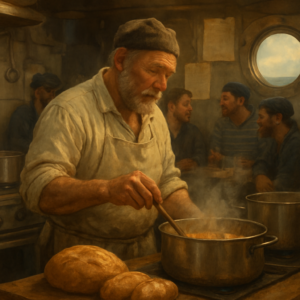 I still remember the way my boots squeaked against the polished floors of Warsaw Chopin Airport, the weight of my duffel bag digging into my shoulder as I scanned the crowd for familiar faces. It was 2000, and I was about to board my first ship—a rust-streaked bulk carrier bound for the Black Sea. I had no idea what to expect, but I was young, eager, and ready to absorb every bit of wisdom the sea had to offer. Little did I know that my first real lesson wouldn’t come from the chief mate or the grizzled old bosun, but from a woman who called herself the ship’s cook.
She was waiting near the check-in counter, a sturdy figure in a faded floral apron, her hair pulled back into a tight bun. Even from a distance, she radiated confidence—no, not confidence, swagger. She held a cigarette between her fingers like it was an extension of her hand, and when she spotted me, she waved me over with the kind of authority that made me feel like I’d just been summoned by the captain himself. “You the new third mate?” she asked, her voice rough from years of shouting over clattering pots and diesel engines. I nodded, and she smirked. “Good. You’ll eat well on my ship.”
More information on Inside PCTC & PCC Ships: Engineering the Ocean Giants
That was the first—and last—time I fully believed her.
Her name was Irina, and she was, as far as I could tell, the only female cook I’d ever work with in my two decades at sea. She spoke about herself like she was some kind of culinary celebrity, dropping names of shipping company directors in London like they were old drinking buddies. “They beg me to stay,” she’d say, lighting another cigarette. “But I like to move around. Keep things interesting.” At the time, I was impressed. Here was a woman who had the sea in her veins, who could turn a ship’s galley into a five-star kitchen if she wanted to. Or so I thought.
The reality hit me the moment we stepped on board. The first meal was… well, let’s just say it was a statement. The American divers who’d been on the ship for a month already were gathered in the mess, their plates piled high with what looked like yesterday’s leftovers. Irina clapped her hands and announced, in her thickly accented English, “Sit down! Eat! Borscht, please!” That was it. That was the extent of her English. “Borscht, please.” And “More bread, please.” And, on particularly rough days, “No complain, please.”
I should’ve seen the warning signs then. But I was too green, too willing to give her the benefit of the doubt. Maybe she was just having an off day. Maybe the provisions hadn’t arrived yet. Maybe—just maybe—she’d pull a rabbit out of her hat and serve up something edible by dinner. Spoiler: she didn’t.
The next morning, I shuffled into the mess at 0600, bleary-eyed and ready for a hearty breakfast to fuel me through my first watch. What I got instead was a plate of eggs that looked like they’d been cooked the night before and left to congeal under the heat lamp. The yolks were a sickly gray, the whites rubbery and shriveled. I poked at them with my fork, half-expecting them to bounce. Across the table, the second mate, a man who’d seen enough bad cooks to last a lifetime, sighed and pushed his plate away. “Welcome to the ship,” he muttered. “Hope you like your eggs pre-chewed.”
Irina, meanwhile, was nowhere to be found. She’d already retreated to her domain—the galley—a place that, over the next few weeks, I’d come to think of as a culinary black hole. The only time she emerged was to deliver meals, and even then, it was with the enthusiasm of someone being led to the gallows. The food was either underseasoned to the point of being inedible or so salty it made your lips pucker. The meat was always overcooked, the vegetables mushy, and the bread—when there was bread—had the texture of a hockey puck. And yet, somehow, the captain always seemed to have a steaming plate of something different in his cabin. Something that smelled suspiciously like real food.
It didn’t take long for the crew to notice. Whispers started circulating in the mess, then in the engine room, then on deck. “She’s sleeping with the old man,” someone said. “That’s why he gets the good stuff.” I didn’t want to believe it. Not because I had some naive notion of professionalism, but because the alternative was too depressing: that the one person on board responsible for keeping our spirits up had already checked out. That she was phoning it in, day after day, while the rest of us suffered through meals that tasted like punishment.
One evening, after a particularly grueling shift, I dragged myself to the mess, hoping for something—anything—that might resemble comfort food. What I got was a bowl of borscht that looked like it had been strained through a dirty sock. The beets were overcooked to the point of disintegration, the cabbage limp, the broth watery and flavorless. I stared at it, my stomach growling in protest. The chief engineer, a man who’d survived wars, famines, and at least three divorces, sat down across from me and sighed. “You know,” he said, stirring his soup with a spoon, “I once worked on a ship where the cook was a former prison chef. That was bad. But this? This is just lazy.”
That was the moment it clicked. Irina wasn’t a bad cook. She was a checked-out cook. And that was worse. Because a bad cook can improve. A lazy cook? A cook who doesn’t care? That’s a problem no amount of overtime or crew complaints can fix.
By the end of that contract, I’d lost five pounds, my skin had taken on a permanent grayish hue, and I’d developed a Pavlovian response to the sound of Irina’s voice. Every time she yelled “Borscht, please!” from the galley, my stomach would clench in anticipation of another culinary disappointment. The crew had long since given up on complaining. Instead, we’d taken to smuggling snacks from port—cans of tuna, packets of instant noodles, anything to supplement the sad, salty slop we were being served. The captain, of course, remained blissfully unaware. Or maybe he just didn’t care. After all, he was the only one on board who didn’t have to eat Irina’s cooking.
Looking back, I realize that my first contract taught me one of the most important lessons of my seafaring career: a ship’s cook isn’t just a person who prepares meals. They’re the heartbeat of the crew. A good cook can turn a miserable contract into a bearable one. A bad cook can make even the smoothest voyage feel like a death march. And a cook who doesn’t give a damn? That’s a recipe for mutiny.
Irina left the ship at the end of that contract, and I never saw her again. But her legacy lived on—in the way the crew groaned every time a new cook came aboard, in the way we’d eye the first meal with suspicion, in the way we’d always, always check the captain’s plate before touching our own. She taught me that the galley isn’t just a place where food is made. It’s where morale is either built or broken. And that, more than any navigation chart or engine manual, is what keeps a ship—and its crew—afloat.