

Entering the Gulf Stream: When Climate Turns Against You
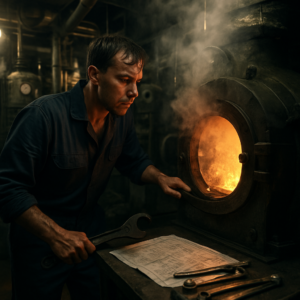 The moment you cross the invisible line into the Gulf Stream, the ship doesn’t just change course—it enters a different world. One minute, you’re cruising in a mild 22°C with a gentle breeze cutting through the engine room vents. The next? The air turns thick, like breathing through a wet blanket, and the thermometer on the bulkhead starts climbing with unsettling speed. Eight hours. That’s all it took for the Gulf Stream to rewrite the rules of our voyage.
I remember glancing at the seawater temperature gauge first—13°C to 21°C in a single watch. A jump like that doesn’t just affect the cooling systems; it’s a full-scale assault on the ship’s equilibrium. The engine room, already a furnace under normal conditions, became a pressure cooker. By midday, the digital display above the main engine read 40°C, and the metal handrails burned to the touch. The air conditioning units, usually reliable workhorses, gasped under the load, their compressors cycling on and off like asthmatic lungs. Even the LED lights seemed dimmer in the haze of heat.
The Machinery Strikes Back
The first casualty was the deck air compressor. This beast, normally a quiet giant, started throwing high-temperature alarms every twenty minutes. The problem wasn’t just the ambient heat—it was the combination of factors: the intake air was now 30°C instead of 20°C, the cooling seawater was warmer, and the oil, despite being fresh, was thinning out faster than a cheap suntan lotion. We had to babysit it like a sick child—constant oil level checks, manual purges of the intercooler, and adjusting the load to keep it from tripping entirely.
But the compressor wasn’t alone. The hydraulic systems on deck, which rely on oil viscosity to function, started acting sluggish. The hatch covers, usually smooth as butter, groaned like they were lifting twice their weight. The winches for the mooring lines hesitated before engaging, as if debating whether the effort was worth it. And then there were the pneumatic tools—the grinders, the impact wrenches—all of them gasping for air because the compressor couldn’t keep up. Every time we needed to secure a fitting or tighten a bolt, it became a negotiation with the machine: “Come on, just one more job before you overheat.”
Personal Hell: Working in the Engine Room Oven
I’ve worked in engine rooms from the Baltic to the Persian Gulf, but there’s something uniquely brutal about the Gulf Stream’s heat. It doesn’t just make you sweat—it steals your focus, turns every task into a marathon. You start a job—say, inspecting the fuel oil purifier—and by the time you’ve removed the first three bolts, your gloves are soaked, your safety glasses fog up, and your brain feels like it’s been replaced with cotton wool.
One evening, I was elbow-deep in the auxiliary boiler’s fuel system, trying to trace a persistent leak in the steam line. The metal was too hot to touch without gloves, but the gloves made my hands clumsy. I’d wipe my forehead with the back of my wrist, only to smear grease across my face. The air smelled like burnt oil and salt, and every breath felt like inhaling through a straw. At one point, I had to step back, lean against a relatively cool bulkhead, and just breathe for a full minute. My watch alarm went off—time to log the temperatures—but I couldn’t remember the last time I’d seen a number below 38°C on any of the gauges.
The heat doesn’t just affect the crew; it warps your perception of time. A job that should take an hour stretches into two, then three. You start cutting corners—not because you’re lazy, but because your body is screaming for relief. That’s when mistakes happen. A loose bolt here, a missed reading there. And in the back of your mind, the USCG inspection looms like a deadline written in fire: “You don’t have time for this.”
The First Signs of Trouble
The alarms started small. A high-temperature warning on the main engine’s lube oil cooler. A low-pressure alarm on the freshwater generator, which was struggling to condense vapor in the suddenly humid air. Then came the smoke detector in the incinerator room—a false alarm, thankfully, but a reminder that the system was already under stress before we even touched it.
But the real wake-up call came when the steering gear’s hydraulic pumps started cycling erratically. The system is designed to handle fluctuations, but the Gulf Stream’s heat was pushing it into uncharted territory. The oil temperature in the reservoir crept up, and the pumps, sensing the strain, would kick in and out like a car stalling on a hill. We had to manually override the auto-start to prevent a cascade of failures. That’s when the Chief Engineer gathered us for a quick briefing, his voice cutting through the hum of the fans: “We’re not just fighting the heat. We’re fighting the clock. Every system we ignore now is a red flag for USCG.”
Adapting or Surrendering
The Gulf Stream doesn’t care about your schedule. It doesn’t care that you have a USCG inspection in five days or that the incinerator is already on its last legs. It forces you to adapt—or break. So we adapted.
- Cooling systems became our religion. We rerouted seawater intakes to the coldest possible depths, even if it meant throttling back on other systems. Every heat exchanger was inspected, cleaned, and tested. The Chief ordered us to double the frequency of lube oil sampling—not just for the main engine, but for every piece of machinery that relied on oil for cooling or lubrication.
- Work schedules were rewritten. The hottest part of the day—between 11 AM and 4 PM—became a “no-go zone” for non-critical tasks. We shifted heavy maintenance to the early morning or late evening, when the engine room was a relatively “cool” 35°C. Even then, we rotated crews every 45 minutes, forcing breaks in the shade with electrolyte drinks. No one wanted to admit it, but we were all running on fumes.
- Equipment was babied like never before. The deck air compressor, our most temperamental patient, got a dedicated watch. Someone was always there to check the oil level, purge the intercooler, or adjust the load. We even rigged up a temporary shade over its intake to keep the ambient air as cool as possible. It was a band-aid, but it bought us time.
- Documentation became a lifeline. Every alarm, every adjustment, every drop of oil added to a system was logged and photographed. The USCG doesn’t just want things fixed—they want to see proof that you’re in control. So we documented everything, even the false alarms, because in their eyes, a false alarm is better than a missed one.
The Gulf Stream’s heat wasn’t just a challenge—it was a filter. It separated the systems that could take the punishment from those that couldn’t. And as the days ticked down to our arrival in US waters, one thing became painfully clear: we weren’t just preparing for an inspection. We were preparing for survival.