

Pharaohs’ Ditch: The First Suez Canal
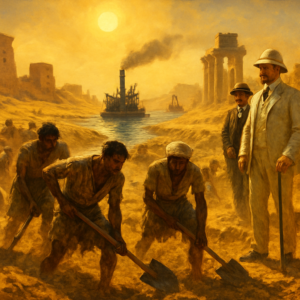 The idea of carving a waterway between the Mediterranean and Red Seas isn’t a 19th-century invention—it’s a dream that flickered to life thousands of years before Ferdinand de Lesseps ever set foot in Egypt. Long before steam shovels and dynamite, the ancient Egyptians, with nothing but copper tools and sheer human muscle, attempted what would become one of history’s most ambitious engineering feats. Their canal wasn’t just a trade route; it was a lifeline, a military artery, and a divine offering—one that would shape the fate of empires for centuries to come.
The first whispers of this grand project trace back to the Twelfth Dynasty, around 1850 BCE, under the rule of Pharaoh Senusret III. Unlike the modern Suez Canal, which slices straight through the Isthmus of Suez, the pharaohs’ ditch took a winding path, linking the Nile River—specifically, a branch near the city of Bubastis—to the Red Sea at a point near modern-day Suez. This wasn’t a direct Mediterranean-to-Red Sea connection, but it was the next best thing: a way to bypass the treacherous overland journey through the Sinai Peninsula, where bandits, sandstorms, and thirst could turn a merchant’s fortune into a corpse.
More information on Toxic Voyages: The Hidden Dangers of VCM and Butadiene
The Canal That Built an Empire
Why did Senusret III, a ruler already preoccupied with securing Egypt’s southern borders against Nubian raids, bother with a canal? The answer lies in three pillars of power: trade, war, and the gods.
- Trade: Egypt was the breadbasket of the ancient world, but its wealth didn’t just come from grain. The Red Sea was a gateway to Punt, the fabled land of myrrh, frankincense, ebony, and gold. By the time of the Middle Kingdom, Egyptian ships were already sailing south, but the overland trek from the Nile to the Red Sea ports was a bottleneck. A canal would turn weeks of grueling desert travel into a few days’ sail, slashing costs and risks. Suddenly, luxury goods from the Horn of Africa could flow into Egypt—and from there, into the palaces of Mesopotamia and the Levant—without the middlemen of the Sinai tribes skimming off their cut.
- War: Senusret III wasn’t just a merchant-king; he was a conqueror. His canal wasn’t just for cargo—it was for troops. The ability to move soldiers and supplies quickly between the Nile and the Red Sea meant Egypt could project power into the Sinai and beyond. If a rebellion flared up in the eastern Delta or a foreign army threatened from Asia, reinforcements could be dispatched in days, not weeks. Later, when the Persians and Romans ruled Egypt, this same logic would drive them to maintain and expand the canal: control the waterway, control the empire.
- The Gods: In ancient Egypt, even the most practical projects had a sacred dimension. The canal was no exception. By linking the Nile—a river Egyptians believed was the vein of the god Osiris—to the Red Sea, the pharaohs were symbolically uniting two divine realms. Inscriptions from later periods suggest the canal was seen as a gift to the gods, a way to ensure Ma’at (cosmic order) flowed as smoothly as the water itself. When the Persian king Darius I restored the canal in the 5th century BCE, he didn’t just brag about his engineering prowess—he erected stelae along its banks, thanking the gods for allowing him to complete a work that “no king before me had done.”
A Ditch Through Hell: The Challenges of Ancient Engineering
Building a canal in the 19th century was brutal. Building one 3,700 years earlier, with nothing but copper chisels, wooden levers, and the backs of tens of thousands of laborers? That was a nightmare.
The first obstacle was geography. The modern Suez Canal follows a relatively flat, low-lying path through the isthmus, but the pharaohs’ route had to contend with the Eastern Desert’s undulating terrain. The canal didn’t just have to be dug—it had to be carved through rock in places, and in others, it had to follow the natural depressions where water could pool. Early versions were likely little more than a series of shallow, interconnected basins, allowing ships to be dragged or poled along when the Nile’s floodwaters receded.
Then there was the sand. Oh, the sand. The Eastern Desert isn’t just a wasteland—it’s a shifting, suffocating, ever-hungry beast. Sandstorms could bury a half-dug canal in hours. Even when the winds were calm, the fine desert grit would infiltrate everything: clogging tools, grinding down wooden planks, and turning the air into a choking haze. Workers—likely a mix of conscripted peasants, prisoners of war, and Nubian slaves—labored under the scorching sun, their skin blistering, their lungs burning. There were no hard hats, no safety harnesses, no unions demanding fair wages. If you collapsed from heatstroke, you were left where you fell.
And then there was the silting. The Nile is a river of life, but it’s also a river of mud. Every year, the floodwaters dumped millions of tons of silt into the canal, gradually raising its bed until it became too shallow for ships to pass. Maintenance wasn’t a once-in-a-decade chore—it was a constant, backbreaking battle. Herodotus, writing in the 5th century BCE, claimed that the canal under Pharaoh Necho II (610–595 BCE) was abandoned because an oracle warned that it would “benefit the barbarians.” The truth? It was probably just too damn expensive to keep dredging.
The Rise and Fall of the Pharaohs’ Dream
Despite the challenges, the canal endured—or at least, it was repeatedly resurrected. After Senusret III’s initial effort, later pharaohs, including Ramses II and Necho II, expanded and deepened the waterway. Necho’s version was particularly ambitious: according to Herodotus, he employed 120,000 men and dug for years before abandoning the project (though whether this was due to the oracle’s warning or the sheer logistical nightmare is debated). The Persian king Darius I, after conquering Egypt in 525 BCE, took up the mantle, completing a canal that could accommodate two triremes side by side. His stelae, discovered in the 19th century near the modern Suez Canal, boast of his achievement in three languages—Old Persian, Elamite, and Egyptian hieroglyphs—a testament to the canal’s importance across empires.
The Romans, too, saw value in the waterway. Under Emperor Trajan (98–117 CE), the canal was restored yet again, this time linking the Nile to the Red Sea via a new branch called the Trajan’s Canal. But by the 8th century CE, the dream finally died. The rise of Islam shifted trade routes away from the Red Sea, and the decline of the Nile’s western branches (which fed the canal) made maintenance impossible. The desert, as it always does, reclaimed its own. By the time Arab geographers like Al-Mas’udi wrote about the canal in the 10th century, it was little more than a dry scar in the sand, a ghost of what had once been.
Echoes in the Sand: Why the Past Still Matters
The pharaohs’ canal may have vanished, but its legacy never truly faded. The idea of a waterway linking the Mediterranean and Red Seas was too powerful to die. When Napoleon’s engineers surveyed the Isthmus of Suez in 1799, they weren’t just looking at empty desert—they were standing on the bones of an ancient dream. The stelae of Darius, the accounts of Herodotus, the very memory of a canal that once was—all of it whispered the same thing: it could be done.
And yet, the pharaohs’ ditch also carried a warning. Building a canal wasn’t just about moving earth—it was about moving people. Thousands of workers had died to dig it. Thousands more would die maintaining it. The modern Suez Canal would claim 120,000 lives in a single decade, a grim echo of the past. The desert doesn’t care about progress. It doesn’t care about empires. It only cares about survival—and for those who dared to carve a path through it, survival was never guaranteed.
But for all its challenges, the pharaohs’ canal proved one thing: the impossible was only impossible until someone did it. And that, more than any stela or inscription, is why its story still matters. Because long after the last ship sailed through its waters, long after the sand buried its banks, the idea lived on—waiting for the next empire, the next visionary, the next foolhardy dreamer to try again.