

The Science Behind Boil-Off Gas
 Boil-off gas (BOG) isn’t just an operational nuisance—it’s a fundamental thermodynamic reality of transporting liquefied natural gas (LNG). At its core, BOG is the result of an unavoidable battle between cryogenic temperatures and the relentless creep of external heat. To understand why it happens—and why it can never be fully eliminated—we need to break down the physics at play, the role of tank design, and how real-world conditions turn theory into a daily challenge for LNG carriers.
The Thermodynamic Tug-of-War
LNG is stored at around -162°C (-260°F), a temperature so low it would freeze the air around it if exposed. Yet, no insulation is perfect. Even the most advanced cryogenic tanks—whether membrane or spherical—are constantly bombarded by heat from the outside world. This heat ingress, though minimal, is enough to trigger evaporation because LNG exists in a delicate equilibrium between its liquid and vapor phases at these temperatures.
Here’s how the process unfolds:
- Heat Ingress: Ambient heat—from the sun, seawater, or even the ship’s own machinery—penetrates the tank’s insulation. The rate of heat transfer depends on factors like the thickness and material of the insulation, the temperature differential between the LNG and the outside environment, and even the ship’s movement (more on that later).
- Phase Change: As heat seeps in, it raises the temperature of the LNG at the surface. Since LNG is stored just below its boiling point, even a tiny amount of additional energy is enough to push some of the liquid into vapor. This is the boil-off gas—methane-rich vapor that rises to the top of the tank.
- Pressure Dynamics: The vaporization process increases the pressure inside the tank. If left unchecked, this pressure would eventually exceed the tank’s design limits. That’s why BOG management isn’t just about efficiency; it’s a safety imperative. Systems like spray cooling or reliquefaction step in to keep pressure in check, but the evaporation itself is inevitable.
The laws of thermodynamics dictate that this process will continue as long as there’s a temperature gradient between the LNG and its surroundings. In other words, BOG is not a flaw—it’s a feature of transporting LNG. The goal isn’t to stop it, but to manage it intelligently.
More information on Switching to LPG Tankers: A Starter’s Roadmap
Insulation: The First Line of Defense (and Its Limits)
If heat ingress is the enemy, insulation is the shield. But even the best shields have weak spots. Modern LNG tanks use multi-layered insulation systems designed to minimize heat transfer, but their effectiveness varies depending on the tank type and construction.
- Membrane Tanks: These are the most common type of tanks in modern LNG carriers. They use a thin, corrugated stainless steel membrane (typically 0.7–1.5 mm thick) supported by a layer of insulation, usually made of plywood boxes filled with perlite or other insulating materials. The insulation is backed by a secondary barrier and a thick layer of foam or fiberglass to further reduce heat transfer.
- BOG Rates: In membrane tanks, typical boil-off rates range from 0.10% to 0.15% of the cargo volume per day. For a 170,000 m³ carrier, that translates to roughly 170–255 m³ of BOG generated daily. The rate can spike during rough seas or in warmer climates, as we’ll see later.
- Weak Points: The insulation is highly effective, but the membrane’s thinness means it’s vulnerable to thermal bridging—areas where heat finds a path through structural supports or joints. Over time, insulation can also settle or degrade, slightly increasing BOG rates.
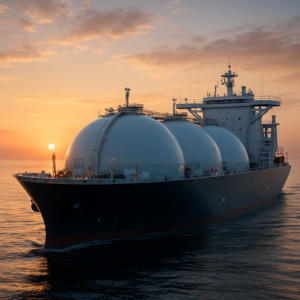
- Spherical (Moss) Tanks: These self-supporting spherical tanks, made of aluminum or 9% nickel steel, are insulated with a thick layer of polyurethane foam. They’re less common today but still in use, particularly in older vessels or specialized applications.
- BOG Rates: Spherical tanks tend to have slightly lower boil-off rates—around 0.08% to 0.12% per day. Their design minimizes thermal bridging, and the thick insulation provides consistent performance. However, their complex shape makes them more expensive to build and maintain.
- Weak Points: The insulation is robust, but the tanks’ large surface area relative to volume can offset some of these gains. Additionally, the spherical shape can lead to “sloshing” in rough seas, which agitates the LNG and accelerates evaporation.
No matter the tank type, insulation can only slow heat ingress—it can’t stop it entirely. That’s why BOG management systems are just as critical as the tanks themselves.
Ambient Conditions: The Wild Cards of BOG
While tank design sets the baseline for BOG rates, real-world conditions can turn those numbers on their head. Two factors—ambient temperature and sea state—play outsized roles in how much gas a carrier loses to evaporation.
1. Temperature: The Heat That Won’t Quit
LNG carriers don’t operate in a vacuum. They traverse oceans where air and water temperatures can swing dramatically. These fluctuations directly impact BOG rates:
- Tropical Routes: In regions like the Persian Gulf or the Caribbean, where seawater temperatures can exceed 30°C (86°F), heat ingress accelerates. BOG rates in membrane tanks can jump by 20–30% compared to temperate routes. For example, a carrier moving from Europe to Asia via the Suez Canal might see its daily BOG generation rise from 200 m³ to 250 m³ or more as it enters warmer waters.
- Arctic Routes: Conversely, in colder regions like the Barents Sea or the North Atlantic, BOG rates can drop by 10–15%. The reduced temperature differential between the LNG and its surroundings slows evaporation. However, this benefit is often offset by the need for additional heating in other parts of the vessel, such as the cargo handling systems, to prevent freezing.
- Seasonal Variations: Even on the same route, BOG rates can vary by season. A carrier on the Australia-to-Japan route might generate 15% more BOG in summer than in winter. Operators account for this by adjusting their fuel strategies—using more BOG as fuel during warmer months to offset the higher generation rates.
2. Sea State: When the Ocean Fights Back
Rough seas don’t just make for a bumpy ride—they also agitate the LNG inside the tanks, accelerating evaporation. This phenomenon, known as sloshing, is particularly problematic in membrane tanks, where the liquid has more freedom to move.
- How Sloshing Works: When a ship rolls or pitches, the LNG inside the tanks sloshes back and forth, increasing the surface area exposed to heat ingress. This agitation also mixes warmer LNG from the surface with the colder liquid below, raising the overall temperature of the cargo. The result? A temporary spike in BOG generation.
- Real-World Impact: During severe storms, BOG rates can double or even triple for short periods. For example, a carrier caught in a North Atlantic storm might see its daily BOG generation jump from 200 m³ to 500 m³ or more. While these spikes are temporary, they can overwhelm reliquefaction systems or force the crew to vent excess gas—a last resort due to environmental and economic costs.
- Design Mitigations: Some modern membrane tanks incorporate anti-sloshing devices, such as baffles or partial bulkheads, to reduce liquid movement. Spherical tanks, with their rigid structure, are less prone to sloshing but can still experience increased BOG during rough seas due to the sheer force of the liquid’s movement.
Sloshing isn’t just a BOG issue—it’s also a structural concern. Repeated sloshing can stress the tank walls, leading to fatigue over time. That’s why operators monitor sea conditions closely and may adjust course or speed to minimize exposure to rough waters.
Why BOG Is Here to Stay
Despite advances in insulation, tank design, and BOG management systems, evaporation will always be part of the LNG transport equation. Here’s why:
- Physics Doesn’t Negotiate: The second law of thermodynamics ensures that heat will always flow from warmer to colder areas. As long as LNG is stored below its boiling point, any heat ingress will cause evaporation. Even in a perfectly insulated tank, there would still be some BOG due to the residual heat from loading or the cargo’s own thermal inertia.
- Economic Trade-offs: Improving insulation or adding more robust BOG management systems comes at a cost. For example, thicker insulation reduces BOG but also reduces cargo capacity, cutting into revenue. Similarly, larger reliquefaction plants add weight and complexity, increasing fuel consumption. Operators must strike a balance between minimizing BOG and maximizing profitability.
- The Human Factor: Even the best-designed systems rely on human oversight. Crews must monitor tank pressures, adjust spray cooling systems, and manage fuel consumption in real time. A lapse in attention—say, during a storm or a port call—can lead to unnecessary BOG generation or even safety risks.
In the end, BOG isn’t a problem to be solved—it’s a reality to be managed. The most successful LNG carriers are those that treat BOG not as waste, but as an integral part of their energy ecosystem. Whether it’s fueling the ship’s engines, being reliquefied, or carefully vented when necessary, BOG is a resource in its own right. Understanding the science behind it is the first step in turning a thermodynamic inevitability into a competitive advantage.