

From Telegraphs to Terabytes: A Brief History of Undersea Cables
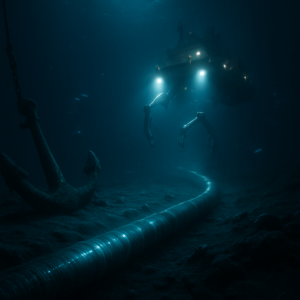 Picture this: It’s August 1858, and the world is holding its breath. After years of failed attempts, two ships—one sailing from Ireland, the other from Newfoundland—finally meet in the middle of the Atlantic. Their mission? To splice together the first-ever transatlantic telegraph cable, a fragile lifeline of copper and gutta-percha that promised to shrink the ocean between Europe and North America. When the connection was made, the news spread like wildfire. For the first time in history, a message could cross an entire ocean in minutes rather than weeks. The age of instant global communication had begun—but no one yet realized just how messy, ambitious, and downright heroic the journey to get there would be.
That first cable was little more than a proof of concept, a daring experiment that barely survived its own hype. The inaugural message—a 90-word telegram from Queen Victoria to U.S. President James Buchanan—took a grueling 16.5 hours to transmit. Why? Because the signal degraded so severely over the 2,500-mile stretch that operators had to send each letter multiple times to ensure accuracy. The public celebrated, but engineers knew the truth: this was a system on the brink of collapse. Within a month, the insulation failed, the cable went dark, and the dream of a connected world was temporarily snuffed out. Yet, that failure was the spark. If a single cable could carry a message across the Atlantic—even for a few weeks—then the impossible was suddenly within reach.
More information on Life at Sea: Internet & Food Realities on LPG Ships
The Copper Age: Wires, Whales, and Wild Ambition
By the 1860s, the race was on. The first successful permanent transatlantic cable, laid in 1866 by the SS Great Eastern—a ship so massive it was originally designed as a passenger liner but repurposed for cable-laying—proved that undersea communication wasn’t just possible; it was profitable. Suddenly, empires saw the strategic value of these submerged wires. Britain, with its far-flung colonies, became the undisputed king of undersea cables, weaving a web of copper across the oceans that mirrored its naval dominance. By the early 20th century, cables stretched from London to Bombay, Cape Town to Sydney, and even across the Pacific to Hong Kong. The world was shrinking, but the technology was still painfully slow.
These early cables were marvels of engineering, but they were also fragile, temperamental beasts. A single break—caused by a dragging anchor, a curious shark, or even sabotage—could sever an entire empire’s lifeline. Repairing them was a nightmare. Ships had to drag grapnels along the ocean floor for days, hoping to snag the broken cable, then haul it up for splicing. In 1870, when a cable between Malta and Alexandria was cut, the British Navy spent three months fishing for it in the Mediterranean. And then there were the whales. Yes, whales. Sperm whales, in particular, had a habit of mistaking cables for giant squid, biting down and causing costly damage. (One 19th-century repair log notes, with dry British understatement, that the cable had been “severely mauled by a marine animal.”)
Despite the challenges, copper cables ruled for nearly a century. They carried the news of wars, stock prices, and personal telegrams—each word a small miracle of human ingenuity. But by the mid-20th century, the limitations were glaring. Copper could only carry so much data, and the signal degraded over long distances, requiring expensive and unreliable repeaters. The world was hungry for faster, more reliable communication. The solution? Light.
The Fiber Optic Revolution: When Glass Replaced Copper
The shift from copper to fiber optics in the 1980s wasn’t just an upgrade—it was a rebirth. The first fiber-optic undersea cable, TAT-8, laid in 1988, could carry 40,000 simultaneous phone calls—a staggering leap from the few dozen calls its copper predecessors could handle. How? By replacing electrical signals with pulses of light, zipping through hair-thin strands of glass at nearly the speed of light. The science was elegant, but the execution was anything but simple.
Fiber optics solved the signal degradation problem that had plagued copper cables. Light doesn’t weaken as quickly as electricity, but it still needs a boost. Enter the optical repeater, a device that amplifies the light signal every 50–80 kilometers. These repeaters—each about the size of a small refrigerator and weighing 200 kg—had to be built to withstand the crushing pressure of the deep ocean, where the weight of the water above could reach 800 atmospheres. They also needed power, which is why modern cables still include a copper sheath to deliver up to 10,000 volts of electricity to keep the system running. (Fun fact: If you’ve ever wondered why sharks occasionally bite undersea cables, it’s not just curiosity—it’s the electromagnetic field they’re drawn to. Engineers now armor cables in shark-proof materials to avoid “Jaws 2.0” scenarios.)
The 1990s and 2000s saw an explosion of fiber-optic cables, driven by the insatiable demand of the internet. Companies like Google, Facebook, and Microsoft—once mere users of undersea cables—became major investors, laying their own private networks to handle the tsunami of data from cloud computing, video streaming, and global finance. Today, a single fiber pair in a modern cable can carry 250 terabits per second. That’s enough to stream 10 million high-definition movies simultaneously. The contrast with Queen Victoria’s 90-word telegram is almost comical. What once took 16 hours now takes a fraction of a second.
Breaks, Spies, and the Hidden Wars of the Deep
For all their sophistication, undersea cables remain vulnerable. And in the 21st century, the threats aren’t just sharks and anchors—they’re geopolitical.
In 2007, fishermen off the coast of Vietnam accidentally severed a cable, disrupting internet access across Southeast Asia for weeks. In 2011, a ship’s anchor cut three cables in the Mediterranean, slowing down the internet in Egypt, India, and Pakistan. But the most chilling incidents are the ones that look like sabotage. In 2015, Russian submarines were spotted lurking near undersea cables in the North Atlantic, sparking fears of espionage or even cyber warfare. During the 2022 Russian invasion of Ukraine, there were reports of unexplained cable cuts in the Black Sea, raising suspicions of deliberate interference. The U.S. and its allies have since ramped up surveillance of cable routes, treating them as critical infrastructure—because they are.
Then there’s the issue of chokepoints. Not all cables are created equal. A handful of narrow straits—like the Luzon Strait between Taiwan and the Philippines or the Strait of Malacca—are cable superhighways, carrying the bulk of global internet traffic. A single break in one of these areas can cause outages across entire continents. In 2020, a fire at a key cable landing station in Marseille, France, disrupted internet access in parts of Africa and the Middle East for days. The lesson? The internet isn’t as decentralized as we think. It’s a physical network, and its weak points are very real.
How a 19th-Century Experiment Built the Modern Internet
It’s easy to take undersea cables for granted. They’re out of sight, out of mind—until something goes wrong. But every time you load a webpage, make a video call, or send an email, you’re riding on the back of a 160-year-old idea. The engineers who laid the first transatlantic cable in 1858 had no way of knowing that their fragile copper wire would one day evolve into the backbone of the global economy. They were just trying to send a telegram faster than a ship could sail.
What’s remarkable is how little the core challenge has changed. Then, as now, the problem was distance. How do you send a signal across an ocean without it fading into static? The solutions—repeaters, insulation, precise engineering—were pioneered in the 19th century and refined in the 20th. Even the geopolitical tensions aren’t new. In the 1870s, Britain and France nearly went to war over cable rights in the Mediterranean. Today, the U.S. and China are locked in a quiet battle over cable routes in the Pacific.
The next frontier? Quantum cables. Scientists are already experimenting with undersea cables that use quantum encryption, making them theoretically unhackable. If successful, these could redefine global security. But no matter how advanced the technology gets, the principle remains the same: the ocean is vast, but human ingenuity is vaster. The cables beneath the waves aren’t just wires—they’re the invisible threads holding the modern world together. And they started with a single, audacious question: What if we could talk across the ocean?