

The Physics of Separation: How Gravity Discs Control the Interface
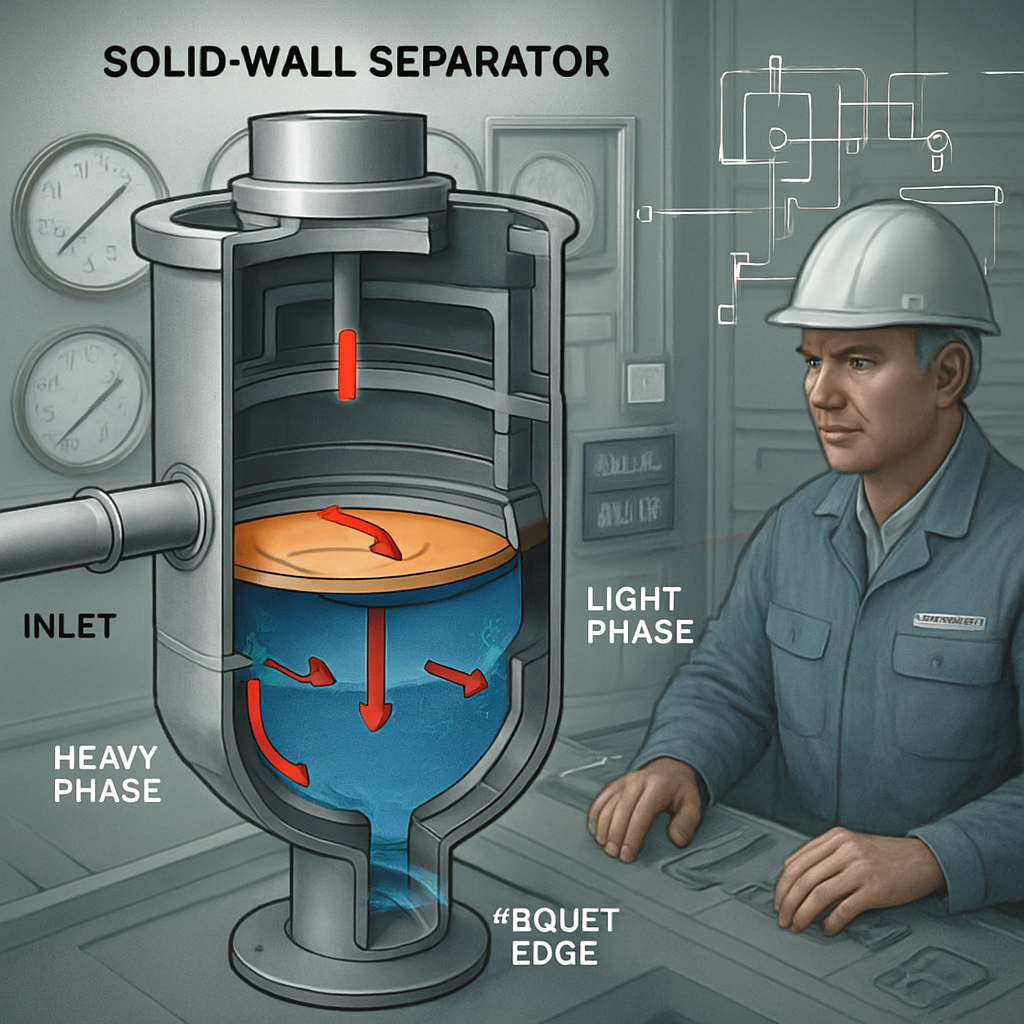 At the heart of every solid-wall separator lies a delicate equilibrium a tug-of-war between centrifugal force, hydrostatic pressure, and the physical properties of the fluids being processed. The interface, that invisible boundary where oil and water meet inside the spinning bowl, isn’t just a passive divider. It’s a dynamic frontier, constantly shifting in response to the forces acting upon it. And the gravity disc? That unassuming ring of metal is the only tool an engineer has to tame it.
To understand why, we need to strip the separator down to its bare mechanics. Imagine, for a moment, a bucket half-filled with water, swung in a wide arc at the end of a rope. The water doesn’t spill—it clings to the bottom of the bucket, pinned there by centrifugal force. Now, picture that same bucket, but this time with a layer of oil floating on top of the water. As you spin it faster, the oil, being lighter, is pushed toward the center, while the water is forced outward. The boundary between them—the interface—isn’t static. It moves based on how hard you swing the bucket (the centrifugal force), the difference in density between the two liquids, and even the shape of the bucket itself.
More information on From Well to Liquid: The LNG Transformation Journey
A solid-wall separator works on the same principle, but with industrial precision. Inside the bowl, the mixture of oil and water is subjected to forces thousands of times stronger than gravity. The heavier water is flung outward, pressing against the bowl’s wall, while the lighter oil is displaced inward. The interface forms where these two forces balance: the outward push of the water’s hydrostatic pressure and the inward pull of the oil’s resistance to displacement. This balance isn’t just theoretical—it’s the difference between clean separation and a costly failure.
The Forces at Play: Centrifugal vs. Hydrostatic
Let’s break it down. Centrifugal force, generated by the bowl’s rotation, acts radially outward on both phases. But because water is denser than oil, it experiences a stronger force per unit volume. This creates a pressure gradient: the highest pressure is at the bowl’s periphery (where the water pools), and the lowest is near the center (where the oil collects). The hydrostatic pressure of the water column, meanwhile, acts as a counterforce, pushing back against the oil. The interface settles where these two pressures equalize.
Here’s where the gravity disc comes in. The disc doesn’t just sit there—it’s a pressure regulator. By changing its diameter, you’re effectively adjusting the outlet pressure for the heavy phase (water). A larger disc diameter means a larger opening for the water to escape, which lowers the backpressure at the water outlet. This, in turn, allows the interface to shift outward, toward the bowl’s periphery. Conversely, a smaller disc diameter restricts the water’s exit, increasing the backpressure and pushing the interface inward, toward the center.
But why does this matter? Because the interface’s position isn’t just a curiosity—it’s the line between success and failure. If it drifts too far inward, water can escape into the oil outlet, contaminating the light phase. If it moves too far outward, oil can be lost into the water drain, wasting fuel and money. The goal is to keep the interface within the separation zone—the narrow band where the disc’s geometry and the bowl’s design ensure optimal separation.
The Gravity Disc’s Role: A Pressure Valve in Disguise
Think of the gravity disc as a manual pressure valve. In a perfect world, you’d want the interface to sit right at the edge of the separation zone, maximizing the bowl’s efficiency. But the world of marine fuel isn’t perfect. Density, viscosity, and temperature fluctuate with every new batch of fuel, and each of these variables nudges the interface in one direction or another.
- Density (Δρ): The greater the difference in density between the oil and water, the more stable the interface. If the fuel’s density increases (e.g., switching from distillate to heavy fuel oil), the interface will shift outward, toward the bowl’s wall. To compensate, you’d need a smaller gravity disc to increase backpressure and pull the interface back inward.
- Temperature: Heat reduces viscosity and density. Warmer fuel flows more easily, but it also becomes less dense, which can cause the interface to drift inward. A larger disc might be needed to lower the backpressure and nudge the interface back outward.
- Viscosity: Thicker fuel resists flow, which can slow the separation process. While viscosity doesn’t directly move the interface, it affects how quickly the system reaches equilibrium. High-viscosity fuels may require longer residence times in the bowl, making precise interface control even more critical.
This is where the golden rule of separator tuning comes into play: always use the largest possible gravity disc that doesn’t cause the water seal to break. Why? Because a larger disc minimizes backpressure, reducing the risk of oil loss into the water drain. But push it too far, and the interface will drift beyond the separation zone, allowing water to escape into the oil outlet. It’s a razor’s edge, and the margin for error is slim.
The Interface Radius Equation: A Simplified Model
For those who like to quantify the chaos, the position of the interface can be approximated with a simplified equation:
ri = √( (ddisc² * Pwater) / (Δρ * ω² * Rbowl²) )
Where:
- ri: The radius of the interface (the distance from the bowl’s center to the boundary between oil and water).
- ddisc: The diameter of the gravity disc’s opening. This is the primary variable under your control. Increase it, and ri grows—interface moves outward. Decrease it, and ri shrinks—interface moves inward.
- Pwater: The hydrostatic pressure of the water column at the disc’s outlet. This is influenced by the water’s density and the height of the water column in the bowl.
- Δρ: The difference in density between the heavy phase (water) and the light phase (oil). A larger Δρ means a more stable interface, less prone to drift.
- ω: The angular velocity of the bowl (how fast it’s spinning). Higher speeds increase centrifugal force, pushing the interface outward.
- Rbowl: The radius of the separator bowl. A larger bowl radius means more space for the interface to move, but also greater sensitivity to changes in ddisc.
This equation isn’t meant for precise calculations—real-world separators have too many variables for that. But it does illustrate the relationships at play. For example:
- If ω increases (bowl spins faster), ri decreases—the interface moves inward. This is why separators are designed to operate at a fixed speed; even small deviations can disrupt the balance.
- If Δρ decreases (e.g., fuel density rises), ri increases—the interface moves outward. This is why switching fuel grades often requires a disc change.
- If ddisc increases, ri increases—the interface moves outward, as expected. But if it moves too far, the water seal breaks, and separation fails.
Why the Separation Zone is Non-Negotiable
The separation zone isn’t just a theoretical concept—it’s a physical constraint built into the disc’s design. Inside this zone, the disc’s geometry ensures that the interface is exposed to the maximum centrifugal force, allowing for efficient phase separation. Outside of it, the system fails in one of two ways:
- Water in the oil outlet: If the interface drifts too far inward, water can slip past the disc’s inner edge and mix with the oil. This is the more dangerous failure mode, as it can lead to engine damage, increased wear, or even catastrophic failure if the water reaches the combustion chamber.
- Oil in the water drain: If the interface moves too far outward, oil can escape through the water outlet, wasting fuel and increasing operational costs. In extreme cases, this can also lead to environmental violations if the oily water is discharged overboard.
The gravity disc’s job is to keep the interface exactly where it needs to be—no more, no less. And because fuel properties are never static, this isn’t a one-time adjustment. It’s an ongoing process of monitoring, tweaking, and adapting. Miss the mark, and the consequences aren’t just theoretical. They’re measured in lost fuel, damaged equipment, and unplanned downtime.
In the end, the physics of separation is a study in balance. Centrifugal force vs. hydrostatic pressure. Density vs. viscosity. The bowl’s speed vs. the disc’s diameter. Get it right, and the separator hums along, quietly doing its job. Get it wrong, and the interface becomes a moving target—one that’s always one adjustment away from disaster.